Liber XVI · Indigenous & Ancient Religions · Chapter VIII: Norse & Germanic Religion
Odin: Norse God of Wisdom, War, Poetry and the Dead
Odin (Woden, Wodan) in Norse and Germanic religion: his names, the myths of the runes and the mead of poetry, Valhalla and the valkyries, and his cult.

Odin (Old Norse Óðinn, Old English Woden, Old High German Wuotan or Wodan) was the chief of the Æsir gods in Norse religion, a god of wisdom, poetry, magic, war and the dead. In the Icelandic Eddas he is the one-eyed All-Father who sacrificed himself on the world tree to win the runes, gathered fallen warriors to Valhalla and will be swallowed by the wolf Fenrir at Ragnarök. Behind these medieval myths lies a much older Germanic god whose name is preserved in English "Wednesday", and whose worship was described by Roman, Christian and Arabic observers.
Names and Origins: Woden, Wodan and Odin§
The god appears across the Germanic world under related names. The Roman historian Tacitus, writing in 98 CE in his Germania, says that the Germans honoured Mercury above all other gods, and Roman writers often called the Germanic god by that name; when the Germanic peoples adopted the Roman seven-day week they translated Mercury's day (dies Mercurii) as Woden's day, which became English Wednesday and Dutch woensdag. The eleventh-century chronicler Adam of Bremen glossed the name as id est furor, "that is, fury", reflecting its probable root in a word for ecstatic frenzy and poetic inspiration.
Woden appears at the head of the genealogies of most Anglo-Saxon royal houses, a sign of his prestige among the early English. He is named in the Old English Nine Herbs Charm, where he strikes a serpent with nine "glory twigs", and in the tenth-century Old High German Merseburg Charms, where Wodan heals the injured foot of a horse with a spell. Gold medallions of the fifth and sixth centuries known as bracteates often show a large head above a horse, and many archaeologists, following Karl Hauck, interpret the figure as Odin in his role as healer.
The Odin of the Viking Age (about 790–1100) was thus the heir of a long tradition, but his prominence may have grown over time. Some historians suggest that he was above all the god of kings, warriors and poets, while farmers turned more readily to Thor and Freyr. Place names containing his name, such as Odense in Denmark (Óðins vé, "Odin's sanctuary"), are common in Denmark and Sweden but rare in Norway and Iceland.
Odin in the Eddas: Creator, Wanderer and King of Gods§
The fullest portraits come from the Poetic Edda, a collection of mythological and heroic poems preserved in an Icelandic manuscript of about 1270, and from Snorri Sturluson's Prose Edda, written around 1220. Both were set down two centuries after Iceland's conversion to Christianity, and Snorri in particular arranged the myths into a system. The problems these sources pose are described in Norse and Germanic religion.
In Snorri's account Odin and his brothers Vili and Vé kill the primeval giant Ymir and make the world from his body. In the poem Völuspá three gods, Odin, Hœnir and Lóðurr, give breath, spirit and life to the first humans, Ask and Embla, found as lifeless logs on the shore. Odin rules from Ásgarðr, sees all the worlds from his high seat Hliðskjálf and rides the eight-legged horse Sleipnir. Two ravens, Huginn ("thought") and Muninn ("memory"), fly over the world each day and bring him news; two wolves eat the food he does not need, for he lives on wine alone. His spear is Gungnir.
He is a restless seeker of knowledge. He gave one of his eyes for a drink from the well of Mímir, guardian of wisdom, and he consults the preserved head of Mímir. He travels in disguise under many names, among them Grímnir ("the masked one"), Gangleri ("wanderer") and Hárbarðr ("grey-beard"), testing kings and giants with questions. In Vafþrúðnismál he wins a contest of wisdom with a giant by asking what Odin whispered into the ear of his dead son Baldr, a question only he can answer.
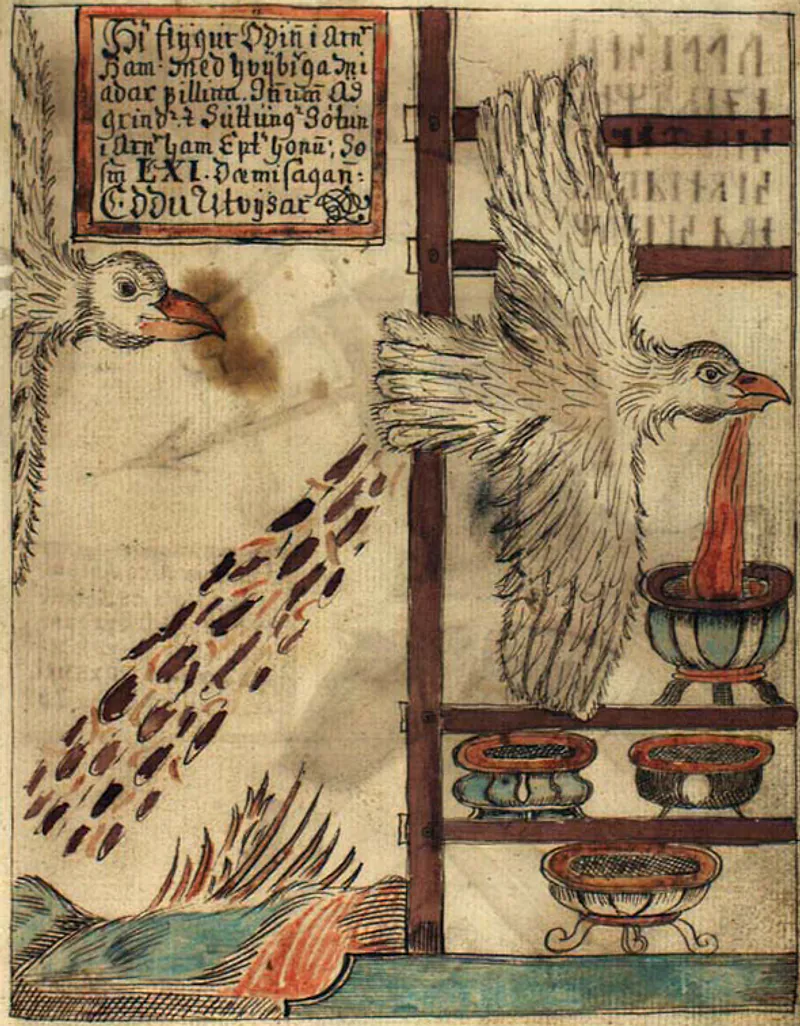
Odin is also a master of poetry. In the myth of the mead of poetry he seduces the giantess Gunnlöð to gain access to the mead brewed from the blood of the wise being Kvasir, drinks it and escapes to Ásgarðr in the shape of an eagle. Skaldic poets called poetry "Odin's mead" and regarded their art as his gift.
Self-Sacrifice on the Tree and the Winning of the Runes§
The most discussed passage about Odin comes from the poem Hávamál ("Sayings of the High One"). In it the god says that he hung on a windswept tree for nine nights, wounded with a spear, given to Odin, himself to himself, on a tree whose roots no one knows. He received no bread and no drink; he peered down, took up the runes, screaming, and fell back. The tree is usually identified with Yggdrasil, the world tree whose name may mean "the horse of Yggr", Yggr ("the terrible one") being one of Odin's names.
The passage has been compared with the crucifixion, and some scholars have suspected Christian influence; others point out that hanging and spear-wounding were the characteristic forms of sacrifice to Odin and that the scene fits a pre-Christian pattern. Mircea Eliade and others read it as a shamanic initiation, a death and rebirth that gives access to hidden knowledge, an interpretation discussed critically in Shamanism. The runes themselves were in use from the second century CE, long before the poem; the myth explains their sacred authority rather than their history, which is traced in Runes.
Odin is also associated with seiðr, a form of magic usually linked with women. In the poem Lokasenna Loki taunts him with having practised it, an accusation of unmanliness, and Snorri says Odin learned it from the goddess Freyja. The tradition is explored in the article on seiðr.
Valhalla, the Valkyries and the God of the Slain§
Odin's title Valföðr, "father of the slain", points to his role as a god of the battle dead. According to the Eddic poem Grímnismál, half of those who fall in battle go to his hall, Valhǫll (Valhalla), and half to the goddess Freyja's field, Fólkvangr. In Valhalla the chosen warriors, the einherjar, fight each day and feast each night on the meat of a boar that is restored every evening and on mead from the goat Heiðrún. The valkyries, "choosers of the slain", select them on the battlefield and serve them in the hall.
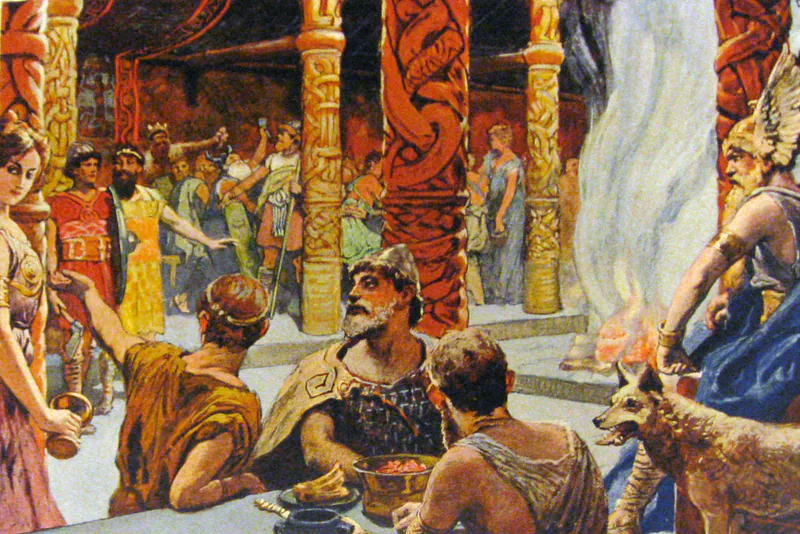
These warriors are gathered for a purpose: at Ragnarök, the end of the present world, they will fight beside the gods against the giants and monsters. Odin will be swallowed by the wolf Fenrir and avenged by his son Víðarr. After the destruction a new green earth will rise and some gods will return, a vision whose relationship to Christian apocalyptic is debated.
Scholars note that Valhalla belongs mainly to aristocratic warrior poetry. Archaeology shows a wide variety of burial customs, and the dead were also imagined as living on in burial mounds or in the realm of Hel. The image of Valhalla as the general Viking afterlife is largely a modern simplification.
Worship of Odin: Sacrifice, Places and Amulets§
Descriptions of cult are sparse and often hostile. Adam of Bremen, writing around 1075, describes a great temple at Uppsala in Sweden containing images of Thor, Wodan and Fricco, and a festival held every nine years at which males of every species, including human beings, were sacrificed and their bodies hung in a sacred grove. Adam never visited Uppsala and relied on informants, and archaeologists continue to debate how far his account can be trusted, but sagas also associate Odin with sacrifice by hanging and with dedicating enemies to him by throwing a spear over their army.
Other evidence is material: small figures and pendants that may represent Odin, among them a seated figure from Lejre in Denmark sometimes identified with Odin on Hliðskjálf, though some see a goddess; picture stones from Gotland showing a rider on an eight-legged horse; and amulets of the valknut, a symbol of three interlaced triangles, whose name is modern. The eighth-century Ribe skull fragment and other runic inscriptions occasionally name him.
Odin after the Conversion and Today§
Christian writers dealt with Odin in several ways. Some called him a demon; Snorri, in the Ynglinga saga and the prologue to his Edda, made him a human king from Asia whose followers later worshipped him as a god. In folklore he survived as the leader of the Wild Hunt, a host of spirits riding through the winter sky, known in Scandinavia as Oskoreia or Odens jakt.
Romanticism revived him. Richard Wagner's Wotan in The Ring of the Nibelung (completed 1874) made him a tragic figure of operatic grandeur, and J. R. R. Tolkien described Gandalf as an "Odinic wanderer". In contemporary Heathenry, discussed in Heathenry and runes, Odin is honoured as a living god, especially by those drawn to rune lore. The appropriation of Odin and his symbols by racist movements in the twentieth and twenty-first centuries has been strongly rejected by many Heathen organisations, including Iceland's Ásatrúarfélagið, which affirm that the old gods belong to no race.
Frequently asked questions§
Is Odin the same as Woden?§
Yes. Óðinn, Woden and Wodan are the Norse, Old English and continental German forms of the same name, all derived from Proto-Germanic *Wōðanaz. The stories told about the god in different regions and periods were not identical, however.
Why does Odin have one eye?§
According to Snorri Sturluson's Prose Edda and the poem Völuspá, Odin pledged one of his eyes at the well of Mímir in exchange for a drink of its water, which gave wisdom. The myth expresses his willingness to pay any price for knowledge.
Did Vikings believe everyone went to Valhalla?§
No. Valhalla was reserved for warriors chosen by Odin, and even they were shared with Freyja. Most of the dead were thought to go to Hel or to live on in their graves, and beliefs varied by region and period.
Sources and further reading§
- The Poetic Edda — Carolyne Larrington, 1996
- The Prose Edda — Snorri Sturluson, c. 1220
- Germania — Tacitus, 98 CE
- Gods and Myths of Northern Europe — H. R. Ellis Davidson, 1964
- Myth and Religion of the North — E. O. G. Turville-Petre, 1964
- Norse Mythology: A Guide to the Gods, Heroes, Rituals, and Beliefs — John Lindow, 2001
- The Viking Way: Magic and Mind in Late Iron Age Scandinavia — Neil Price, 2002
- History of the Archbishops of Hamburg-Bremen — Adam of Bremen, c. 1075