Liber XXXV · Witchcraft & Wicca · Chapter III: Heathenry & Runes
Heathenry and the Runes: Norse Paganism Past and Present
Heathenry and the runes explained: Ásatrú and Norse Paganism, the Eddas and sagas, blót and sumbel, the Elder Futhark, rune poems and modern rune divination.

Heathenry is the modern revival of the pre-Christian religion of the Germanic-speaking peoples, best known in its Norse form as Ásatrú ("faith in the Æsir"). Heathens honour gods such as Odin, Thor and Freyja, together with ancestors and spirits of the land, through offerings, toasts and seasonal feasts, drawing on medieval Icelandic literature and archaeology. The runes, the alphabets used by Germanic peoples from about the second century AD, are both a historical script and, for many modern Heathens and occultists, a tool of meditation, magic and divination.
What Heathenry Is: Names, Groups and Beliefs§
"Heathen" was originally a Christian term for non-Christians; modern followers adopted it as a self-description, much as Pagans did with "pagan". The movement is diverse. Ásatrú is common in Iceland and North America; Forn Sed ("the old custom") is used in Scandinavia; Theodism emphasises the tribal structures of Anglo-Saxon England; Odinism is an older term with its own organisations.
Heathens are generally polytheists who regard the gods as real beings with whom humans can have reciprocal relationships. They also honour the ancestors and the landvættir, spirits of particular places, and some speak of elves and other beings from Norse lore. Important concepts include wyrd (the web of fate and causation), frith (peace and right relationship within a community) and honour. Many groups organise into local communities called kindreds. For the deities themselves see Gods and Goddesses.
The Evidence for Norse and Germanic Religion§
Pre-Christian Germanic peoples left few texts about their religion, and modern Heathens draw on sources of very different kinds:

- Roman accounts, especially Tacitus's Germania (AD 98), describing gods, sacred groves and the casting of lots.
- The Poetic Edda, a collection of mythological and heroic poems preserved mainly in the Codex Regius, written in Iceland around 1270, including the Völuspá (the seeress's prophecy) and the Hávamál (sayings of the High One).
- The Prose Edda of the Icelandic scholar Snorri Sturluson (c. 1220), a handbook of myth for poets, written more than two centuries after Iceland's conversion.
- The sagas and skaldic poetry, which describe sacrifice, feasting, seeresses and temples, though often from a Christian distance.
- Adam of Bremen's account of the temple at Uppsala, written in the 1070s by a hostile German cleric.
- Archaeology, including ship burials, cult sites, amulets such as Thor's hammers, and the remains of feasting halls.
Scholars such as Neil Price and Terry Gunnell stress that Norse religion varied greatly by region and period and was never a unified church with a fixed theology.
The Revival: From Romanticism to Ásatrú§
Interest in the Norse gods revived in the eighteenth and nineteenth centuries with Romantic nationalism, the publication of the Eddas, and artistic works such as Wagner's Ring cycle. In German-speaking lands some völkisch groups of the early twentieth century created racially defined Germanic religions, a history that later Heathens have had to confront.
The modern religious movement began in the early 1970s. In Iceland the farmer and poet Sveinbjörn Beinteinsson founded the Ásatrúarfélagið in 1972, recognised by the state as a religious organisation in 1973; it has since grown into one of the country's largest non-Christian religious bodies. In the United States, Stephen McNallen's Asatru Free Assembly began in the 1970s, and in 1987 The Troth was founded as an inclusive Heathen organisation. In Britain the Odinic Rite and later groups developed independently.
Ritual and Ethics: Blót, Sumbel and Frith§
The central Heathen rite is the blót, an offering to the gods, ancestors or land spirits. In the Viking Age a blót could involve the sacrifice of animals whose meat was then eaten at a communal feast; modern Heathens typically offer mead, ale, food or crafted objects, often pouring a libation onto the earth. The sumbel is a ritual toasting in which a horn is passed around and participants drink to the gods, honour the ancestors and make boasts or oaths, binding words spoken over the horn.
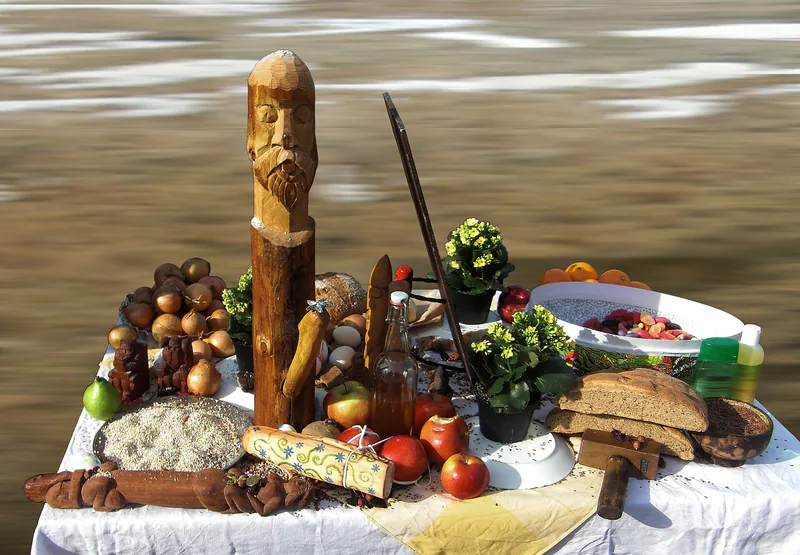
Heathens keep seasonal festivals such as Yule at midwinter, Winter Nights in autumn and Midsummer, along with others reconstructed from Bede's Anglo-Saxon calendar or Scandinavian sources. Ethical teaching draws on the Hávamál, with its counsel on hospitality, moderation, friendship and reputation. Some groups use a list called the "Nine Noble Virtues" (courage, truth, honour, fidelity, discipline, hospitality, self-reliance, industriousness and perseverance), a modern formulation of the 1970s rather than an ancient text. Seeresses' practices such as seiðr and oracular spá, described in the Saga of Erik the Red, have been revived by groups including Diana Paxson's Hrafnar since the 1980s.
The Runes in History: Futhark, Inscriptions and Rune Poems§
The runes are an alphabet, almost certainly adapted from a Mediterranean script, probably an Old Italic or Latin alphabet, around the first or second century AD. The oldest securely dated inscriptions, such as that on the Vimose comb from Denmark, date to around AD 150–200.
- The Elder Futhark, named after its first six letters (f, u, þ, a, r, k), had 24 runes arranged in three groups of eight (ættir). It was used across Germanic Europe until about the eighth century.
- The Younger Futhark of 16 runes developed in Scandinavia around 800 and was used throughout the Viking Age on thousands of rune-stones, many commemorating the dead.
- The Anglo-Saxon futhorc expanded the alphabet to between 26 and 33 runes to fit Old English.
Each rune had a name, for example fehu (cattle, wealth), ansuz (a god) and tiwaz (the god Tyr), reconstructed for the Elder Futhark from later sources. Three medieval rune poems, Old English, Norwegian and Icelandic, give short verses for each rune name and are the nearest thing to ancient "meanings". The Old English poem survives only in an early printed copy, because its manuscript was destroyed in the Cotton Library fire of 1731.
Runic Magic and Divination, Ancient and Modern§
Runes were used mainly for ordinary writing: names, ownership, memorials, letters and graffiti. Some inscriptions are clearly magical or religious, such as the recurring formula alu on amulets, protective inscriptions on weapons and charms on bracteates. In the Hávamál, Odin wins the runes by hanging nine nights on a windswept tree, and Eddic and saga texts refer to carving runes for healing, victory or harm. Tacitus describes the Germanic peoples casting lots marked with signs, but whether these were runes is uncertain, and there is no clear ancient evidence of rune-casting as a divination system.
Modern esoteric runology began with the Austrian occultist Guido von List, who in 1908 published Das Geheimnis der Runen, introducing an invented 18-rune "Armanen" row. List's ideas fed into Nazi symbolism, which adopted runes such as the sig rune and the Odal rune; some of these remain in use by extremist groups today. From the 1980s, popular books such as Ralph Blum's The Book of Runes (1982), which added a blank rune, and the works of Edred Thorsson made rune divination widespread. Historians such as R. I. Page and Michael Barnes emphasise that most modern rune meanings derive from the rune poems combined with twentieth-century interpretation. Chaos magicians and other occultists also use runes; see Chaos Magick.
Politics, Misappropriation and Inclusive Heathenry§
Because Norse imagery was appropriated by Nazism and later by white-supremacist movements, Heathenry has been marked by a sharp division. Folkish groups hold that the religion belongs to people of northern European ancestry; universalist or inclusive groups welcome anyone called to the gods. In 2016 well over a hundred Heathen organisations signed Declaration 127, publicly dissociating themselves from a prominent folkish organisation over its racial policies, and many groups now state explicitly that they reject racism.
Sociologists such as Jennifer Snook and Jenny Blain have documented these debates, and most Heathens today emphasise community, hospitality, environmental care and respectful reconstruction of the past. For related Pagan movements see Druidry and What Is Witchcraft?.
Frequently asked questions§
What is the difference between Heathenry and Ásatrú?§
Heathenry is the umbrella term for modern Germanic Paganism. Ásatrú is one of its main forms, focused on the Norse gods and common in Iceland and North America; other forms include Forn Sed and Theodism.
Are runes an ancient divination system?§
The runes are an ancient alphabet, and some were used in magical inscriptions. However, there is little clear evidence that they were used as a divination system with fixed meanings; modern rune reading largely developed in the twentieth century.
How many runes are there?§
The Elder Futhark has 24 runes, the Younger Futhark 16, and the Anglo-Saxon futhorc between 26 and 33. Modern divination sets usually use the 24 runes of the Elder Futhark.
Is Heathenry linked to racism?§
Some groups have promoted racial ideas, but many Heathen organisations firmly reject racism and welcome people of all backgrounds. In 2016 more than a hundred groups signed Declaration 127 to separate themselves from racist Heathenry.
Sources and further reading§
- The Poetic Edda — Carolyne Larrington (trans.), 1996
- The Prose Edda — Snorri Sturluson, c. 1220
- Runes: A Handbook — Michael P. Barnes, 2012
- Runes — R. I. Page, 1987
- The Viking Way: Magic and Mind in Late Iron Age Scandinavia — Neil Price, 2002
- Nine Worlds of Seid-Magic: Ecstasy and Neo-Shamanism in North European Paganism — Jenny Blain, 2002
- American Heathens: The Politics of Identity in a Pagan Religious Movement — Jennifer Snook, 2015
- Essential Asatru: Walking the Path of Norse Paganism — Diana L. Paxson, 2006