Liber VII · Divination · Chapter XI: Runes
Runes: A Complete Guide to the Futhark and Rune Divination
Runes explained: the Elder and Younger Futhark, the rune poems, Odin in the Hávamál, Tacitus on lot-casting, rune magic and modern rune divination's origins.

Runes are the letters of the alphabets used by Germanic-speaking peoples from about the second century AD until the late Middle Ages, best known in the twenty-four-letter Elder Futhark and the sixteen-letter Younger Futhark of the Viking Age. They were used chiefly for inscriptions on stone, metal, wood and bone, some of which had magical or protective purposes; the use of runes as a set of symbols for divination is largely a twentieth-century development.
Origins of the Runic Alphabet§
The word rune is related to Old Norse rún and Gothic rūna, "secret" or "mystery," and also "letter." The earliest securely dated inscriptions come from the second half of the second century AD, in southern Scandinavia and northern Germany; a comb from the Vimose bog in Denmark, dated to around AD 160, bears one of the oldest readable inscriptions. Scholars agree that the runes were modelled on a Mediterranean alphabet, most likely an Old Italic (north Etruscan) script or Latin, but disagree about exactly which and where the adaptation happened. The angular shapes suited carving across the grain of wood.
The alphabet is called the futhark after its first six letters, and its order differs from that of the Latin alphabet. It was divided into three groups of eight, later called ættir ("families"), each traditionally named after its first rune (Freyr's, Hagal's and Tyr's ætt). Complete futhark sequences appear on objects such as the Kylver stone from Gotland (c. AD 400), perhaps as a protective or magical device rather than a writing lesson.
The Elder Futhark, Younger Futhark and Anglo-Saxon Runes§
The Elder Futhark has twenty-four runes. Their names are not recorded in Elder Futhark times; the standard forms, such as fehu, ūruz, þurisaz and ansuz, are reconstructions in Proto-Germanic based on later medieval names.
| Ætt | Runes (reconstructed names) |
|---|---|
| First | fehu (cattle, wealth), ūruz (aurochs), þurisaz (giant), ansuz (god), raidō (ride), kaunan/kenaz (ulcer or torch), gebō (gift), wunjō (joy) |
| Second | hagalaz (hail), naudiz (need), īsaz (ice), jēra (year, harvest), ei(h)waz (yew), perþō (uncertain), algiz (elk or protection), sōwilō (sun) |
| Third | tīwaz (the god Tyr), berkanan (birch), ehwaz (horse), mannaz (man), laguz (water), ingwaz (the god Ing), dagaz (day), ōþila (inherited land) |
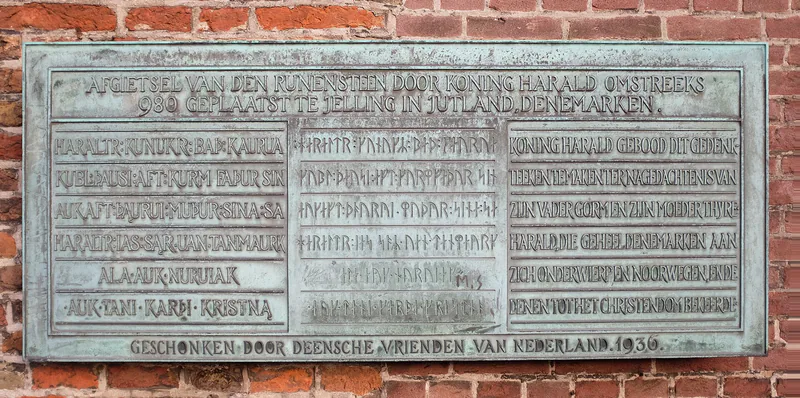
By about the eighth century, Scandinavians had simplified the alphabet to the sixteen-rune Younger Futhark, in which some runes represent several sounds. This is the script of the Viking-Age rune stones, such as the Jelling stones raised by the Danish kings Gorm and Harald Bluetooth in the tenth century. In Anglo-Saxon England and Frisia the alphabet was expanded instead, eventually to around thirty-three runes in the Futhorc, used on objects such as the Ruthwell Cross and the Franks Casket. Medieval Scandinavia continued to use runes for everyday messages, as the hundreds of carved sticks found at Bryggen in Bergen show.
The Rune Poems and Rune Meanings§
Much of what is said about the meanings of individual runes comes from three medieval poems that give a short verse for each rune name:
- The Old English Rune Poem, preserved in a manuscript destroyed in the Cotton Library fire of 1731 and known from an edition printed by George Hickes in 1705.
- The Norwegian Rune Poem, probably of the late twelfth or thirteenth century, covering the sixteen Younger Futhark runes.
- The Icelandic Rune Poem, preserved in manuscripts of the fifteenth century and later.
The verses are often Christian in outlook and practical in content: wealth causes strife among kinsmen, hail is the coldest of grain, ice is slippery. They are valuable evidence for rune names but were not written as divinatory manuals, and modern meanings frequently go well beyond what they say. Pages on individual runes in this section distinguish between the evidence of the poems and later interpretation.
Runes, Magic and Lot-Casting in Early Sources§
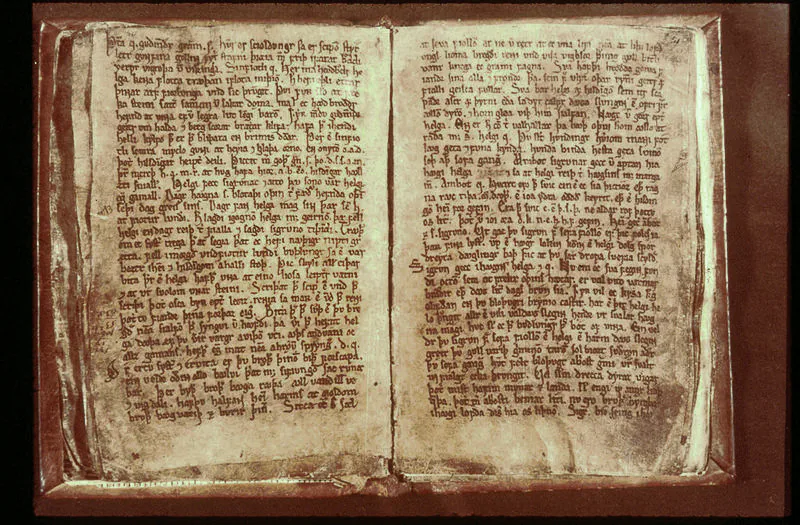
Several early sources link runes with magic. The Eddic poem Hávamál, preserved in the thirteenth-century Codex Regius, describes Odin hanging for nine nights on a wind-swept tree, wounded by a spear, sacrificed "himself to himself," and then taking up the runes. Other Eddic poems mention runes of victory, protection and healing, and the Icelandic Egils saga tells how Egil cured a sick girl by replacing harmful runes carved on whalebone. Inscriptions include formulas such as alu and laþu, whose meanings are debated but which appear on amulets and bracteates, and medieval Scandinavian runic charms invoke Christian as well as pagan powers.
For divination, the key text is the Roman historian Tacitus, whose Germania (AD 98) describes how Germanic peoples cut a branch from a fruit-bearing tree into slips, marked them with signs (notae), scattered them on a white cloth, and had a priest or the head of a household pick up three and interpret them. Tacitus wrote before the earliest datable runic inscriptions and does not say the marks were letters, so whether this was rune-casting is uncertain. No medieval source describes divination with a full set of rune tiles. Historians therefore regard rune divination as a plausible but unproven ancient practice and recognise its modern form as a reconstruction.
The Modern Revival of Runes§
The modern esoteric history of runes begins with the Austrian writer Guido von List (1848–1919), whose Das Geheimnis der Runen (1908) presented an eighteen-rune "Armanen" system based on the Hávamál, claiming it came to him in a vision. His ideas, mixed with racial nationalism, influenced völkisch movements, and several runic shapes were adopted by the Nazi state, most notoriously the double sig-rune of the SS. That association made runes politically fraught in the postwar period, and some symbols remain in use by extremist groups, which heathen organisations and scholars widely condemn.
Rune divination in its now familiar form, with a set of twenty-four stones or tiles drawn from a bag and laid in spreads, was popularised by Ralph Blum's The Book of Runes (1982), which also added a blank rune with no historical basis. Stephen Flowers, writing as Edred Thorsson, published Futhark: A Handbook of Rune Magic (1984), and runes became central in modern Heathenry and Ásatrú, in some forms of traditional witchcraft and in chaos magick. Contemporary rune readers typically interpret each rune through the rune poems, Norse myth and personal reflection, sometimes reading reversed runes as well. For comparable methods see Other Oracles and What Is Divination?
Frequently asked questions§
How many runes are there?§
The Elder Futhark has 24 runes, the Viking-Age Younger Futhark 16, and the Anglo-Saxon Futhorc between 26 and about 33. Modern rune divination usually uses the 24 Elder Futhark runes.
Did the Vikings use runes for divination?§
There is no direct evidence that the Vikings used rune sets for fortune-telling. They used runes for inscriptions, messages and charms; Tacitus's earlier description of lot-casting does not say the marks were runes.
What does "futhark" mean?§
It is a modern name formed from the first six runes of the alphabet, f, u, th, a, r and k, in the same way that "alphabet" comes from alpha and beta.
What is the blank rune?§
The blank rune, sometimes called Odin's rune, was introduced by Ralph Blum in 1982. It has no basis in any historical runic alphabet and many rune readers do not use it.
Sources and further reading§
- Runes: An Introduction — Ralph W. V. Elliott, 1959
- Runes (Reading the Past) — R. I. Page, 1987
- An Introduction to English Runes — R. I. Page, 1973
- Runic Amulets and Magic Objects — Mindy MacLeod and Bernard Mees, 2006
- Germania — Tacitus, AD 98
- The Poetic Edda — trans. Carolyne Larrington, 1996
- The Occult Roots of Nazism — Nicholas Goodrick-Clarke, 1985