What Is Divination? History, Methods and Meaning Explained
What is divination? A history of reading signs from Babylonian omens and Delphi to tarot, astrology, the I Ching and runes, with how scholars explain it.

Divination is the practice of seeking knowledge of hidden matters, past, present or future, by interpreting signs believed to carry meaning: the movements of the stars, the fall of lots or cards, the shape of an animal's liver, the flight of birds, dreams, or the words of an inspired oracle. It is found in nearly every recorded culture, from the clay omen tablets of Mesopotamia and the oracle bones of Shang China to the tarot, astrology and I Ching consulted today.
Defining Divination: Technical and Inspired Methods§
The classic ancient discussion is Cicero's dialogue On Divination (De divinatione, 44 BC). There Cicero's brother Quintus defends the practice and divides it into two kinds. Artificial or technical divination works by observing signs and interpreting them according to accumulated rules: the entrails of sacrificed animals, lightning, the flight of birds, the stars. Natural divination comes directly to a person in an altered state, through dreams or prophetic frenzy, without technique. Cicero himself, in the second book, argues against both.
Modern scholars still use versions of this distinction, often calling them inductive (or deductive) and intuitive divination. Many practices combine the two. A tarot reader lays out cards according to fixed positions and traditional meanings, which is technical, but often also speaks of intuition in interpreting their combination. An astrologer computes a chart by exact astronomy, then judges it by a body of rules accumulated over two thousand years.
A third distinction concerns the source of meaning. In some systems the signs are understood as messages sent deliberately by gods or spirits; in others they are part of a cosmos in which everything corresponds to everything else, so that heaven or a random fall of coins mirrors human affairs. The first view dominates ancient Mesopotamian and Greek religion; the second becomes prominent in Stoic philosophy, Chinese correlative cosmology and Renaissance Hermeticism.
Divination in the Ancient Near East and China§
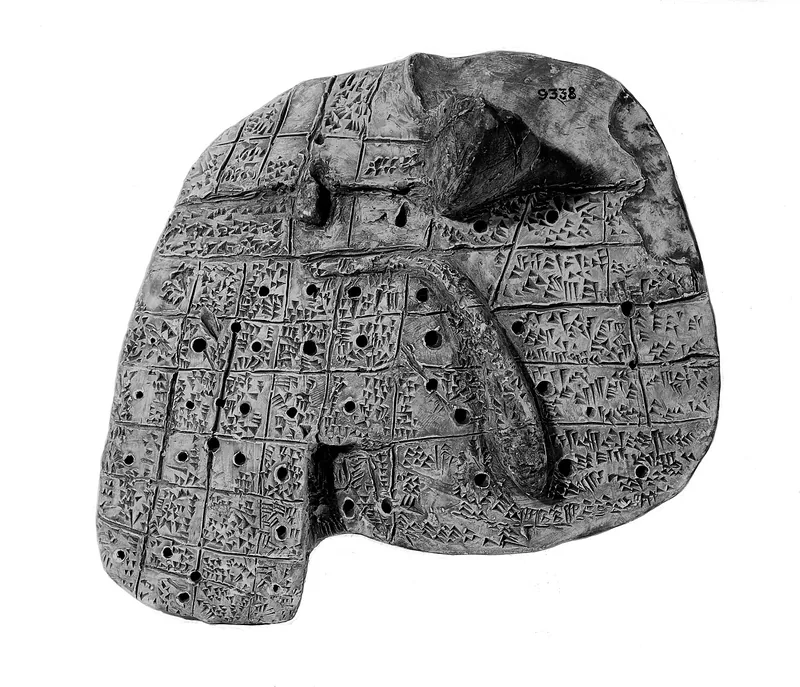
The most extensive early written tradition of divination comes from Mesopotamia. Babylonian and Assyrian scholars compiled long series of omens in the form "if X is observed, then Y will happen." The best known are the celestial omen series Enūma Anu Enlil, assembled in the second millennium BC, and the extispicy series Bārûtu, which interpreted the liver and entrails of sacrificed sheep. Clay models of sheep livers, inscribed with omens, survive from Mari and Babylon and were probably used for teaching. Royal diviners reported omens to Assyrian kings, and letters from these specialists show divination as a working instrument of government. Out of the celestial omen tradition, in the last centuries BC, came personal horoscopes; the history of that development is told in Astrology: A Complete Guide.
In China, the kings of the Shang dynasty (roughly 1600–1046 BC) consulted their ancestors through pyromancy. Diviners applied heat to prepared ox shoulder blades and turtle plastrons and read the resulting cracks; the questions and sometimes the outcomes were then carved on the bone. These "oracle bones," excavated in great numbers at Anyang from 1899 onward, are the earliest substantial body of Chinese writing. Under the Zhou dynasty, divination with yarrow stalks produced the figures of what became the Book of Changes, covered in I Ching: A Complete Guide.
Oracles, Augury and Lots in Greece and Rome§
Greek religion had several famous oracle sanctuaries. At Delphi, Apollo spoke through the Pythia, a priestess who answered questions from individuals and city-states; at Dodona, the oldest oracle of Zeus, questions were inscribed on small lead tablets, many of which survive and show ordinary people asking about marriage, journeys and business. Alongside the oracles, Greeks consulted professional seers (manteis), interpreters of dreams and readers of sacrificial victims, and used lots and dice oracles.
Rome inherited a state system of public divination. The college of augurs took the auspices by observing birds and other signs before public business; the haruspices, a discipline the Romans associated with the Etruscans, read entrails and interpreted prodigies such as lightning. The bronze Liver of Piacenza, an Etruscan model divided into regions named for gods, illustrates this lore. Romans also consulted the Sibylline Books in times of crisis. The emphasis in Roman state divination was less on foreseeing the future than on confirming that the gods approved a proposed course of action.
Divination in Judaism, Christianity and Islam§
The Hebrew Bible condemns many kinds of divination; Deuteronomy 18 lists diviners, soothsayers, enchanters and those who consult the dead among practices forbidden to Israel. Yet it also records approved forms: the casting of lots, and the Urim and Thummim carried by the high priest, whose exact nature is unknown. Later Jewish tradition developed its own literature of dream interpretation, physiognomy and astrological speculation, alongside persistent rabbinic debate over whether Israel is subject to the stars.
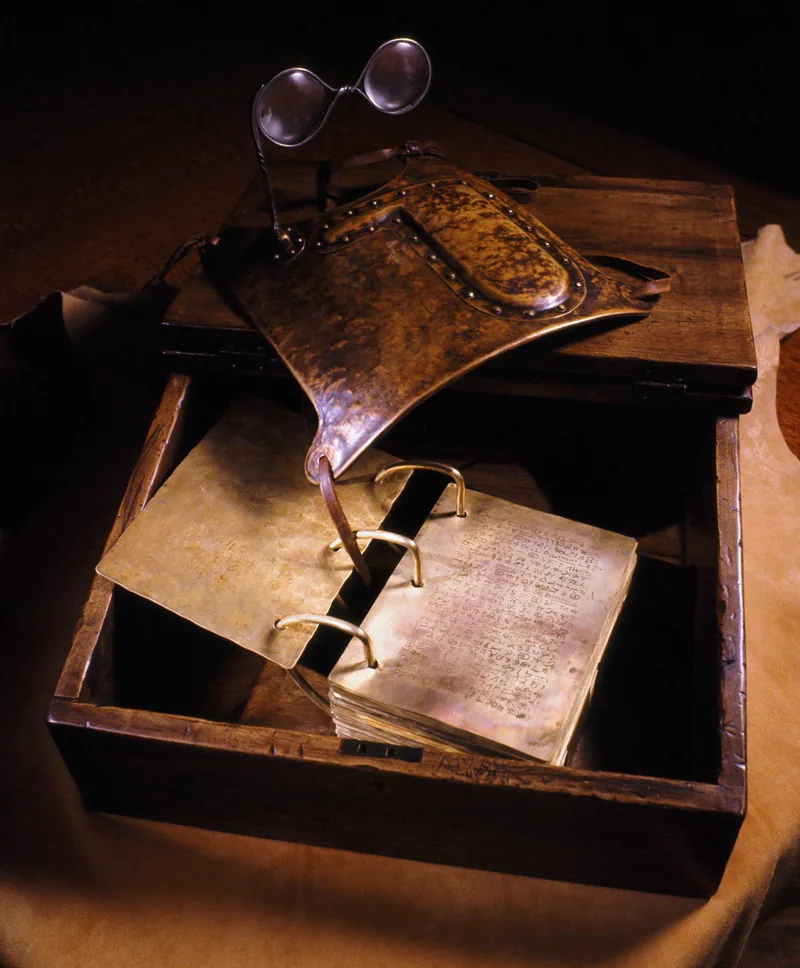
Early Christian writers, above all Augustine, attacked astrology and pagan oracles as either fraudulent or demonic. In practice, medieval Christians used numerous techniques: the sortes biblicae, opening the Bible at random; lot books such as the Sortes Sanctorum; dream books; and, from the twelfth century, astrology and geomancy translated from Arabic. Church authorities repeatedly tried to distinguish legitimate natural knowledge, such as weather prediction or medical astrology, from divination that presumed to know what God alone knows.
The Qur'an forbids divining with arrows (azlām), a pre-Islamic Arabian practice, but the Islamic world produced sophisticated traditions of astrology, dream interpretation (taʿbīr) and the "science of the sand" (ʿilm al-raml), the source of European geomancy. The approved istikhāra prayer, in which a believer asks God for guidance before a decision, was sometimes followed by consulting a dream or opening the Qur'an. The historian Ibn Khaldūn (1332–1406) discussed these methods at length and doubted most of them.
The Main Methods: Stars, Cards, Figures and Signs§
The surviving and revived methods of divination can be grouped by what they read.
- The sky. Horoscopic astrology in its Western, Indian and Islamic forms; Chinese calendrical and fate calculation; the Mesoamerican day count. See Astrology, Vedic Astrology, Chinese Astrology, Mayan astrology and Horoscopes. The site's horoscope calculators compute signs in six of these systems.
- Cards. Tarot, used for divination only from the 1780s (history of tarot), with its Major Arcana and Minor Arcana; and cartomancy with ordinary or Lenormand cards.
- Generated figures. The hexagrams of the I Ching and the sixteen figures of geomancy, both built from random binary choices.
- Letters and numbers. Numerology, gematria and runes as a modern divinatory alphabet.
- Other signs. Scrying, palmistry, bibliomancy, dreams, lots, Ifá and talking boards, surveyed in Other Oracles and the Ouija board.
Timing is a related concern. Many traditions choose auspicious moments rather than predicting outcomes: Roman auspices, Indian muhūrta, Chinese almanacs and Western electional astrology. The site's Almanac shows planetary hours and lunar phases as they were traditionally reckoned.
How Scholars and Skeptics Explain Divination§
Anthropologists have long treated divination as a social technology. E. E. Evans-Pritchard's study of the Azande of central Africa (1937) showed how consulting oracles structured decisions, settled disputes and located responsibility for misfortune within a coherent system of thought. Later studies of Yoruba Ifá, Chinese temple divination and Western tarot have emphasised that divination opens a conversation: the client brings a question, the diviner frames it within a tradition, and the two negotiate an interpretation.
Historians such as Sarah Iles Johnston and Peter Struck stress that ancient divination was as much a form of knowledge as a form of religion, debated by philosophers, and that ancient critics were already raising the objections modern skeptics raise. Psychologists point to the "Barnum" or Forer effect, the tendency to accept vague, general statements as personally accurate, and to the human preference for pattern over randomness. Controlled tests of astrology have generally failed to show predictive power. Carl Jung's notion of synchronicity, meaningful coincidence without causal connection, offered an influential alternative framing for practitioners who use tarot or the I Ching as tools for reflection rather than prediction.
Among practitioners today, attitudes vary widely: some regard divination as genuine foreknowledge, some as communication with gods, ancestors or spirits, and many as a structured way of thinking about a situation. Describing those views fairly, while noting what the historical and experimental evidence shows, is the approach taken throughout this section.
Frequently asked questions§
What is the difference between divination and fortune-telling?§
"Fortune-telling" usually refers to commercial or popular prediction of an individual's future. "Divination" is the broader scholarly term for any practice that seeks hidden knowledge through signs, including state rituals, religious oracles and decisions about timing, not only personal prediction.
What are the oldest forms of divination?§
The oldest well-documented forms are Mesopotamian omen reading, especially extispicy and celestial omens recorded from the early second millennium BC, and Chinese oracle-bone pyromancy of the Shang dynasty. Lot casting and dream interpretation are probably older still but leave fewer records.
Is divination forbidden in the Bible?§
Deuteronomy 18 forbids many forms of divination, and the prophets condemn diviners. The Bible nevertheless records the casting of lots and the high priest's Urim and Thummim as acceptable ways of seeking God's will, so the prohibition was directed at particular practices rather than every attempt to know the divine will.
Does divination actually work?§
Controlled studies have not shown that astrology or other divinatory methods predict events better than chance. Many practitioners value divination for reflection, ritual or spiritual meaning rather than literal prediction, and historians study it for what it reveals about how people make decisions under uncertainty.
Sources and further reading§
- De divinatione (On Divination) — Marcus Tullius Cicero, 44 BC
- Divination and Oracles — Michael Loewe and Carmen Blacker (eds.), 1981
- Ancient Greek Divination — Sarah Iles Johnston, 2008
- Divination and Human Nature: A Cognitive History of Intuition in Classical Antiquity — Peter T. Struck, 2016
- Witchcraft, Oracles and Magic among the Azande — E. E. Evans-Pritchard, 1937
- African Divination Systems: Ways of Knowing — Philip M. Peek (ed.), 1991
- The Heavenly Writing: Divination, Horoscopy, and Astronomy in Mesopotamian Culture — Francesca Rochberg, 2004