Liber VII · Divination · Chapter III: Geomancy
Geomancy: A Complete Guide to the Sixteen Figures and Chart
Geomancy explained: the Arabic science of the sand, its sixteen figures from Via to Cauda Draconis, the shield chart, house chart and its European history.
Geomancy is a method of divination in which the diviner makes random marks, originally in sand or earth, reduces them to sixteen figures of one or two dots, and combines these figures by fixed rules into a chart that answers a question. It originated in the medieval Islamic world as ʿilm al-raml, "the science of the sand," and from the twelfth century became one of the most popular divinatory arts in Latin Europe.
Origins in the Islamic Science of the Sand§
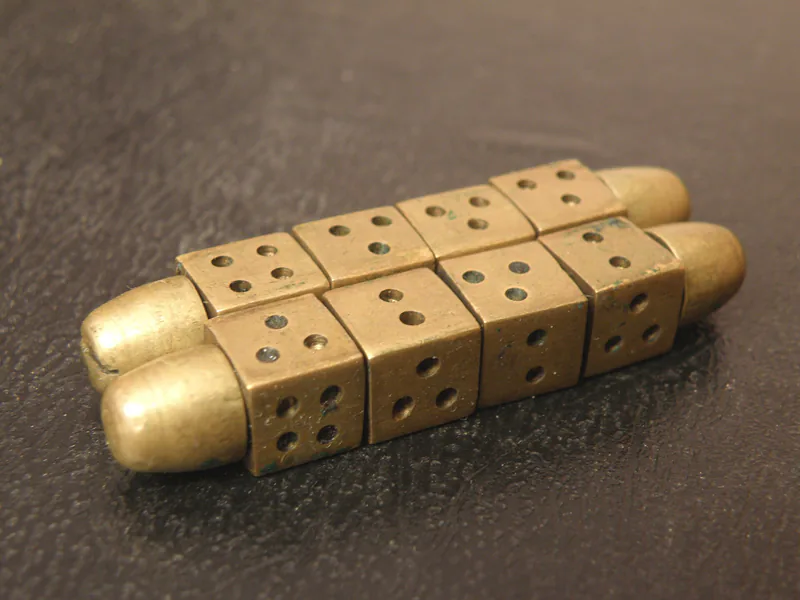
Arabic sources trace geomancy to legendary founders: the prophet Idrīs (often identified with Enoch and Hermes), or the angel Gabriel teaching the art to Idrīs or to the prophet Daniel. Historically the earliest treatises date from about the ninth century, and the practice was associated with North Africa and the Middle East. The diviner struck rows of marks in sand with a finger or stick, which is why the practice became known as "sand" divination. Brass geomantic instruments, such as a thirteenth-century device with sliding indicators studied by Emilie Savage-Smith and Marion Smith, show how far the art could be mechanised.
Related forms spread widely. In West Africa and Madagascar, the sikidy of Madagascar and other systems use the same sixteen binary figures, apparently derived from Arabic geomancy. The relationship between geomancy and Yoruba Ifá, which also uses sixteen basic signs, is debated by scholars.
The Sixteen Geomantic Figures§
Each figure is made of four lines, read from top to bottom and traditionally associated with the elements fire, air, water and earth. An odd number of marks reduces to one dot; an even number to two. The sixteen combinations received Latin names in medieval Europe:
| Figure | Meaning of name | Figure | Meaning of name |
|---|---|---|---|
| Via | the way | Populus | the people |
| Conjunctio | conjunction | Carcer | prison |
| Fortuna Major | greater fortune | Fortuna Minor | lesser fortune |
| Acquisitio | gain | Amissio | loss |
| Laetitia | joy | Tristitia | sorrow |
| Puella | the girl | Puer | the boy |
| Albus | white | Rubeus | red |
| Caput Draconis | head of the dragon | Cauda Draconis | tail of the dragon |
Via, with a single dot in every row, and Populus, with two dots in every row, are complementary; Caput and Cauda Draconis take their names from the lunar nodes. Medieval and Renaissance authors assigned the figures to planets and zodiac signs, and each has a traditional character as favourable, unfavourable or mixed, sometimes varying with the question asked. Acquisitio is generally good for gain, Carcer signifies restriction, Rubeus is associated with Mars and passion, and Albus with Mercury and calm.
How a Geomantic Chart Is Formed§
The traditional procedure is mechanical once the first figures are generated, and was valued precisely for that objectivity.
- The Mothers. The diviner, concentrating on the question, makes sixteen lines of random marks. Counted in groups of four lines, these give the four Mothers.
- The Daughters. Reading the Mothers across, row by row, produces four Daughters: the first Daughter is made from the top lines of the four Mothers, and so on.
- The Nieces. Adjacent pairs among the eight figures are "added": where two rows are both odd or both even, the result is even; otherwise odd. This gives four Nieces (also called Nephews).
- The Witnesses and Judge. The Nieces are added in pairs to form the Right and Left Witnesses, which together produce the Judge. Some authors add a sixteenth figure, the Reconciler, from the Judge and the first Mother.
Because of the mathematics of the procedure, the Judge always has an even number of total dots, so only eight of the sixteen figures can appear in that position. This is a simple consistency check on the work. In the "shield chart" the figures are arranged in a triangle with the Judge at the base; the answer is read from the Judge and the Witnesses, and from the way particular figures recur in the chart.
The astrological house chart§
From the late Middle Ages the first twelve figures were often placed in the twelve houses of an astrological chart, giving a form of "terrestrial astrology." The querent and the quesited are given houses as in horary astrology, and the reader examines where figures repeat, or "pass," between houses.
Geomancy in Medieval and Renaissance Europe§
Geomancy entered Latin in the twelfth century. Hugh of Santalla's Ars geomantiae, made in Spain, is among the earliest translations, and other treatises circulated under the names of Gerard of Cremona and later Bartholomew of Parma, who wrote on the art in the late thirteenth century. Geomancy's appeal was practical: it required no astronomical tables or ephemerides, only a stick, a stylus or pen and paper. Hundreds of manuscripts survive, and the art appears in courtly settings and in the books of lay readers.
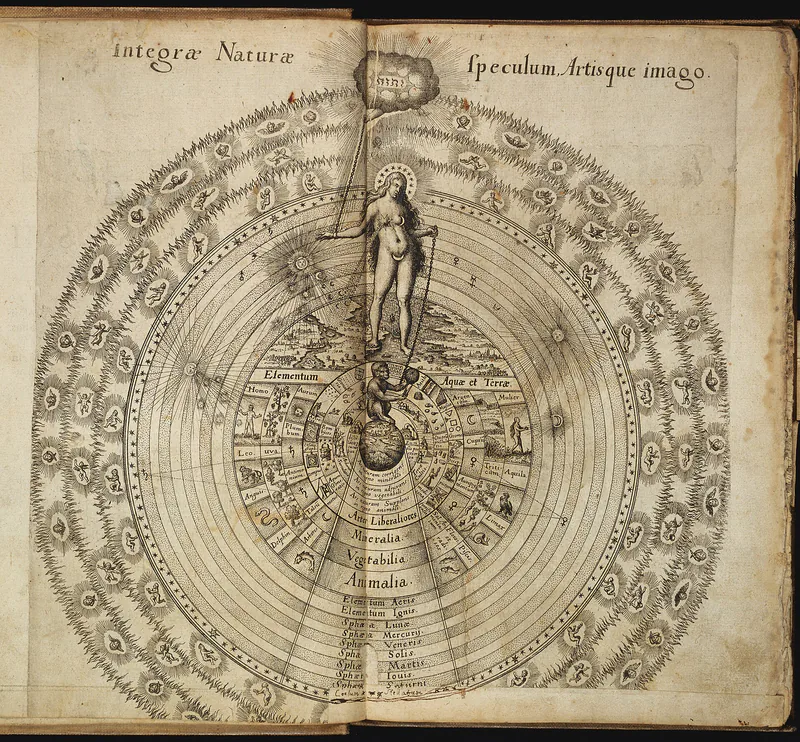
In the Renaissance, geomancy attracted learned discussion. Cornelius Agrippa listed it among the divinatory arts in De occulta philosophia (1533) and later criticised all such arts in his work on the vanity of the sciences; see Agrippa's Three Books. A short treatise on geomancy falsely attributed to Agrippa circulated with the spurious Fourth Book of Occult Philosophy. Christopher Cattan's La Géomance (1558) appeared in English in 1591, and the physician and Hermetic philosopher Robert Fludd wrote extensively on the subject. Like astrology, geomancy declined among the educated after the seventeenth century, persisting in cheap chapbooks and fortune-telling manuals.
The Golden Dawn and the Modern Revival§
The Hermetic Order of the Golden Dawn taught geomancy to its members in the 1890s, attaching each figure to a zodiac sign, a planet and a ruling spirit or "genius" drawn from Agrippa, and recommending that the figures be marked in sand or earth after an invocation. Its tables shaped twentieth-century occult manuals, though they reduced the older techniques to a fairly simple form; see the Golden Dawn.
Since the 1980s, works by Stephen Skinner and John Michael Greer, among others, have returned to medieval and Renaissance sources and restored methods such as the reading of the shield chart, the company of figures and the passing of figures in the house chart. Modern geomancy is a small but active practice, often compared with the I Ching, the other major divinatory system built from random binary choices. For a broader context see What Is Divination?
Frequently asked questions§
Is geomancy the same as feng shui?§
No. Western geomancy is a divinatory art using sixteen dot figures, derived from Arabic ʿilm al-raml. Feng shui is the Chinese practice of siting buildings and graves in harmony with landscape and cosmic forces; it was called "geomancy" by some nineteenth-century Western writers, which causes confusion.
How many geomantic figures are there?§
There are sixteen, each formed of four rows of one or two dots. They carry Latin names such as Via, Populus, Fortuna Major, Carcer and Caput Draconis, and are traditionally linked to planets and zodiac signs.
Why can the Judge only be certain figures?§
The Judge is derived by repeated addition from the four Mothers, and the arithmetic ensures that it always has an even number of dots in total. Only eight of the sixteen figures meet that condition, so an odd Judge shows a mistake in the calculation.
Where did geomancy come from?§
It developed in the Islamic world, probably by the ninth century, as the "science of the sand." It was translated into Latin in the twelfth century and became widespread in medieval and Renaissance Europe.
Sources and further reading§
- Recherches sur une technique divinatoire: la géomancie dans l'Occident médiéval — Thérèse Charmasson, 1980
- Islamic Geomancy and a Thirteenth-Century Divinatory Device — Emilie Savage-Smith and Marion B. Smith, 1980
- Terrestrial Astrology: Divination by Geomancy — Stephen Skinner, 1980
- The Art and Practice of Geomancy — John Michael Greer, 2009
- De occulta philosophia libri tres — Heinrich Cornelius Agrippa, 1533
- The Geomancie of Maister Christopher Cattan — Christopher Cattan, 1591