Liber XI · Hermeticism · Chapter VI: Renaissance Magic
Agrippa's Three Books of Occult Philosophy: History and Ideas
Cornelius Agrippa's Three Books of Occult Philosophy explained: the 1510 draft and 1533 edition, natural, celestial and ceremonial magic, and its legacy.
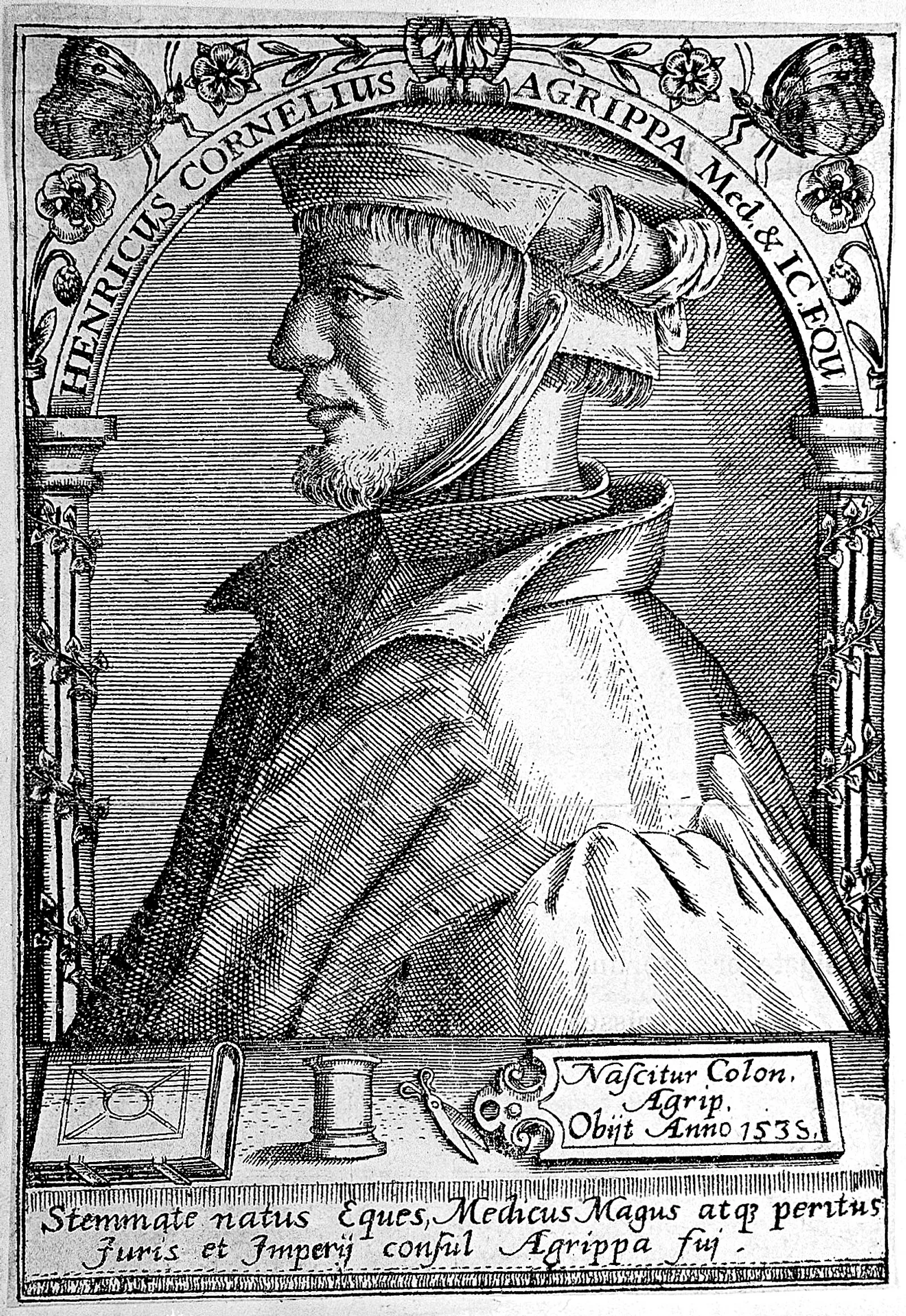
De occulta philosophia libri tres (Three Books of Occult Philosophy) is the great Renaissance encyclopaedia of magic written by the German humanist Heinrich Cornelius Agrippa von Nettesheim (1486–1535). Drafted around 1510 and published in an expanded form in 1533, it organises magic into three ascending levels: natural magic of the elemental world, celestial magic of the stars and numbers, and ceremonial magic of the divine and angelic world. Drawing on Hermetic, Neoplatonic and Kabbalistic sources, it became the standard reference for later magicians, from John Dee to the Hermetic Order of the Golden Dawn.
Heinrich Cornelius Agrippa: Life of a Renaissance Humanist§
Agrippa was born in Cologne on 14 September 1486 into a family of minor nobility. He studied at the University of Cologne and developed early interests in the occult sciences, Kabbalah and the works of the Catalan philosopher Ramon Llull. His career was restless and often troubled. He served as a soldier and diplomat, lectured on Johannes Reuchlin's Kabbalistic De verbo mirifico at the University of Dole in 1509, an event that brought accusations of heresy from Franciscan critics, and later lived in Italy, where he encountered the Platonism of Marsilio Ficino and Giovanni Pico della Mirandola.
He worked successively as a town advocate and orator at Metz, where in 1519 he successfully defended a woman accused of witchcraft; as a physician at Geneva and Fribourg; as physician to Louise of Savoy, the mother of King Francis I of France; and as historiographer to the Habsburg regent of the Netherlands, Margaret of Austria. He married three times and was frequently in debt. In 1530 he published De incertitudine et vanitate scientiarum (On the Uncertainty and Vanity of the Sciences), a sceptical attack on all human learning, including the occult arts. He died at Grenoble in 1535, probably early in that year.
The 1510 Draft and the 1533 Edition§
In 1509–1510 Agrippa visited the Benedictine abbot Johannes Trithemius at Würzburg, himself a celebrated scholar of cryptography and magic. Agrippa then sent him a manuscript of De occulta philosophia, and Trithemius replied with a letter of praise, advising him to share its deepest secrets only with trusted friends. This early version, now usually called the Würzburg manuscript, was shorter and simpler than the later printed text.
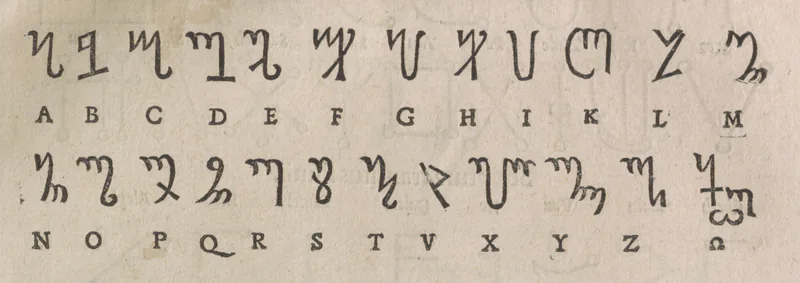
Agrippa returned to the work over the following two decades, greatly enlarging it with material from Ficino, Pico, Reuchlin, Pliny, the Corpus Hermeticum and medieval works on astral magic such as the Picatrix. The first book was printed in Antwerp in 1531, and the complete three-book edition appeared in Cologne in 1533 despite opposition from the Dominican inquisitor of the city. The critical edition by Vittoria Perrone Compagni (1992) shows the layers of revision in detail.
Reconciling scepticism and occult philosophy§
That Agrippa should publish an encyclopaedia of magic three years after denouncing the vanity of all sciences has long puzzled readers. The 1533 edition includes a note saying that the work was written in his youth and that he had revised rather than abandoned it. Historians have offered several explanations. Charles Nauert argued that Agrippa's scepticism and his magic were two responses to the same crisis: if human reason cannot reach certain knowledge, only divine revelation and a spiritually purified mind can. Others, such as Marc van der Poel, read De vanitate as a rhetorical declamation rather than a straightforward statement of belief. On any reading, Agrippa saw true magic as inseparable from piety.
The Structure of the Three Books§
Agrippa's organising principle comes from Neoplatonism. The universe consists of three worlds: the elemental (the material world of the four elements), the celestial (the stars and planets), and the intellectual (the angels, intelligences and God). Each higher world governs the one below it, and powers flow downward through them. The wise person, Agrippa argues, can ascend through the same chain and draw down higher virtues into lower things. This is the cosmological sense of the Hermetic principle summarised in the Emerald Tablet.
Book I: natural magic§
The first book concerns the elemental world. Agrippa explains the four elements and their qualities, and then the "occult virtues" of things: powers that cannot be explained by elemental qualities alone and must be derived from the stars and ultimately from the World Soul. He discusses sympathies and antipathies between creatures, the plants, animals and stones under each planet, the use of perfumes, ointments and suffumigations, the effect of the passions and imagination on the body, and divination by natural signs. Much of this material repeats and systematises ancient and medieval natural history.
Book II: celestial or mathematical magic§
The second book addresses the celestial world through number, geometry, harmony and astrology. Agrippa explores the symbolism of each number from one to twelve and beyond, the sacred proportions of the human body, musical harmony, the planets and fixed stars, the lunar mansions, and the making of images or talismans under specific astrological conditions. Here numbers are not merely tools of calculation but carry intrinsic spiritual power.
Book III: ceremonial magic§
The third book turns to the intellectual and divine world. It treats religion as the necessary foundation of magic and discusses the divine names, the sefirot of the Kabbalah, the orders of angels and demons, the souls of the dead, prophecy and divine frenzy, and the rites, prayers and purifications that prepare the magician to receive higher powers. Agrippa insists that without faith, purity and the help of God, ceremonial operations are vain or dangerous.
Correspondences, Kabbalah and the Scale of Numbers§
One of the features that made Agrippa so useful to later magicians is his systematic presentation of correspondences. In Book II he provides "scales" for numbers from one to twelve, tables in which each number is linked with divine names, angels, planets, elements, parts of the body, animals, stones and other things. The scale of seven, for example, aligns the seven planets with seven angels, metals, birds, fishes, stones and bodily organs.
In Book III Agrippa sets out Kabbalistic material that he drew largely from Reuchlin and Pico: the ten sefirot with their associated divine names, the angelic orders, the seventy-two-fold name of God, and methods of letter-number calculation familiar from gematria. He also reproduces several magical alphabets, including the "Celestial," "Malachim" and "Passing of the River" scripts, which he took in part from earlier authors and which became staples of later occult writing.
Planetary Magic Squares and Seals§
The most famous pages of the book are the tables of planetary magic squares in Book II. A magic square is a grid of numbers in which every row, column and main diagonal adds up to the same total. Agrippa presents seven such squares, assigning one to each planet according to its traditional number: Saturn three by three, Jupiter four by four, Mars five by five, the Sun six by six, Venus seven by seven, Mercury eight by eight, and the Moon nine by nine. Each square is given in Arabic numerals and in Hebrew letters.
From each square Agrippa derives a seal of the planet, and the sigils of a planetary intelligence and a planetary spirit, whose names are linked to the numbers of the square by gematria. The intelligence was understood as a good angelic power and the spirit as a more ambivalent one. These squares, which had antecedents in Arabic and medieval Latin astral magic, were widely engraved on talismans and later absorbed into the teaching of the Hermetic Order of the Golden Dawn, where sigils were traced on the squares using a "rose" of Hebrew letters.
The Spurious Fourth Book§
In 1559, about twenty-four years after Agrippa's death, a Fourth Book of Occult Philosophy appeared under his name, and it was later printed together with his collected works. It gives practical instructions for ceremonial magic, including the construction of names and characters of spirits and the composition of pentacles and circles, much as in the Key of Solomon tradition. Johann Weyer, the physician and critic of witch persecutions who had been Agrippa's student and household member, declared the book a forgery, and modern scholars agree that Agrippa did not write it. It was often printed alongside the Heptameron, a short ritual text falsely attributed to the medieval physician Peter of Abano. An English translation by Robert Turner appeared in 1655.
Influence on Dee, the Grimoires and Modern Occultism§
Agrippa's book quickly became the essential reference on magic for learned readers. John Dee owned and studied it, and its angelology and Kabbalah helped shape the background to his angel conversations, discussed in our article on Enochian magic. Giordano Bruno drew on it for his own magical writings. The English translation of 1651, signed "J.F." and usually attributed to the physician John French, made the work available to a wider audience.
The book also seeded later grimoires and handbooks. Large parts of Francis Barrett's The Magus (1801) were copied from Agrippa, often without acknowledgement, and Barrett's book in turn influenced nineteenth-century occultists. Éliphas Lévi, the Golden Dawn and Aleister Crowley all relied on Agrippa's tables of correspondences, magic squares and alphabets. At the same time, Agrippa's legend grew in popular imagination: he was said to be accompanied by a demonic black dog and to own a book that could summon devils, stories that fed into the Faust legend and were rebutted by Weyer.
Modern historians, beginning with Frances Yates and continuing with scholars such as Christopher Lehrich and Wouter Hanegraaff, see the Three Books as a key document of Renaissance thought: an attempt to unite religion, philosophy and natural science within a single vision of a living, ordered cosmos.
Frequently asked questions§
When was the Three Books of Occult Philosophy written?§
Agrippa wrote a first version around 1510 and sent it to Johannes Trithemius. He expanded it substantially over two decades, and the full edition was printed in Cologne in 1533, with the first book published separately in 1531.
What are the three kinds of magic in Agrippa?§
Agrippa divides magic into natural magic, concerned with the elemental world and the hidden virtues of things; celestial or mathematical magic, concerned with the stars and numbers; and ceremonial magic, concerned with the divine and angelic world.
Did Agrippa write the Fourth Book of Occult Philosophy?§
No. It appeared in 1559, long after his death, and his former student Johann Weyer declared it a forgery. Modern scholars agree that it is spurious, though it was influential among practitioners of ritual magic.
Why did Agrippa also write against the occult sciences?§
In 1530 he published On the Uncertainty and Vanity of the Sciences, which criticised all human knowledge, including magic. Scholars interpret this either as a sincere sceptical turn that left room only for faith, or as a rhetorical exercise, and Agrippa himself presented the Three Books as a revised work of his youth.
Sources and further reading§
- De occulta philosophia libri tres — Heinrich Cornelius Agrippa, ed. Vittoria Perrone Compagni, 1992
- Three Books of Occult Philosophy — Heinrich Cornelius Agrippa, trans. J. F., 1651; ed. Donald Tyson, 1993
- Agrippa and the Crisis of Renaissance Thought — Charles G. Nauert, 1965
- The Language of Demons and Angels: Cornelius Agrippa's Occult Philosophy — Christopher I. Lehrich, 2003
- Cornelius Agrippa: The Humanist Theologian and His Declamations — Marc van der Poel, 1997
- The Occult Philosophy in the Elizabethan Age — Frances A. Yates, 1979