Liber XII · Hermeticism · Chapter I: Astral Magic
Astral Magic: Talismans, Planetary Images and the Picatrix
Astral magic explained: celestial influence and talismans, the Picatrix, al-Kindi, Ficino's De vita, Agrippa's planetary squares and the Church's response.

Astral magic is the branch of learned magic that seeks to capture and direct the influences of the stars and planets, chiefly by making talismans or "images" at astrologically chosen moments and by using substances, colours, sounds and words that correspond to particular planets. It flourished in the medieval Islamic world, entered Latin Europe through translations such as the Picatrix, and was refashioned in the Renaissance by Marsilio Ficino and Cornelius Agrippa.
The theory behind astral magic§
Ancient and medieval cosmology placed the earth at the centre of nested celestial spheres, each moved by divine or intelligent powers. Almost everyone in the premodern world accepted that the heavens influenced the earth: the sun governs the seasons, the moon the tides. Astrologers extended this influence to human temperament and destiny, and natural philosophers to the generation of plants, stones and metals.
Astral magic went a step further, holding that a skilled practitioner could gather and concentrate celestial influence for specific ends. The ninth-century Arab philosopher al-Kindi, in a treatise known in Latin as De radiis ("On Rays"), argued that every star, and indeed everything in the world, emits rays that act on all other things; words, images and intentions could therefore have real effects. Neoplatonic ideas of a cosmic soul and chains of sympathy, discussed in our guide to correspondences, provided another rationale.
The Picatrix and Arabic image magic§
The most famous handbook of astral magic is the Ghāyat al-Ḥakīm ("The Goal of the Sage"), an Arabic compilation usually dated to the tenth or eleventh century and long misattributed to the Andalusian mathematician Maslama al-Majriti. Translated into Spanish and then Latin at the court of Alfonso X of Castile around 1256, it became known in Europe as the Picatrix (the catalogue text is available as the Picatrix).
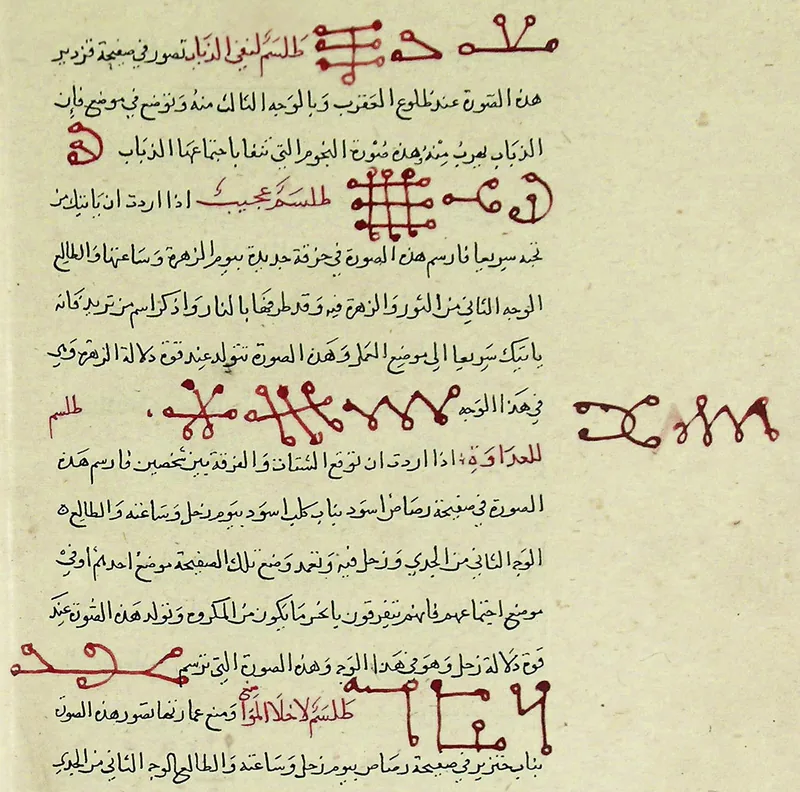
The Picatrix gathers material from Hermetic, Sabian, Indian and Greek sources. It explains the philosophy of magic as the drawing down of celestial spirit (pneuma), lists the images to be engraved for each planet and decan, describes the twenty-eight mansions of the moon and their uses, and records long prayers addressed to the planets, with offerings and suffumigations. Other influential Arabic and Latin texts include Thabit ibn Qurra's treatise on images and a range of works circulating under the name of Hermes, such as the Book of the Twelve Images of the Hours of the Night.
Talismans, images and timing§
The central technique of astral magic is the talisman (from Arabic ṭilsam, itself from Greek telesma, a consecrated object). A talisman was typically made of a metal or stone associated with a planet, engraved with an image, sign or inscription, and created when that planet was strong in the heavens, for example in its own sign or rising on the eastern horizon. Texts specify, for instance, that an image of Jupiter should be made in tin when Jupiter is well placed.
Practitioners chose moments through elections, the branch of astrology that selects favourable times, and through planetary hours, a system that assigns each hour of the day to one of the seven planets in the "Chaldean order" (Saturn, Jupiter, Mars, Sun, Venus, Mercury, Moon). The days of the week, named after the planets in many languages, follow the same system. Fumigation with appropriate incenses, colours, music and spoken invocations completed the operation.
Planetary magic squares (kameas)§
A distinctive tool of later astral magic is the planetary magic square, a grid of numbers in which every row, column and diagonal adds to the same total. Squares of orders three to nine were assigned to Saturn, Jupiter, Mars, the Sun, Venus, Mercury and the Moon respectively. Magic squares are attested in Arabic manuscripts and in Latin texts before the sixteenth century, but they became standard through the second book of Agrippa's Three Books of Occult Philosophy (1533), which printed them alongside the "seals" and the names of the planetary intelligences and spirits derived from the squares' numerical values.
Modern occultists often call these squares kameas, a term taken from the Hebrew qameʿa, "amulet". The Hermetic Order of the Golden Dawn used them to derive sigils by tracing the letters of a name across the square, a practice that remains common in ceremonial magic.
Ficino and Renaissance astral magic§
Marsilio Ficino (1433–1499), translator of Plato, Plotinus and the Hermetica, wrote the most influential Renaissance account of astral magic in the third book of his De vita libri tres (1489), titled "On Obtaining Life from the Heavens". Writing as a physician concerned for scholars prone to melancholy under Saturn, Ficino recommended living in harmony with benign planets such as the Sun, Jupiter and Venus through diet, colours, scents, gems, music and "Orphic" hymns sung to the planets. He discussed talismans more cautiously, wavering on whether their power was natural or risked involving demons.
Ficino's synthesis drew on the Picatrix, Plotinus and the statue-animating passage of the Hermetic Asclepius. It shaped later writers including Agrippa, Giordano Bruno and Tommaso Campanella, who in 1628 is said to have performed astrological rites with Pope Urban VIII to avert a threatened eclipse. D. P. Walker's Spiritual and Demonic Magic from Ficino to Campanella (1958) remains a classic study.
Theological debate and condemnation§
Christian theologians did not usually doubt that the heavens influenced bodies, but they debated whether images and inscriptions could have natural power. Thomas Aquinas argued that figures and characters have no natural efficacy and that any effect of such images must come from demons responding to signs addressed to them. The thirteenth-century Speculum astronomiae, traditionally attributed to Albertus Magnus, tried to distinguish acceptable "astronomical images" from abominable ones involving invocations and suffumigations.
Astral magic thus remained suspect, tolerated in some circles and condemned in others. Pope Sixtus V's bull Coeli et terrae (1586) condemned judicial astrology and related divinatory and magical arts. Despite this, talismanic and astrological magic persisted in manuscripts, printed grimoires and the practice of astrologer-physicians well into the seventeenth century, and it was revived by nineteenth- and twentieth-century occultists. Its links to the theurgy of late antiquity are explored in Neoplatonism and theurgy.
Frequently asked questions§
What is the Picatrix?§
The Picatrix is the Latin name of the Ghāyat al-Ḥakīm, an Arabic compendium of astral magic probably compiled in the tenth or eleventh century. Translated in thirteenth-century Castile, it became the most important source of planetary image magic in Europe.
What is a planetary talisman?§
It is an object, usually a metal plate or engraved stone, made at an astrologically chosen moment with images or signs associated with a planet. Practitioners believed it captured and retained that planet's influence for purposes such as health, favour or protection.
What are the planetary hours?§
They are a traditional system that assigns each hour of the day and night to one of the seven classical planets in a fixed sequence, beginning at sunrise with the planet that rules the day. Astral magicians used them to time operations.
Sources and further reading§
- Picatrix: A Medieval Treatise on Astral Magic — Dan Attrell & David Porreca, 2019
- Three Books of Occult Philosophy — Heinrich Cornelius Agrippa, 1533
- Spiritual and Demonic Magic from Ficino to Campanella — D. P. Walker, 1958
- Les 'images astrologiques' au Moyen Âge et à la Renaissance — Nicolas Weill-Parot, 2002
- Giordano Bruno and the Hermetic Tradition — Frances A. Yates, 1964
- Eros and Magic in the Renaissance — Ioan P. Couliano, 1987