Liber XII · Hermeticism · Chapter VI: Renaissance Magic
Marsilio Ficino: Plato, Hermes and Renaissance Magic in Florence
Marsilio Ficino's life and work: Medici translator of Hermes and Plato, author of the Platonic Theology and Three Books on Life, and Renaissance magus.

Marsilio Ficino (1433–1499) was a Florentine philosopher, physician and priest who translated the complete works of Plato and the Greek Hermetic treatises into Latin and became the leading figure of Renaissance Platonism. Supported by the Medici, he presented Plato, Plotinus and Hermes Trismegistus as witnesses to an ancient wisdom in harmony with Christianity. His Three Books on Life (1489), with its advice on living in harmony with the stars, made him the founder of learned Renaissance magic.
Early Life and the Medici Patronage§
Ficino was born on 19 October 1433 at Figline in the upper Arno valley, the son of Diotifeci d'Agnolo, a physician who served Cosimo de' Medici. He studied grammar, philosophy and medicine in Florence, absorbing the scholastic Aristotelianism of the university, but he was drawn early to Plato, whom he first knew through Latin sources such as Cicero, Augustine and Macrobius.
Florence was then a centre of Greek studies. The Council of Florence (1438–1439) had brought Byzantine scholars to the city, among them Gemistos Plethon, whose lectures on Plato reportedly impressed Cosimo. Ficino learned Greek in the 1450s, and around 1462 Cosimo gave him Greek manuscripts and the use of a house near the Medici villa at Careggi, outside Florence, so that he could devote himself to translating Plato. The arrangement made Ficino the household philosopher of three generations of Medici: Cosimo, his son Piero and his grandson Lorenzo the Magnificent.
Translating Hermes Before Plato§
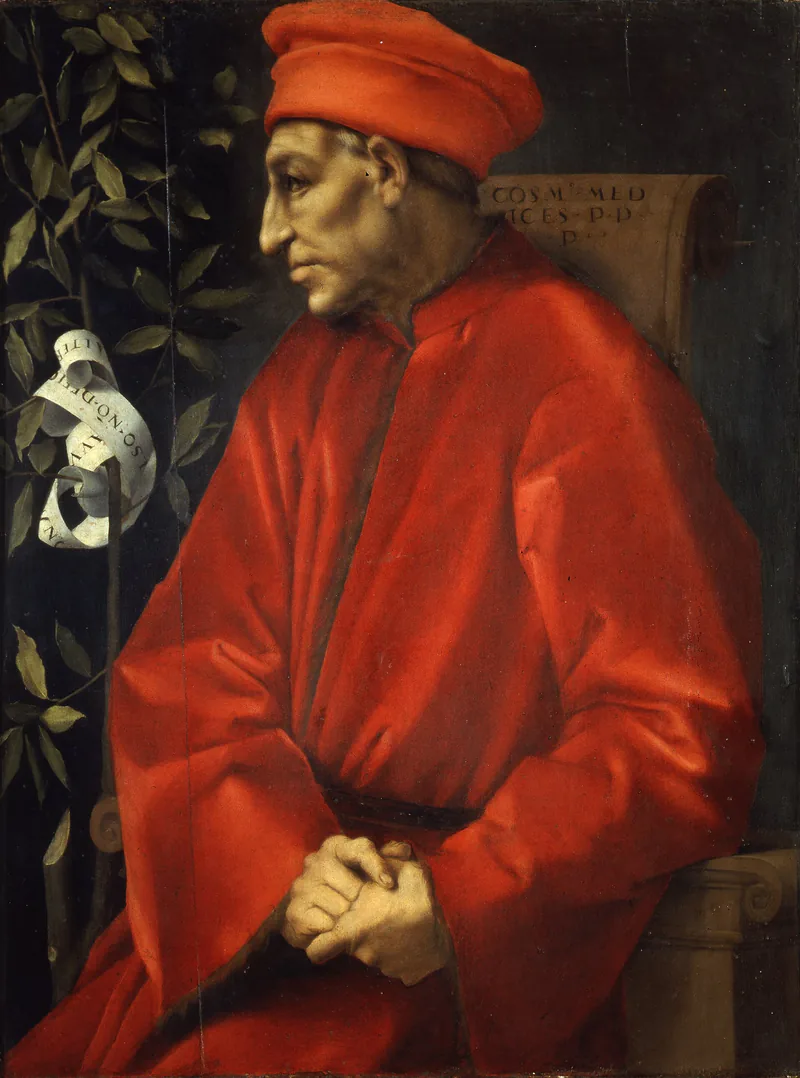
In 1463, while Ficino was working on Plato, a manuscript of the Greek Corpus Hermeticum arrived in Florence, brought from Macedonia by a monk acting for Cosimo. Cosimo, old and ill, asked Ficino to put Plato aside and translate Hermes first, so that he could read it before he died. Ficino completed fourteen treatises within a few months and dedicated the translation to Cosimo, who died in 1464.
The reason for this priority was chronological as Ficino understood it. Following ancient Christian writers, he believed Hermes Trismegistus was a sage of remote antiquity, roughly contemporary with Moses, and the first of a line of "ancient theologians" whose wisdom descended through Orpheus and Pythagoras to Plato. Ficino titled the work Pimander after its first treatise, the Poimandres. Printed at Treviso in 1471, it went through many editions and made the Corpus Hermeticum one of the most widely read philosophical texts of the age.
Ficino then completed his translation of all of Plato's dialogues, circulated in manuscript and printed in Florence in 1484, with introductions to each dialogue. His translation of Plotinus' Enneads, with commentary, appeared in 1492, and in 1497 the Venetian printer Aldus Manutius issued his Latin versions or paraphrases of Iamblichus' On the Mysteries, Proclus, Porphyry, Psellus, Synesius and other Neoplatonic texts. Few individuals have done more to shape the canon of philosophy available to Europe.
The Platonic Theology and the Immortal Soul§
Ficino's main philosophical work, the Platonic Theology on the Immortality of Souls, written between about 1469 and 1474 and printed in 1482, runs to eighteen books. Its purpose was apologetic: to refute those, especially followers of the Averroist and Alexandrist interpretations of Aristotle, who denied or doubted personal immortality, and to show that Platonic philosophy and Christian faith agree.
Ficino arranged reality in five levels: God, angelic mind, rational soul, quality and body. The soul stands in the middle, the "bond of the universe", linking the higher and lower worlds, able to rise toward God through contemplation or sink toward the body. Because the soul naturally desires infinite truth and goodness, and no natural desire is in vain, Ficino argued that the soul must be immortal and destined to enjoy God. The idea of the soul as the centre and knot of the cosmos echoes the Hermetic Asclepius and was developed by his younger friend Pico della Mirandola.
Platonic Love and the Florentine Circle§
In 1469 Ficino wrote De amore, a commentary on Plato's Symposium framed as a banquet held on Plato's supposed birthday, 7 November, with speeches by Florentine friends. Love, he explained, is the desire for beauty, and beauty is the radiance of the divine goodness shining through creatures. Earthly love, rightly understood, leads the soul upward from bodies to souls, to angelic mind and finally to God. In his letters Ficino spoke of friendship grounded in this shared love of the divine, and the phrase "Platonic love" spread from his circle into European literature.
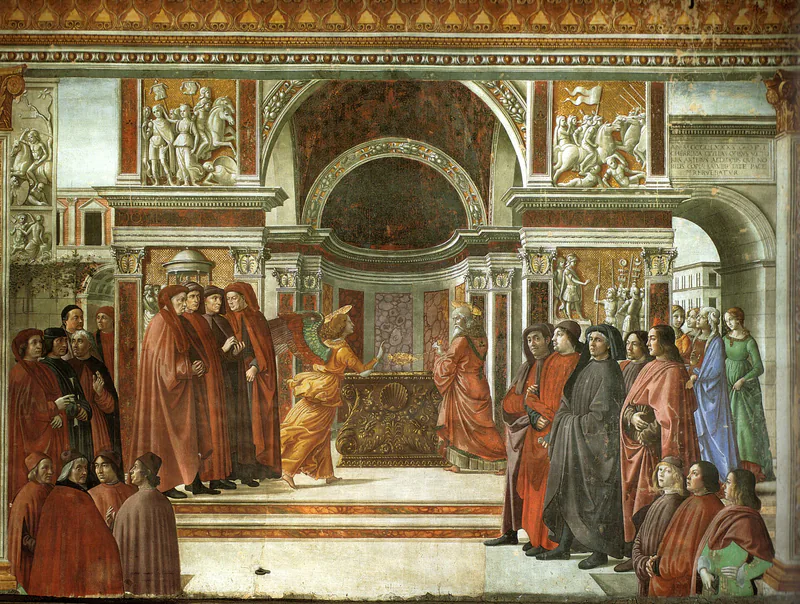
Historians long spoke of a "Platonic Academy" at Careggi, imagined as a formal institution with members and meetings. Research by James Hankins and others has shown that it was rather a loose network of friends, students and correspondents, including poets, statesmen and clergy, who gathered around Ficino and called him their teacher. Ficino's Letters, arranged in twelve books, are the best record of this circle and of his teaching. He was ordained a priest in 1473 and later served as a canon of Florence Cathedral, and his On the Christian Religion (1474) presented his Platonism as a support for faith.
Three Books on Life: Medicine, Melancholy and the Stars§
Ficino's most influential book outside philosophy was De vita libri tres (Three Books on Life, 1489). The first book offers health advice for scholars, who, he argued, are especially prone to melancholy because their contemplative work falls under Saturn and because study dries and cools the body. Ficino himself had Saturn rising in his horoscope and wrote with feeling about the scholar's temperament. The second book concerns prolonging life in old age.
The third book, On Obtaining Life from the Heavens, is the foundational text of Renaissance astral magic. Drawing on Plotinus, Iamblichus, Proclus, the Asclepius and the Arabic Picatrix, Ficino explains that a "spirit of the world" (spiritus mundi) flows from the heavens through all things and that the human spirit can be tuned to it. One may attract the beneficent influences of the Sun, Jupiter and Venus by surrounding oneself with their colours, scents, foods, gems, plants and music, and by singing hymns to the planets in the manner Ficino believed Orpheus had taught. Ficino himself performed such songs to the lyre.
He discussed talismans and images more cautiously, setting out arguments for and against their efficacy and leaving open whether they acted naturally or risked involving demons. The book drew accusations of magic, and Ficino responded with an Apology insisting that he was describing natural, medical magic, not the worship of demons. With support from friends in Rome, he avoided formal censure. D. P. Walker's classic study traced this line of "spiritual" magic from Ficino to Campanella.
Ancient Theology and Christian Platonism§
Running through all of Ficino's work is the idea of a prisca theologia, an ancient theology given by God to the gentiles alongside the revelation to the Hebrews. Ficino's lineage ran from Zoroaster or Hermes through Orpheus, Aglaophemus, Pythagoras and Philolaus to Plato, and its later heirs included Plotinus, Iamblichus and Proclus. On this view, pagan philosophy at its best was a preparation for Christianity, and a revival of Platonism could renew Christian piety.
This conviction allowed Ficino to embrace Hermetic, Orphic and Neoplatonic texts that earlier theologians had viewed with suspicion. It also opened the door to the more ambitious syntheses of Pico, who added Kabbalah, and of Agrippa, whose Three Books of Occult Philosophy systematised natural, celestial and ceremonial magic. The broader development is traced in occult philosophy and the Renaissance magical cosmos.
Legacy and Modern Scholarship§
Ficino died at Careggi on 1 October 1499. His translations remained standard for generations: his Latin Plato was reprinted into the eighteenth century, and his Plotinus shaped readings of Neoplatonism long after. His ideas of love and beauty influenced poets and artists, and his astrological medicine and natural magic shaped a century of occult philosophy.
Modern study of Ficino was transformed by Paul Oskar Kristeller, whose The Philosophy of Marsilio Ficino (1943) presented him as a systematic metaphysician, and by Frances Yates, whose Giordano Bruno and the Hermetic Tradition (1964) made him the starting point of a "Hermetic" magical tradition. Later scholars have qualified Yates's emphasis on Hermes, pointing to the larger role of Plotinus, Proclus and medical theory, but Ficino remains a central figure in the history of Western esotericism.
Frequently asked questions§
Why did Ficino translate Hermes before Plato?§
Cosimo de' Medici asked him to do so in 1463, because the Hermetic texts had just arrived and Cosimo wished to read them before he died. Ficino also believed Hermes was far older than Plato and the source of the wisdom Plato later expressed.
Did Ficino practise magic?§
Ficino described and, by his own account, practised a natural and musical magic intended to harmonise the spirit with beneficent planets, especially for health. He was cautious about talismans and denied any dealings with demons, defending his work as a form of medicine.
What was the Platonic Academy of Florence?§
It was the circle of friends, pupils and patrons who gathered around Ficino, especially at Careggi near Florence. Older histories pictured it as a formal academy, but recent scholarship sees it as an informal network rather than an institution.
What is Ficino's Platonic Theology?§
It is an eighteen-book treatise, printed in 1482, arguing for the immortality of the soul using Platonic philosophy and Christian theology. It places the soul at the centre of a hierarchy of being, linking body and God.
Sources and further reading§
- Three Books on Life (De vita libri tres) — Marsilio Ficino, 1489
- Platonic Theology — Marsilio Ficino, 2001
- Commentary on Plato's Symposium on Love — Marsilio Ficino, 1985
- The Philosophy of Marsilio Ficino — Paul Oskar Kristeller, 1943
- Spiritual and Demonic Magic from Ficino to Campanella — D. P. Walker, 1958
- The Ancient Theology — D. P. Walker, 1972
- Giordano Bruno and the Hermetic Tradition — Frances A. Yates, 1964