Hermes Trismegistus: Thoth, the Thrice-Great Sage and His Legend
Who was Hermes Trismegistus? The thrice-great sage born from Thoth and Hermes, his books, his Arabic and Latin legends, and how scholars redated him in 1614.
Hermes Trismegistus, "thrice-great Hermes", is the legendary sage to whom the Hermetic writings were attributed. He arose in Ptolemaic and Roman Egypt from the identification of the Greek god Hermes with the Egyptian god Thoth, and was gradually reimagined as an ancient human teacher of philosophy, astrology, alchemy and magic. Medieval Arabic and Latin writers made him a prophet or primeval king, Renaissance humanists treated him as a contemporary of Moses, and modern scholarship regards him as a literary figure rather than a historical person.
Thoth and Hermes in Greco-Roman Egypt§
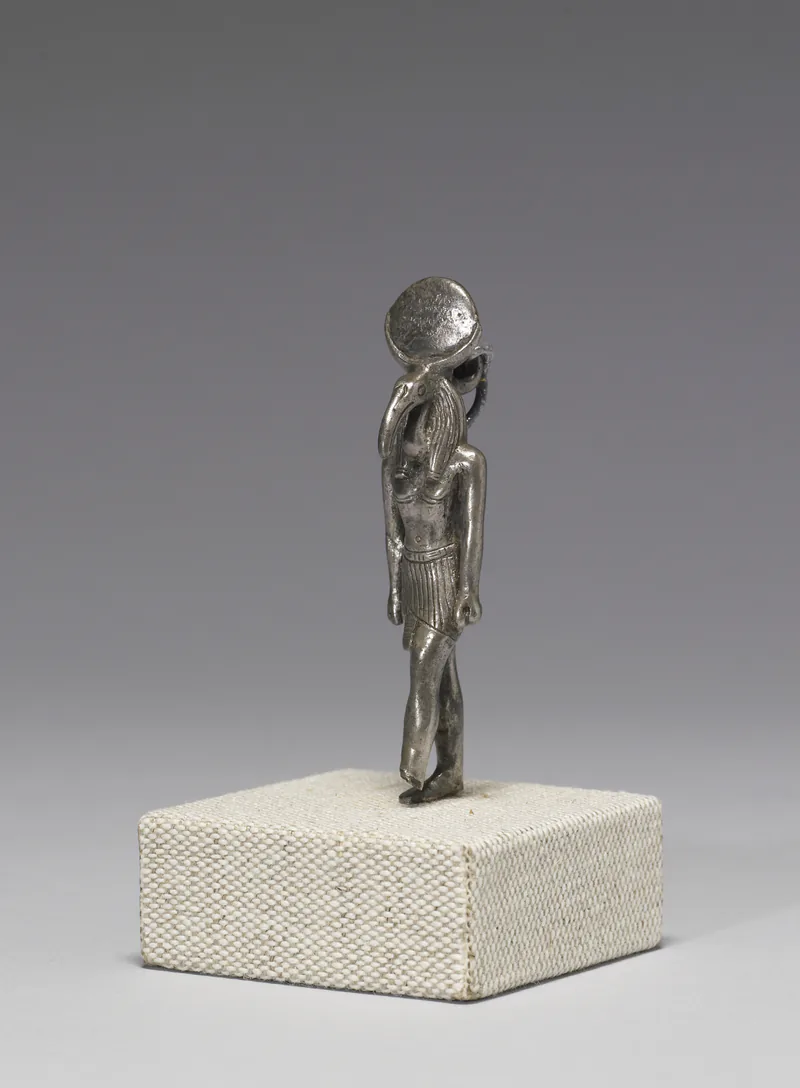
Thoth (Egyptian Djehuty) was one of the oldest and most respected gods of Egypt. Depicted as an ibis-headed man or as a baboon, he was the scribe of the gods, the reckoner of time and the moon, the inventor of hieroglyphic writing and the keeper of sacred knowledge. In judgement scenes of the Book of the Dead he records the result of the weighing of the heart. His chief cult centre was Khemenu, which the Greeks called Hermopolis, "the city of Hermes", a name that already shows the equation of the two gods (see ancient Egyptian religion).
After Alexander the Great's conquest in 332 BCE, Greek settlers and Egyptian priests lived side by side, and gods were routinely matched across languages. Hermes, the Greek messenger who guided souls to the underworld and patronised speech, cunning and exchange, was the natural partner of Thoth. Egyptian texts already addressed Thoth with doubled or tripled forms of "great", and documents of the Ptolemaic period, including the Demotic archive of the priest Hor of Sebennytos in the second century BCE, speak of Thoth as "three times great". The Greek adjective trismegistos became common in the Roman period, and by the second and third centuries CE "Hermes Trismegistus" was a familiar name throughout the Greek-speaking world.
From God to Sage: The Author of Countless Books§
The decisive change was not the fusion of two gods but the transformation of Hermes into an author. Egyptian temples housed libraries of sacred books, and priests ascribed their contents to Thoth as the divine scribe. Greek writers took this literally. Clement of Alexandria, around 200 CE, describes a procession in which Egyptian priests carried forty-two "indispensable" books of Hermes, covering hymns, astrology, temple ritual, sacred law and medicine. Later authorities gave fantastic totals: Iamblichus reports traditions crediting Hermes with twenty thousand or even more than thirty-six thousand books.
The writings that actually circulated under his name fall into two broad groups, a distinction explained in our introduction to Hermeticism. The "technical" Hermetica dealt with astrology, the properties of plants and stones, iatromathematics (astrological medicine) and alchemy; the alchemist Zosimus of Panopolis, writing around 300 CE, already cites Hermes as an authority. The "philosophical" Hermetica, preserved above all in the Corpus Hermeticum and the Latin Asclepius, present Hermes as a teacher of spiritual rebirth who instructs his son Tat, his disciple Asclepius and King Ammon, and who is himself taught by the divine Mind in the Poimandres.
How many Hermeses?§
Ancient writers disagreed about who Hermes had been. Cicero, in On the Nature of the Gods, lists five Mercuries, the last of whom fled to Egypt after killing Argus and gave the Egyptians their laws and letters. The Asclepius itself mentions an elder Hermes, grandfather of the speaker. Some Christian authors, notably Lactantius in the early fourth century, treated Hermes as a very ancient pagan witness who had glimpsed the truth about a single creator God and his Son; Augustine, more suspicious, condemned the Hermetic praise of god-making statues in The City of God.
Hermes in the Arabic and Islamic Tradition§
In the Islamic world Hermes became a prophet of science. Arabic writers identified him with Idris, the prophet whom the Qur'an describes as truthful and "raised to a high place" (19:56–57), and through Idris with the biblical Enoch, who "walked with God". As Kevin van Bladel has shown, a widely copied account derived from the astrologer Abu Ma'shar in the ninth century spoke of three Hermeses: a first, antediluvian Hermes who recorded the sciences on temple walls to save them from the Flood, a second who lived in Babylon after the Flood, and a third who taught in Egypt and wrote on alchemy, medicine and poisons.
Under this name circulated a large Arabic literature on astrology, talismans and alchemy. The Emerald Tablet, which first appears in Arabic, is the most famous example. The Sabians of Harran in northern Mesopotamia were said to honour Hermes as one of their prophets, although how far reports about them reflect their own beliefs is debated. These traditions travelled into Latin through the translation movement of the twelfth century and through compilations such as the Secretum secretorum and the Picatrix, discussed in our history of the Islamic occult sciences.
The Medieval Latin Hermes§
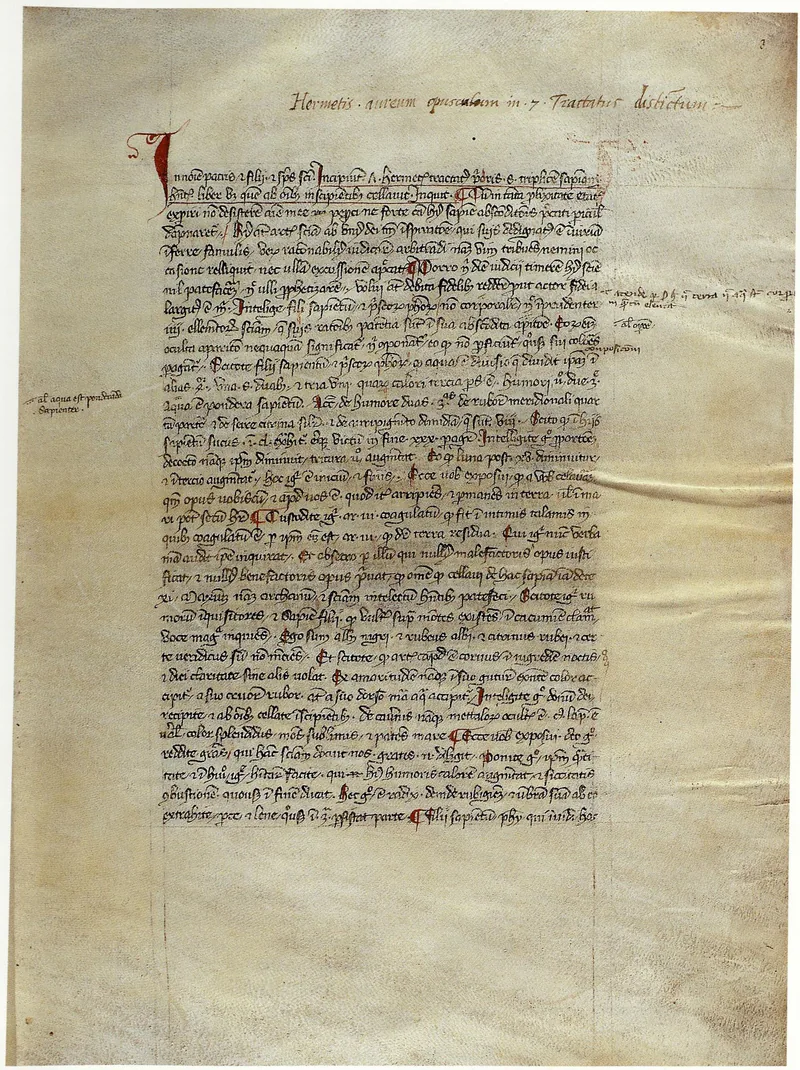
Before the Renaissance, Latin readers knew Hermes chiefly from the Asclepius, from scattered references in the Church Fathers, and from the Arabic-Latin technical works. Twelfth-century writers cited "Mercurius" or "Hermes Mercurius Triplex" as a philosopher who had reached knowledge of God by reason. A short theological work, the Book of the Twenty-Four Philosophers, containing the definition of God as an infinite sphere whose centre is everywhere and circumference nowhere, came to be attributed to Hermes in some manuscripts. Alchemists treated him as the founder of their art, which is why alchemy is still called the "Hermetic art" and why a vessel sealed airtight is "hermetically sealed".
The Renaissance Prophet: Ancient Theology§
The Florentine rediscovery of the Greek Corpus Hermeticum transformed his reputation. In 1463 Marsilio Ficino, at Cosimo de' Medici's request, set aside his translation of Plato to render the newly arrived Hermetic treatises into Latin. In his preface Ficino placed Hermes in a chain of "ancient theologians" (prisci theologi) running through Orpheus, Aglaophemus, Pythagoras and Philolaus to Plato, all of whom were thought to have shared, in veiled form, a wisdom compatible with Christianity.
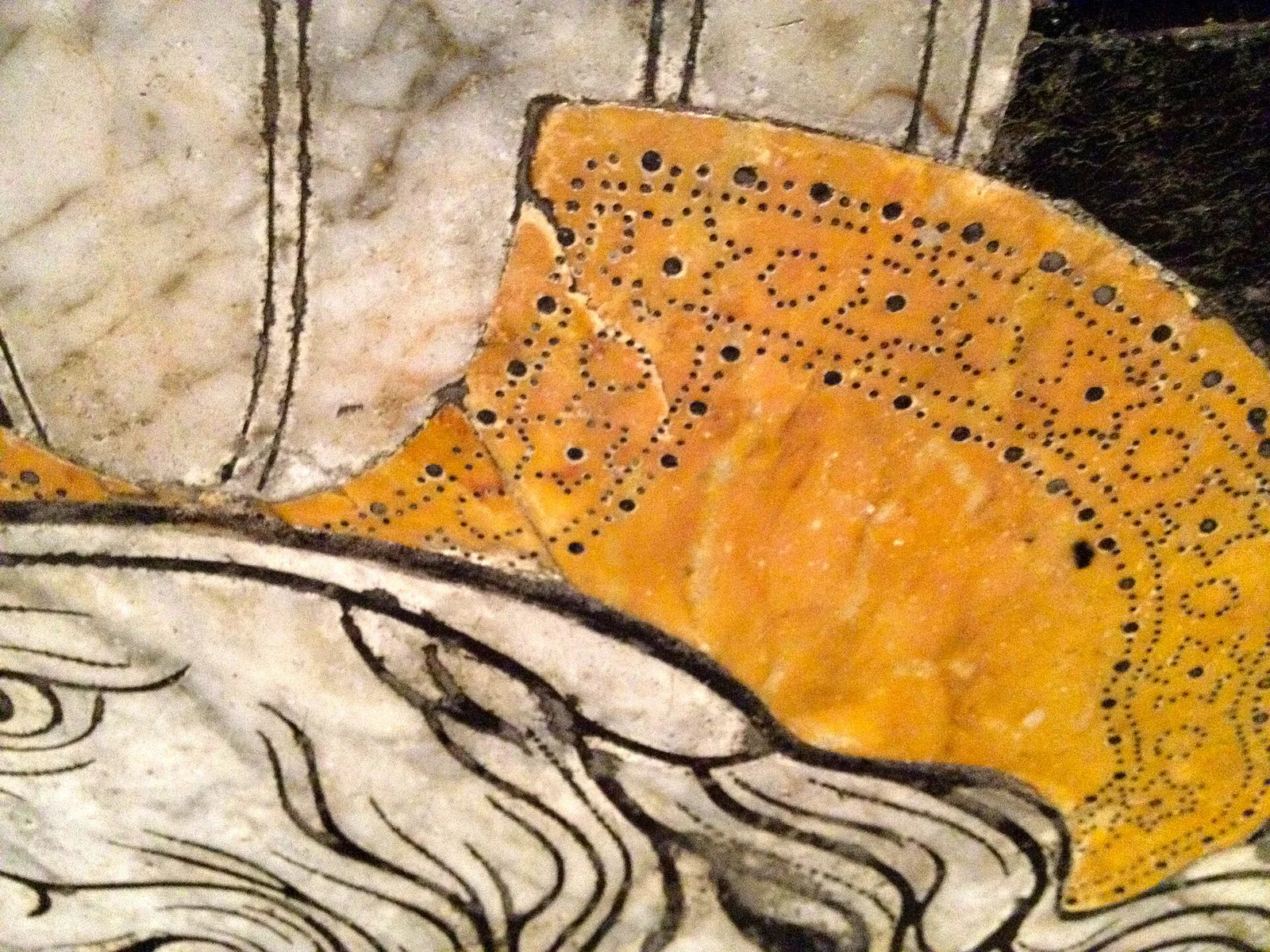
This idea of an ancient theology made Hermes a near-contemporary of Moses and a pagan prophet of the Trinity. The marble floor of Siena Cathedral, laid in the 1480s, shows him in the nave with an inscription calling him "contemporary of Moses". Ludovico Lazzarelli, Francesco Giorgi, Agrippa and many others drew on the same conviction, and it underlay much of what Frances Yates called the "Hermetic tradition" of Renaissance magic (see occult philosophy and the Renaissance magical cosmos).
Casaubon's redating§
In 1614 the Swiss-born classical scholar Isaac Casaubon published a long critique of the Catholic church historian Cesare Baronius. In it he examined the Greek of the Hermetica and showed that their vocabulary, philosophy and apparent knowledge of Christian and Platonic ideas placed them in the early centuries CE. Hermes could no longer be a contemporary of Moses. Casaubon's argument was not accepted everywhere at once, and Hermetic enthusiasts such as Robert Fludd and Athanasius Kircher continued to honour Hermes, but learned opinion gradually shifted.
Hermes in Modern Esotericism and Scholarship§
The nineteenth-century occult revival restored Hermes as a symbol of initiatic wisdom. The Hermetic Order of the Golden Dawn took his name, G. R. S. Mead published English translations of the Hermetica under the title Thrice-Greatest Hermes in 1906, and the anonymous Kybalion of 1908 presented a set of "Hermetic principles" that owe more to American New Thought than to the ancient texts.
Academic study took a different course. Early twentieth-century scholars, notably the French Dominican André-Jean Festugière, read the Hermetica as essentially Greek philosophy in Egyptian dress. Garth Fowden's The Egyptian Hermes (1986) and the work of Jean-Pierre Mahé emphasised instead the genuinely Egyptian setting, and Christian Bull has argued that the figure of Hermes was modelled on the Egyptian priest-teacher of Roman times. Today Hermes Trismegistus is studied as a remarkably durable authorial persona, a name under which many unknown writers across two millennia placed their teachings.
Frequently asked questions§
Was Hermes Trismegistus a real person?§
There is no evidence that a single historical individual stood behind the name. Hermes Trismegistus is a figure of religious tradition and literary attribution: the Hermetic texts were written by various anonymous authors, mostly in Roman Egypt, who presented their teaching under his authority.
Why is Hermes called "thrice-great"?§
The epithet goes back to Egyptian honorific formulas in which Thoth was called "great, great" or "great, great, great". Greek speakers condensed this into trismegistos. Later writers offered symbolic explanations, such as mastery of three kinds of wisdom or the three parts of the Hermetic work.
Is Hermes Trismegistus the same as Thoth?§
He originates in the identification of Thoth with Hermes, so the two are closely linked. In the Hermetic writings, however, he usually appears not as a god but as an ancient sage or priest who received and passed on divine knowledge.
Why is Hermes identified with Idris and Enoch?§
Medieval Arabic scholars associated the ancient founder of the sciences with Idris, a prophet mentioned in the Qur'an, and with Enoch, the biblical patriarch said to have been taken by God. This identification made Hermes acceptable as a monotheist prophet and explained how scientific knowledge survived the Flood.
Sources and further reading§
- The Egyptian Hermes — Garth Fowden, 1986
- The Tradition of Hermes Trismegistus: The Egyptian Priestly Figure as a Teacher of Hellenized Wisdom — Christian H. Bull, 2018
- The Arabic Hermes: From Pagan Sage to Prophet of Science — Kevin van Bladel, 2009
- The Secret History of Hermes Trismegistus: Hermeticism from Ancient to Modern Times — Florian Ebeling, 2007
- Hermetica: The Greek Corpus Hermeticum and the Latin Asclepius — Brian P. Copenhaver, 1992
- Giordano Bruno and the Hermetic Tradition — Frances A. Yates, 1964
- Thrice-Greatest Hermes — G. R. S. Mead, 1906