Liber XII · Hermeticism · Chapter IV: Emerald Tablet
Secretum Secretorum: The Pseudo-Aristotelian Secret of Secrets
The Secretum secretorum explained: an Arabic mirror for princes posing as Aristotle's letter to Alexander, with medicine, magic and the Emerald Tablet.

The Secretum secretorum ("Secret of Secrets") is a medieval book of advice for rulers that presents itself as a letter from Aristotle to his pupil Alexander the Great. Compiled in Arabic as the Kitāb Sirr al-asrār, probably by the tenth century, and translated into Latin in the twelfth and thirteenth centuries, it mixed political wisdom with medicine, physiognomy, astrology, the virtues of stones and talismans, and in its longer versions the text of the Emerald Tablet. It became one of the most widely copied secular books of the Middle Ages.
What the Secret of Secrets Claims to Be§
The book opens with a frame story. Alexander, having conquered Persia, writes to his old teacher asking him to come to his side. Aristotle, now too old to travel, sends instead a book containing everything a ruler needs to know, written in part in riddles and symbols so that it will not fall into unworthy hands. A preface attributed to the translator, called Yahya ibn al-Bitriq, describes how he searched the temples of the ancient philosophers until he found the work in the shrine of the sun, written in gold, and translated it from Greek into Syriac and then into Arabic.
This is a literary device. The ninth-century Yahya ibn al-Bitriq was a real translator, but his name lends the text a borrowed authority, and no Greek original has ever been found. The theme of hidden wisdom recovered from an ancient temple links the Secretum to the Hermetic literature in which, as the Emerald Tablet relates, secret knowledge is discovered in the tomb or vault of Hermes Trismegistus.
Arabic Origins of the Sirr al-Asrar§
Scholars distinguish a shorter Arabic version, perhaps assembled in the tenth century from older Arabic and Persian advice literature, and a longer version that expanded it with medical, astrological and occult material. The work belongs to the genre of "mirrors for princes", popular in the Abbasid world, which drew on Persian court wisdom, Greek popular philosophy and Islamic ethics. Its Aristotelian frame suited a culture in which Aristotle was revered as the First Teacher and Alexander as a world conqueror and, in some traditions, a righteous king.
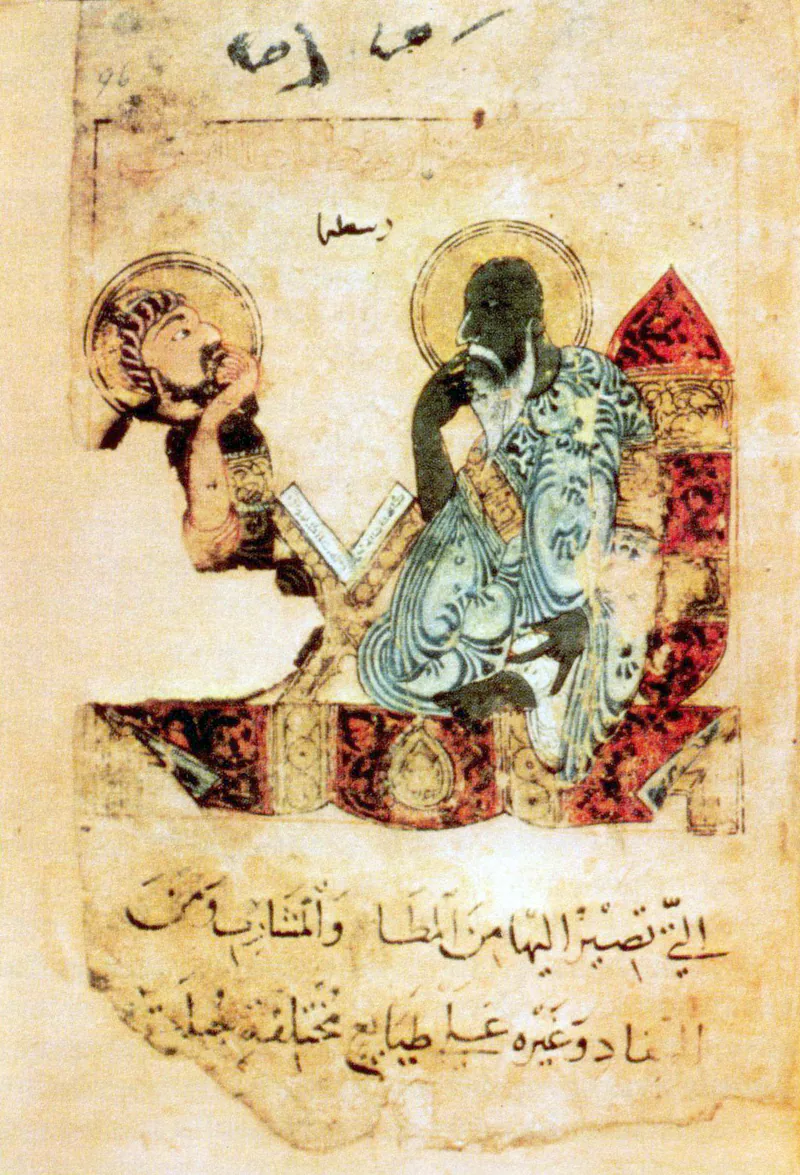
The compilers drew freely on Hellenistic and Arabic sources: Galenic medicine, popular astrology, physiognomic handbooks, lapidaries and Hermetic texts. Several elements, such as the story of an Indian queen who sent Alexander a beautiful girl nourished on poison from infancy, entered later European literature through the Secretum. The fluid, cumulative character of the work explains why manuscripts differ widely in length and arrangement. For the wider setting see our history of the Islamic occult sciences.
Contents: Kingship, Health and Physiognomy§
The core of the Secretum is political advice. Aristotle counsels Alexander to be generous but not prodigal, to keep his word, to protect the weak, to honour learning, to choose ministers carefully and to avoid both excessive familiarity and cruelty. A celebrated passage arranges the ideas of justice and order as a circle of eight maxims, each leading to the next, often drawn as a wheel in manuscripts: the world is a garden whose wall is the state, the state is upheld by law, the law by the king, the king by the army, the army by wealth, wealth by the people, the people by justice, and justice sustains the world.
The medical sections present a regimen for maintaining health. They explain the four humours, advise how to sleep, bathe, exercise and eat, and describe how the ruler should vary his diet across the four seasons, which are compared to the ages of life. This material circulated separately in the Middle Ages as a guide to health, and a partial Latin translation of it was one of the first parts of the work to reach Europe.
A further section teaches physiognomy, the art of judging character from the body. A ruler, the text argues, must read the faces of those around him: the shape of the eyes, forehead, nose and voice reveal loyalty, courage, greed or deceit. Medieval readers valued this as practical knowledge, and many later physiognomic treatises depend on it.
Hidden Sciences: Astrology, Stones and the Emerald Tablet§
In its longer forms the Secretum also teaches what it calls the secret sciences. The king is urged to consult astrology before acting, to choose favourable moments for war, journeys and medical treatment, and to understand the influence of the planets. Further chapters treat the occult virtues of precious stones and plants, a form of number divination by names (onomancy) for predicting the outcome of battles, and the making of images and talismans in accordance with the heavens, a practice described in detail in the Picatrix and in our guide to astral magic.

The most significant passage for Hermetic history is the text of the Emerald Tablet. In the long Arabic version and in the Latin translation of Philip of Tripoli, the Secretum includes the famous sayings attributed to Hermes, beginning with the declaration that what is below corresponds to what is above. This version differs in wording from the one transmitted in the twelfth-century Book of the Secrets of Nature attributed to Apollonius, and the comparison of the two has been essential to scholars tracing the Tablet's Arabic origins. Through the Secretum, the Tablet entered the reading of courtiers and physicians as well as alchemists (see western alchemy).
Latin Translators and Roger Bacon§
The medical section reached Latin first. In the twelfth century John of Seville, a translator active in Toledo, rendered it as a letter addressed to a Queen Theresa, probably Teresa of Portugal. The full work was translated by Philip of Tripoli, a cleric serving in the crusader states, who made his version from an Arabic manuscript found in Antioch, usually dated to the first half of the thirteenth century.
Philip's translation became the standard Latin text. The English Franciscan Roger Bacon prepared an annotated edition, probably in the mid-thirteenth century, adding glosses and an introduction in which he defended the work's scientific value and drew on its advice about astrology, medicine and the prolongation of life. Bacon's interest shows how seriously learned readers took the Secretum as genuine Aristotle, and his edition was published by Robert Steele in 1920.
Popularity in Medieval Europe§
Few medieval books were more widely read. Several hundred Latin manuscripts survive, and the work was translated into French, English, German, Italian, Castilian, Catalan, Dutch, Czech and other languages, as well as Hebrew. In Castile an independent translation from Arabic was known as the Poridat de las poridades. In England versions were made in prose and verse; the poet John Lydgate began a verse paraphrase, Secrees of Old Philisoffres, completed after his death by Benedict Burgh.
The book's success lay in its usefulness and its authority. It offered rulers a compact guide to statecraft and health, while its secret sections satisfied curiosity about hidden knowledge. Humanist scholars of the fifteenth and sixteenth centuries increasingly doubted its Aristotelian authorship, but it continued to be printed. Modern scholarship, notably the collection edited by W. F. Ryan and Charles B. Schmitt and Steven J. Williams's study of its scholarly reception, treats it as a key document of cultural transmission between the Islamic world and Latin Europe.
Frequently asked questions§
Did Aristotle write the Secretum secretorum?§
No. The book presents itself as Aristotle's letter to Alexander, but it was compiled in Arabic, probably in the tenth century, from a range of earlier sources. No Greek original exists, and modern scholars classify it as pseudo-Aristotelian.
What is the connection between the Secretum secretorum and the Emerald Tablet?§
The longer versions of the Secretum, including the Latin translation by Philip of Tripoli, contain a text of the Emerald Tablet attributed to Hermes. This made the Secretum one of the main channels through which the Tablet became known in medieval Europe.
Why was the Secret of Secrets so popular?§
It combined practical advice on government, health and judging people with the prestige of Aristotle and the attraction of hidden sciences. Its sections could be read separately, and it was translated into most European languages.
Sources and further reading§
- Secretum Secretorum: Nine English Versions — M. A. Manzalaoui, 1977
- Pseudo-Aristotle, The Secret of Secrets: Sources and Influences — W. F. Ryan & Charles B. Schmitt, 1982
- The Secret of Secrets: The Scholarly Career of a Pseudo-Aristotelian Text in the Latin Middle Ages — Steven J. Williams, 2003
- Secretum Secretorum cum Glossis et Notulis — Robert Steele, 1920
- The Arabic Hermes: From Pagan Sage to Prophet of Science — Kevin van Bladel, 2009
- Tabula Smaragdina: Ein Beitrag zur Geschichte der hermetischen Literatur — Julius Ruska, 1926