Liber XII · Hermeticism · Chapter IV: Emerald Tablet
Sabians of Harran: Star Worship, Hermes and Arabic Science
The Sabians of Harran: the last pagans of Mesopotamia, their planetary temples, Hermes as prophet, Thabit ibn Qurra and the debate over Hermetic transmission.

The Sabians of Harran were the pagan community of the city of Harran, in what is now south-eastern Turkey, who kept an ancient cult of the moon and the planets alive under Islamic rule until about the eleventh century. Medieval Arabic writers reported that they honoured Hermes and Agathodaimon as their prophets, built temples to the planets and produced some of the greatest scientists of the Abbasid age, above all Thabit ibn Qurra. Whether they were also a channel for Hermetic philosophy and astral magic is one of the most debated questions in the history of Hermeticism.
Harran, City of the Moon God§
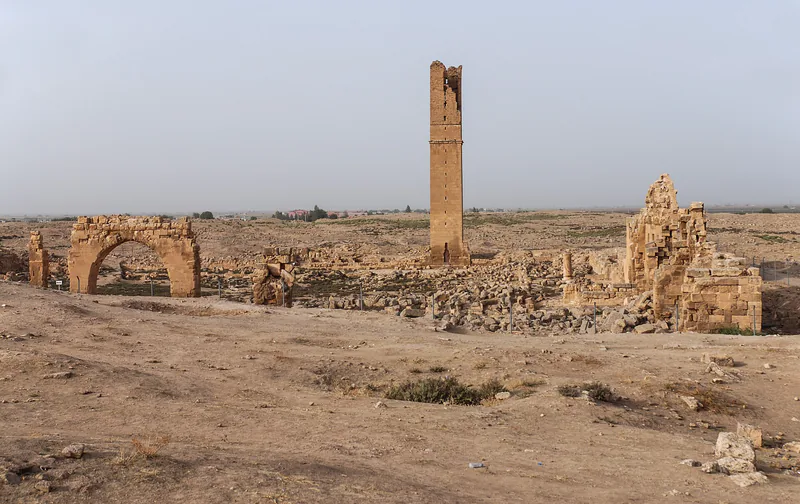
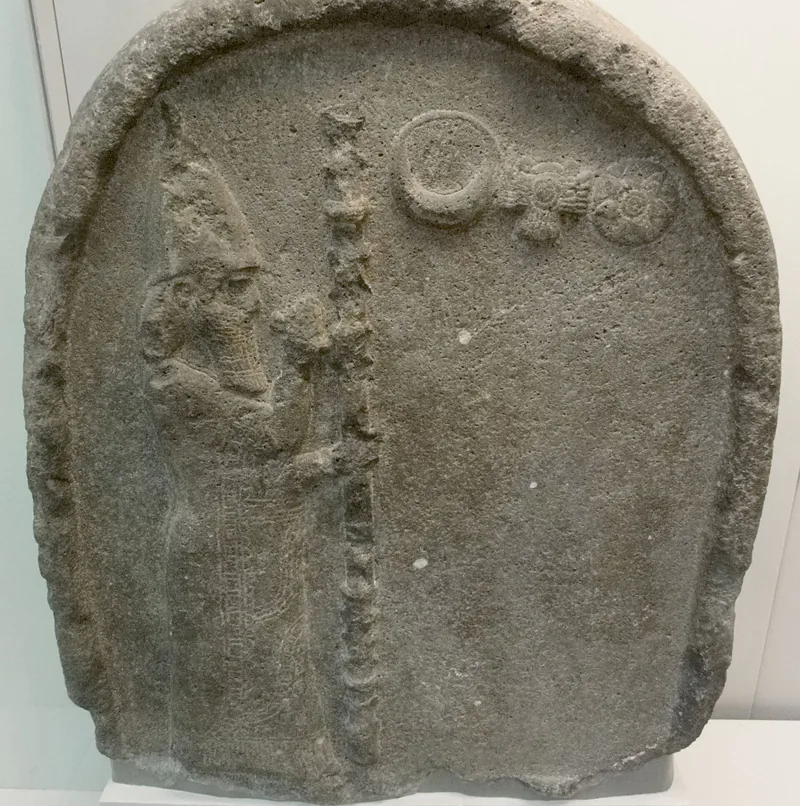
Harran lies on the plain south of Şanlıurfa (ancient Edessa), on an old trade route between Mesopotamia, Anatolia and Syria. The Bible names it as the place where Abraham's family settled after leaving Ur and where his father Terah died. In Mesopotamian religion it was the second great city of the moon god Sin, after Ur; his temple, called E-hulhul, was rebuilt by several Assyrian kings and by Nabonidus (r. 556–539 BCE), the last king of Babylon, whose mother was a devotee of Sin at Harran. Stelae of Nabonidus found at the site show the king before the emblems of the moon, the sun and the planet Venus.
The cult outlived the empires that had sponsored it. Under the name Carrhae, Harran was the site of the Roman general Crassus' disastrous defeat by the Parthians in 53 BCE. The emperor Caracalla was murdered in 217 CE on the road to Carrhae, where he was going to visit the temple of the moon, and the emperor Julian performed rites there in 363 on his way to war with Persia. When the surrounding region became Christian, with nearby Edessa as a centre of Syriac Christianity, Harran stayed largely pagan, and Syriac writers called it a city of heathens.
Sabians by Name: The Story of al-Ma'mun§
After the Arab conquest in the seventh century, Islamic law recognised Jews, Christians and "Sabians" (al-Ṣābi'ūn) as peoples of a revealed scripture, entitled to protection. The Qur'an mentions the Sabians three times without explaining who they were; the name probably referred originally to a baptising group such as the Mandaeans of southern Iraq.
The Fihrist of Ibn al-Nadim, a catalogue of books compiled in Baghdad in 987, preserves a famous story taken from a Christian author. In about 830 the caliph al-Ma'mun passed through Harran on campaign against Byzantium. Struck by the long hair and distinctive dress of some of the people who came to greet him, he asked their religion, and when they could not name a recognised faith he ordered them to become Muslims or adopt one of the religions of the Book before he returned. Some converted; others, advised by a jurist, declared themselves "Sabians", since the Qur'an named that community and no one could say exactly what it believed. Al-Ma'mun died on campaign in 833, and the name stuck.
Whatever the historical value of the anecdote, from the ninth century onwards the pagans of Harran were known as Sabians, and Muslim scholars used the term for star-worshipping pagans in general, distinguishing them only loosely from the Mandaean "Sabians of the marshes".
Hermes and Agathodaimon: Prophets of the Harranians§
Arabic writers who described Harranian religion repeatedly say that its prophets were Hermes and Agathodaimon. Agathodaimon, the "good spirit", had been a deity and a figure of Hermetic literature in Greco-Roman Egypt, where some texts present him as the teacher of Hermes. Muslim authors identified Hermes with the prophet Idris of the Qur'an and with the biblical Enoch, and Agathodaimon sometimes with Seth, the son of Adam.
One important report comes from the philosopher al-Kindi, preserved through his pupil al-Sarakhsi in the Fihrist. Al-Kindi described the Sabians as believing in one eternal First Cause, beyond all attributes, which governs the world through the celestial spheres and the planets. He also mentioned having seen a book they accepted, consisting of discourses of Hermes to his son on the unity of God, which he found to be close to philosophical monotheism.
This picture presents Harranian religion as a philosophical, Hermetic and Neoplatonic paganism, rather like the theology of late antique thinkers such as Iamblichus and Proclus. Some scholars accept it as an accurate account of the Harranian elite; others suspect that it reflects the way the Sabians presented themselves to Muslim rulers and intellectuals, and the way those intellectuals wished to see them. Claiming Hermes, whom Muslims honoured as Idris, as a prophet gave the community a respectable sacred history.
Planetary Temples and the Cult of the Stars§
The Arabic sources agree that the Harranians honoured the seven planets as the governors of the world below, each with its own day, colour, metal, incense and offerings. The historian al-Mas'udi (d. 956) reported that they had temples dedicated to higher principles such as the First Cause and the Intellect and to each of the planets, and that the temples were built in different geometrical shapes. Later writers, notably the geographer al-Dimashqi in the fourteenth century, gave fuller descriptions of seven planetary temples with their images, colours and rituals, though by then the cult had long ceased and his account may be partly literary.
The Fihrist preserves a calendar of Sabian festivals, fasts and sacrifices, and descriptions of prayers addressed to the planets. Several of these features resemble the planetary rites in the Picatrix, the great Arabic manual of astral magic, which includes prayers and ceremonies it attributes to the Sabians and other ancient peoples. For this reason Harran has long been seen as a possible source of the theory and practice of astral magic: the idea that each planet has a spirit who can be addressed with appropriate materials, at the right astrological moment, to draw down its influence.
How much of this reflects real Harranian practice is difficult to establish. The authors who described the Sabians were outsiders, writing at a time when "Sabian" had become a learned label for ancient star worship. Lurid accounts of exotic rites cannot be trusted without independent evidence.
Thabit ibn Qurra and the Sabian Scholars of Baghdad§
Harran's reputation rests above all on its scholars. Thabit ibn Qurra (c. 826–901), born there into a Sabian family, was brought to Baghdad by the Banu Musa brothers, wealthy patrons of science. He became one of the outstanding mathematicians and astronomers of his age: he translated and revised Greek works by Euclid, Archimedes, Apollonius of Perga and Ptolemy, wrote original studies in geometry and number theory (including a rule for finding amicable numbers), and worked in astronomy and mechanics. He also wrote in Syriac on the religion of his community and led the Sabians of Baghdad.
Thabit's treatise on talismanic images, which explains how images made at astrologically chosen times could act on the world, was translated into Latin in the twelfth century, by John of Seville and also by Adelard of Bath. It became one of the basic texts of medieval image magic, alongside the works of al-Kindi and the Picatrix.
Thabit's descendants formed a dynasty of Sabian physicians and scholars in Baghdad, among them his son Sinan and grandson Ibrahim ibn Sinan. The astronomer al-Battani (d. 929), known in Latin as Albategnius, came from a Sabian family of Harran, though he himself was a Muslim.
Harran and the Hermetic Tradition: A Debated Link§
For the nineteenth-century scholar Daniel Chwolsohn, who collected the sources in his great work Die Ssabier und der Ssabismus (1856), the Harranians were heirs of ancient Babylonian religion and a bridge between pagan antiquity and Islam. Later historians built on this view. Some suggested that Harran preserved Greek Hermetic writings and passed them to Arabic translators; the French scholar Michel Tardieu proposed that Platonist philosophers, after the closure of the school of Athens in 529, settled at Harran and founded a school that survived into the Islamic period.
These theories have been strongly contested. Tamara Green's study of Harranian religion stressed the continuity of local Mesopotamian and Syrian cults beneath a philosophical surface. Kevin van Bladel, in The Arabic Hermes (2009), argued that there is little firm evidence that Harran transmitted Hermetic texts, and that the Arabic legend of Hermes was shaped mainly by Sasanian Persian traditions of astrology and by Abbasid scholars. On this view, the Hermetic identity of the Sabians was in part an adaptation to the expectations of their Muslim neighbours.
What remains certain is that Harran was the last major centre of organised pagan worship in the Near East, that its scholars made a major contribution to Arabic science, and that medieval authors associated it with Hermes, the planets and astral magic. Those associations, true or exaggerated, shaped the image of Hermetic wisdom that passed into Latin Europe alongside texts such as the Secretum Secretorum and the Emerald Tablet.
Frequently asked questions§
Who were the Sabians of Harran?§
They were the pagan inhabitants of Harran in northern Mesopotamia who maintained a cult of the moon and the planets under Islamic rule. They adopted the Qur'anic name "Sabians" in the ninth century to be recognised as a protected religious community.
Did the Sabians of Harran worship Hermes?§
Arabic writers say they regarded Hermes and Agathodaimon as their prophets rather than as gods. Muslim scholars identified this Hermes with the prophet Idris, which helped the Sabians present their religion as revealed and respectable.
Are the Sabians of Harran the same as the Mandaeans?§
No. The Sabians mentioned in the Qur'an were probably a baptising community such as the Mandaeans of southern Iraq. The Harranians took the name later, and medieval authors used "Sabian" for both groups and for star worshippers in general.
What happened to the Sabians of Harran?§
Their temples and public worship disappear from the sources after about the eleventh century, and the city itself declined and was largely abandoned in the Mongol period. A Sabian scholarly community in Baghdad, founded by Thabit ibn Qurra, flourished for several generations before it too faded.
Sources and further reading§
- The City of the Moon God: Religious Traditions of Harran — Tamara M. Green, 1992
- Die Ssabier und der Ssabismus — Daniel Chwolsohn, 1856
- The Arabic Hermes: From Pagan Sage to Prophet of Science — Kevin van Bladel, 2009
- The Fihrist of al-Nadim — Bayard Dodge (trans.), 1970
- Thabit ibn Qurra: Science and Philosophy in Ninth-Century Baghdad — Roshdi Rashed (ed.), 2009
- Picatrix: The Latin Version of the Ghayat al-Hakim — David Pingree, 1986