Liber IX · Gnosticism · Chapter VII: Manichaeism & Mandaeism
The Mandaeans: Ginza Rabba, Baptism and the Last Gnostics
The Mandaeans explained: the Gnostic religion of Iraq and Iran, its Ginza Rabba and Book of John, baptism in living water, priests, death rites and diaspora.

The Mandaeans are a small ethno-religious community whose traditional homeland lies along the rivers and marshes of southern Iraq and the Iranian province of Khuzestan, and who are the only surviving religion directly descended from the Gnostic movements of late antiquity. Their faith, introduced alongside Manichaeism in the guide to Manichaeism and Mandaeism, centres on the World of Light, the soul's return to it, and frequent baptism in flowing "living" water; they honour John the Baptist (Yahia Yuhana) as their great prophet and priest. Their scriptures, above all the Ginza Rabba ("Great Treasure"), are written in Mandaic, a distinct dialect of Eastern Aramaic with its own script.
Who the Mandaeans Are§
Mandaeans call themselves Mandaiia, "knowers", and the most learned among them Nasuraiia, Nasoraeans, a term that today refers mainly to the priests. In Arabic they have long been known as Sabba or Subba, and since the Islamic period they have identified themselves with the Sabians mentioned in the Qur'an (Surah 2:62) as a people of scripture, a claim that secured them a degree of legal protection under Muslim rule.
Mandaeism is not an offshoot of Judaism, Christianity or Islam, though it shares figures and stories with all three. Mandaeans regard Adam as the first to receive their teaching, followed by a line of righteous ancestors including Shitil (Seth) and Shem. John the Baptist is honoured as a priest and healer who renewed the true baptism, but not as the founder of the religion. Abraham, Moses and Jesus appear in their literature mostly as figures who departed from the original faith. Membership is by birth to two Mandaean parents; the community does not seek converts.
Origins and History: From the Jordan to the Marshes§
The origins of the Mandaeans are one of the classic puzzles of the history of religions. A Mandaean text called the Haran Gawaita ("Inner Harran") tells of a migration of Nasoraeans from Jerusalem and the Jordan region, under the protection of a Parthian king, into the hills of "inner Harran" and then to Mesopotamia. Many scholars, including Kurt Rudolph, have taken this as a memory of a western origin in baptising sects around the Jordan in the first centuries CE, which would explain the religion's sacred word for any running water: yardna, "Jordan". Others argue that the community took shape in Mesopotamia and that the Jordan traditions were later additions.

What is clear is that the Mandaeans were established in southern Mesopotamia by late antiquity. Mandaic incantation bowls, comparable to the Jewish and Syriac incantation bowls of the same region, date from roughly the fifth to the seventh centuries, and some inscribed lead amulets may be older. The colophons of Mandaean manuscripts list chains of copyists reaching back to a scribe named Zazai d-Gawazta, whom Jorunn Buckley dates to the later third century. The earliest Manichaean psalms in Coptic appear to borrow from Mandaean hymns, which suggests that Mani, raised among a baptist sect in Mesopotamia, knew Mandaean or closely related traditions.
Under the Sasanians and then the caliphs, the community lived mainly in the marshes and river towns of the lower Tigris and Euphrates, working as boat-builders, silversmiths and goldsmiths. European travellers and missionaries in the seventeenth century took them for "Christians of Saint John". Serious study began in the nineteenth century, and the English scholar Ethel Stefana Drower, who lived among them in the 1920s and 1930s, recorded their rites and collected many manuscripts.
The Mandaean Scriptures: Ginza Rabba and the Book of John§
The Ginza Rabba is the largest and most authoritative Mandaean book. It is divided into two parts bound back to back. The Right Ginza contains cosmological, mythological and ethical tractates, accounts of creation, teachings on morality and the history of the world. The Left Ginza, written upside down relative to the Right, deals with the fate of the soul after death and its ascent to the World of Light, in a sequence of hymns and laments.
The Book of John (Drashe d-Malkia, "Discourses of the Kings", often called Drashe d-Yahia) collects teachings and legends, including a cycle about Yahia Yuhana. The Qolasta, edited by Drower as The Canonical Prayerbook of the Mandaeans (1959), gathers hymns and prayers for baptism and the death mass. In addition there are esoteric priestly commentaries, such as The Thousand and Twelve Questions, illustrated scrolls like the Diwan Abatur, which depicts the soul's journey through the purgatories, and the Book of the Zodiac, a work of astrology and omens.
Cosmology: The World of Light and the World of Darkness§
Mandaean cosmology has a clear two-level structure. Above is the World of Light, ruled by the Great Life (Hiia Rbia), also called the King of Light, surrounded by countless uthras, beings of light who dwell in heavenly dwellings beside celestial rivers. Below is the World of Darkness, ruled by the female spirit Ruha and her son Ur, a monstrous king of darkness, with the seven planets and twelve signs of the zodiac as her offspring.
Between them stands the material world, which was fashioned by a demiurgic uthra named Ptahil, acting at the command of his father Abatur, in a way that is flawed but not entirely evil. Adam's body was made by Ptahil and the dark powers, but his soul (nishimta) came from the World of Light. The saviour figure Manda d-Hiia ("Knowledge of Life"), together with Hibil Ziwa and other uthras, brings the saving knowledge that allows souls to return. The similarities with other Gnostic cosmologies are clear, but Mandaeism differs in valuing marriage, procreation and family life as religious duties, and in rejecting celibacy and asceticism.
Masbuta: Baptism in Living Water§
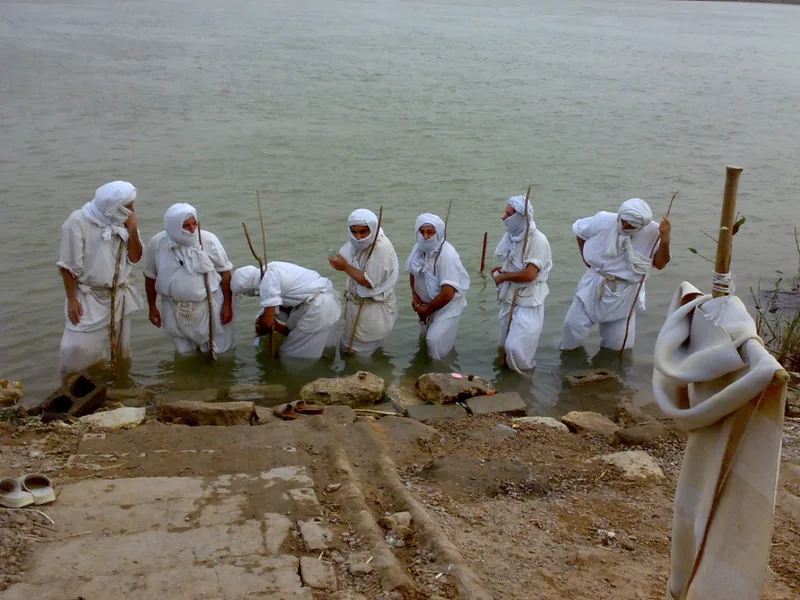
The heart of Mandaean practice is baptism. Unlike the once-for-all Christian sacrament, masbuta is repeated often: traditionally every Sunday for the devout, and on many occasions such as marriage, after childbirth or after contact with impurity. It must take place in flowing water, which Mandaeans see as a channel of life from the World of Light; still or stagnant water is unsuitable.
In the rite, the priest, dressed like the believers in a white cotton garment called a rasta, immerses the person three times, marks the forehead with water, and gives them water to drink, a sesame-oil anointing, a ritual meal of bread (pihta) and water (mambuha), and a "handshake of truth" (kushta). The banner called the drabsha, a cloth on a cross-shaped wooden frame, stands by the water during major rites. Shorter daily ablutions, rishama and tamasha, are performed by laypeople themselves. The Mandaean year includes a festival of five intercalary days, Parwanaya, when baptisms are especially frequent.
Priests, Death Rites and the Soul's Ascent§
Mandaean priests form a hierarchy: the tarmida (ordinary priest), the ganzibra ("treasurer", a senior priest) and, in principle, the rishama (head of the people), an office that has rarely been filled in modern times. Ordination is long and demanding, and priests must observe strict purity rules. The scarcity of trained priests has become a serious concern for the community.
Death is understood as the departure of the soul from the body on a journey of forty-five days through a series of maṭarta, "watch-stations" or purgatories, guarded by beings who test it, before it is weighed in the scales of Abatur and admitted to the World of Light. The priestly masiqta, "raising up", is the death mass that helps the soul on this journey through prayers, ritual meals and the creation of a new spiritual body. Food offerings for the dead (lofani) maintain a bond between the living and their ancestors.
The Mandaeans Today: War, Exile and Diaspora§
In the twentieth century most Mandaeans lived in Baghdad, Basra and the towns of southern Iraq, and in Ahvaz and other cities of Khuzestan. The draining of the southern marshes in the 1990s and, above all, the violence that followed the 2003 invasion of Iraq devastated the community: Mandaeans, unarmed by religious principle and conspicuous as goldsmiths, suffered kidnappings, killings and forced conversions. Most fled to Syria and Jordan and then onward to Sweden, Australia, the Netherlands, Germany, the United States and elsewhere.
Estimates of the worldwide population vary widely, often between about 60,000 and 100,000, with only a few thousand thought to remain in Iraq. In exile, Mandaeans have built new mandis (cult sites) beside rivers, trained priests, and worked with scholars to publish and translate their scriptures, as in the recent English translation of the Book of John by Charles Häberl and James McGrath. Their survival as a living tradition gives historians of Gnosticism a rare opportunity to see how an ancient religion of knowledge and light is actually practised.
Frequently asked questions§
Are the Mandaeans Christians?§
No. Mandaeans honour John the Baptist but do not regard Jesus as the Messiah or as divine, and their scriptures and rituals are independent of Christianity. Early European visitors called them "Christians of Saint John", but the label is a misunderstanding.
What is the Ginza Rabba?§
The Ginza Rabba, "Great Treasure", is the principal Mandaean scripture. It has two parts: the Right Ginza on creation, mythology and ethics, and the Left Ginza on the soul's ascent after death. It is written in Mandaic, a form of Eastern Aramaic.
Why do Mandaeans baptise so often?§
For Mandaeans, flowing water carries life and light from the World of Light, and baptism renews the believer's bond with it. Baptism is repeated on Sundays, at major life events and after impurity, rather than performed once.
Can someone convert to Mandaeism?§
Traditionally, no. Mandaeism is passed on by birth to two Mandaean parents, and the community does not accept converts. Marriage outside the community has long been a difficult issue in the diaspora.
Sources and further reading§
- The Mandaeans of Iraq and Iran — E. S. Drower, 1937
- The Canonical Prayerbook of the Mandaeans — E. S. Drower (trans.), 1959
- The Mandaeans: Ancient Texts and Modern People — Jorunn Jacobsen Buckley, 2002
- The Mandaeans: The Last Gnostics — Edmondo Lupieri, 2002
- Ginza: Der Schatz oder das große Buch der Mandäer — Mark Lidzbarski, 1925
- The Mandaean Book of John — Charles G. Häberl and James F. McGrath, 2020
- Gnosis: The Nature and History of Gnosticism — Kurt Rudolph, 1983