Liber IX · Gnosticism · Chapter VII: Manichaeism & Mandaeism
Mani, Prophet of Light: Life, Writings and Death of a Founder
Mani (216–c. 276), founder of Manichaeism: his Babylonian baptist youth, the Twin, his mission under Shapur I, the seven scriptures and his death in prison.

Mani (216–c. 276 CE) was a Babylonian religious teacher who founded Manichaeism, a missionary religion that spread from the Roman West to China and survived in places for more than a thousand years. Raised in a Jewish-Christian baptist community in southern Mesopotamia, he reported revelations from a heavenly "Twin", proclaimed himself the apostle of Jesus Christ and the final messenger after Zoroaster and the Buddha, and wrote his own scriptures to prevent the corruption he believed had befallen earlier religions. He died in prison under the Sasanian king Bahram I.
Evidence for the Life of Mani: Polemics and Discoveries§
Everything known about Mani comes from texts written by his followers or his opponents, and few are early. Until the twentieth century historians depended largely on hostile Christian and Muslim writers: the Acts of Archelaus (fourth century), which presents him as a charlatan defeated in debate; Augustine, who had been a Manichaean "hearer" for about nine years; and Arabic authors such as the bookseller Ibn al-Nadim, whose catalogue the Fihrist (987) preserves valuable Manichaean material, and the scholar al-Biruni.
Twentieth-century discoveries changed the picture. Manichaean manuscripts in Middle Persian, Parthian, Sogdian, Old Turkic and Chinese were recovered at Turfan and Dunhuang in Central Asia from 1902 onwards. In 1929 Coptic Manichaean codices were found at Medinet Madi in Egypt, including the Kephalaia, the Homilies and a Psalm-Book. From the 1990s, excavations at Kellis in the Dakhleh Oasis produced Manichaean letters and texts written by ordinary believers. The most remarkable find is the Cologne Mani Codex, a tiny parchment book (about 4.5 by 3.5 cm) of perhaps the fifth century, containing a Greek work titled On the Origin of His Body. Edited by Albert Henrichs and Ludwig Koenen from 1970, it assembles testimonies about Mani's youth from his early disciples.
Childhood Among the Babylonian Baptists§
Mani was born on 14 April 216, according to Manichaean tradition, in northern Babylonia near the Tigris and the twin capital Seleucia-Ctesiphon. His father, Pattikios (Patig), was said to come from Hamadan and to have joined a community that practised ritual washings, abstained from meat and wine and lived apart. When Mani was about four, his father took him into this community.

The Cologne Mani Codex identifies the group as followers of Elchasai (Alchasaios), a Jewish-Christian prophet of the early second century. They washed their food and themselves daily, worked the land and kept a strict law of purity. Mani's later religion owed much to this setting, including its Christian vocabulary, its concern with purity and its sense of the divine light trapped in food and plants. It also defined itself against it: in the codex, the young Mani questions the efficacy of washing the body, argues that true purity comes through knowledge, and refuses to harvest vegetables and fruit because they cry out in pain.
Revelations from the Twin§
Manichaean sources say that Mani received two decisive revelations, at the age of twelve and at twenty-four, from a heavenly being called his Twin (Greek syzygos, Arabic al-Tawm). The Twin was understood as his spiritual counterpart, sent by the Father of Greatness through Jesus, who revealed to him the mysteries of the cosmos: the original separation of Light and Darkness, the attack of Darkness, the mixture of the two in the present world and the future separation.
The second revelation, around 240, commanded him to leave the baptists and preach openly. When he challenged their practices, the community's elders put him on trial, and he left with a few followers, including his father. This break, narrated in detail in the Cologne codex, is the founding moment of the Manichaean Church. Mani understood himself in the light of earlier messengers: Seth, Enoch, Zoroaster, the Buddha, Jesus and the apostle Paul. He presented himself as the Paraclete promised by Jesus in the Gospel of John and as the last of the prophets, the "seal" of the series.
Mission, Shapur I and the Spread of the Religion§
Mani's first journey took him east by sea to India, probably to the region of Turan and Sind, around 240–242, where he encountered Buddhist communities and converted a local ruler, according to his followers. He returned at about the time that Shapur I became king of the Sasanian Empire (c. 240–242).
At the Sasanian Court§
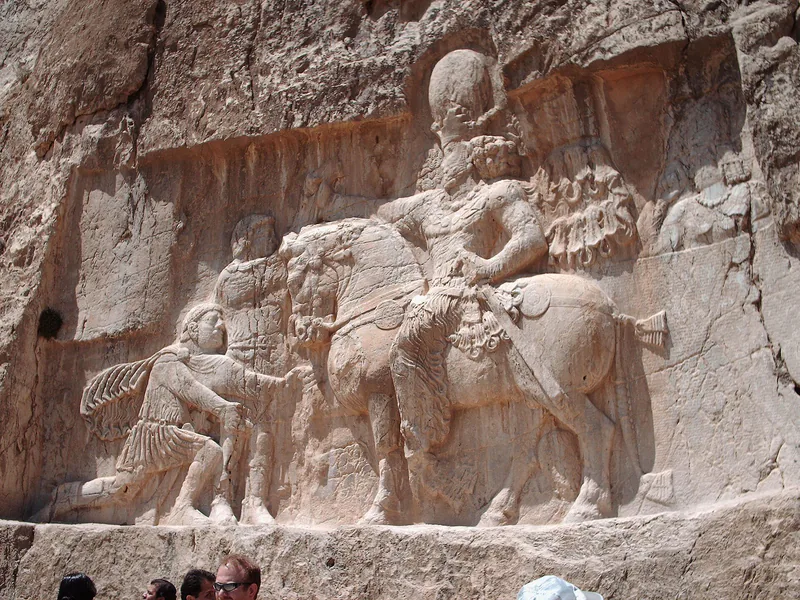
Mani won an audience with Shapur, perhaps through the king's brother Peroz, and gained his favour. For the king he wrote the Shabuhragan, the only one of his works in Middle Persian, which presented his teaching in terms familiar to a Zoroastrian audience, including the end of the world and the judgement. He seems to have travelled in the royal entourage for some years, and the king's protection allowed his missionaries to work throughout the empire.
Missions East and West§
Mani organised his followers into a hierarchy of elect and hearers, discussed in our guide to Manichaeism and Mandaeism, and sent disciples abroad. Adda and Pattikios went west to the Roman Empire, reaching Egypt; Mar Ammo went east to Parthia and the borders of Central Asia. Mani himself remained largely in Mesopotamia and Iran. His followers were trained to translate his teaching into the religious language of each region, using Christian terms in the West, Zoroastrian terms in Iran and Buddhist terms in the East, a strategy that helps explain both the religion's rapid spread and its later reputation as a syncretic faith.
The Writings of Mani and His Book of Pictures§
Mani was unusual among founders of religions in writing his own scriptures. He argued that the teachings of Zoroaster, the Buddha and Jesus had been distorted because those teachers did not write them down. The Manichaean canon, listed with slight variations in different sources, comprised seven works:
- The Living Gospel, arranged in twenty-two parts according to the letters of the Aramaic alphabet.
- The Treasure of Life.
- The Pragmateia (Treatise).
- The Book of Mysteries.
- The Book of Giants, which reworked the Jewish Enochic story of the giants born to the fallen Watchers.
- The Epistles, letters to communities and individuals.
- The Psalms and Prayers.
To these was added the Picture Book (Middle Persian Ardahang, Greek Eikon), a set of didactic illustrations of the cosmology. Persian and Islamic tradition later remembered Mani above all as a painter, and illuminated Manichaean manuscripts from Turfan show that the religion valued fine books and painting. All the original works were written in Eastern Aramaic (Syriac) apart from the Shabuhragan; today they survive only in fragments, quotations and translations.
Imprisonment, Death and Memory§
Shapur I died around 270 and his son Hormizd I continued to tolerate Mani, but under Bahram I (r. c. 273–276) the situation changed. The Zoroastrian priest Kerdir, whose inscriptions boast of suppressing Jews, Buddhists, Christians, Manichaeans and others, gained influence at court. Mani was summoned to the capital at Bēlābād (Gundeshapur), accused before the king, and imprisoned in chains.
According to Coptic Manichaean homilies, he died after twenty-six days in prison, around 274–277 (the exact year is debated). His body was mutilated and displayed. His followers called his death a crucifixion, not in the literal sense, but because they understood it as a passion like that of Jesus. They commemorated it each year at the Bema festival, at which an empty raised seat, the bema or throne of the teacher, stood at the centre of the assembly.
After his death the Manichaean Church faced intermittent persecution in Iran and the Roman Empire, yet it reached North Africa, where it attracted the young Augustine, and later the Uyghur kingdom in Central Asia, where it briefly became the state religion in the eighth and ninth centuries. In southern China it survived into the Ming period, and a shrine at Cao'an near Quanzhou still preserves a statue venerated as Mani, the Buddha of Light. Its dualism invites comparison with Zoroastrian dualism, and its view of the world with the Gnostic systems described in our overview of Gnosticism.
Frequently asked questions§
Was Mani a Christian?§
Mani called himself "apostle of Jesus Christ" and grew up in a Jewish-Christian community, and Christian elements are central to his teaching. Yet he also claimed to complete the work of Zoroaster and the Buddha and founded a separate church, so he is best seen as the founder of a new religion with deep Christian roots.
What is the Cologne Mani Codex?§
It is a miniature Greek parchment codex, probably of the fifth century, now in Cologne. It contains On the Origin of His Body, a compilation of accounts of Mani's youth among the Elchasaite baptists and his first revelations.
How did Mani die?§
He was imprisoned on the orders of the Sasanian king Bahram I, after opposition from the Zoroastrian priest Kerdir, and died in chains after some weeks, around 274–277. His followers commemorated his death at the annual Bema festival.
Did Mani meet Buddhists?§
Manichaean sources say he travelled to India early in his mission, and his teaching describes the Buddha as an earlier messenger of light. Later Manichaeans in Central Asia and China used Buddhist terms extensively, and some Chinese texts present Mani as a Buddha of Light; for the Buddhist account of the founder himself, see the life of the Buddha.
Sources and further reading§
- The Founder of Manichaeism: Rethinking the Life of Mani — Iain Gardner, 2020
- The Cologne Mani Codex: Concerning the Origin of His Body — Ron Cameron and Arthur J. Dewey (trans.), 1979
- Manichaeism in the Later Roman Empire and Medieval China — Samuel N. C. Lieu, 1985
- Manichaean Texts from the Roman Empire — Iain Gardner and Samuel N. C. Lieu, 2004
- The Kephalaia of the Teacher — Iain Gardner (trans.), 1995
- Gnosis on the Silk Road: Gnostic Texts from Central Asia — Hans-Joachim Klimkeit, 1993
- Mani's Pictures: The Didactic Images of the Manichaeans from Sasanian Mesopotamia to Uygur Central Asia and Tang-Ming China — Zsuzsanna Gulácsi, 2015