Liber XXXVI · Zoroastrianism · Chapter I: Ahura Mazda & Cosmic Dualism
Ahura Mazda and Ahriman: Zoroastrian Cosmic Dualism
Ahura Mazda and Ahriman in Zoroastrianism: the Wise Lord, the twin spirits, the Amesha Spentas, demons, the cosmic battle and the dualism debate.

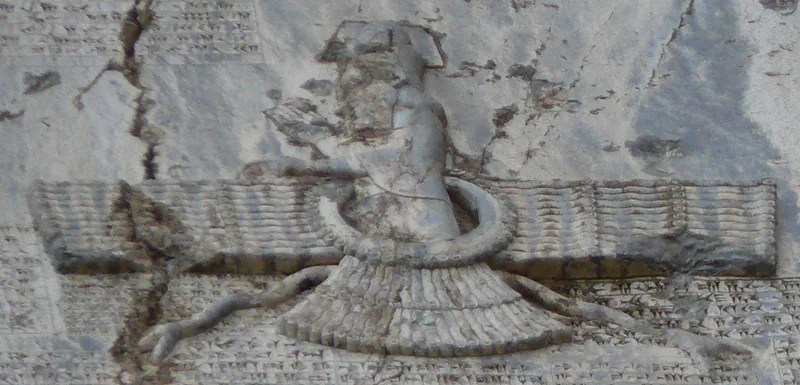
Ahura Mazda, the "Wise Lord", is the supreme God of Zoroastrianism: the uncreated, wholly good creator of light, life and order. Opposed to him stands Angra Mainyu, the "Destructive Spirit", known in later Persian as Ahriman, the source of darkness, disease, death and deceit. Zoroastrian teaching describes world history as the struggle between these two powers, in which every human being must take part, ending in the defeat of evil and the renewal of creation. This "cosmic dualism" is the religion's most distinctive and most debated idea.
Ahura Mazda: The Wise Lord§
The name combines ahura, "lord" — the same word as the Vedic asura, a class of powerful gods in early India — and mazda, "wise". In the Old Persian inscriptions of Darius I and his successors it appears as Ahuramazda, in Middle Persian as Ohrmazd and in modern Persian as Hormozd. In the Gathas of Zarathustra, Ahura Mazda is the creator who fixed the paths of sun and stars, the father of truth and of the Good Mind, and the judge who will reward each person according to their deeds (see Zarathustra and the Gathas).
Zoroastrians understand Ahura Mazda as wholly good and wise but, in the traditional theology of the Middle Persian books, not all-powerful in the sense of controlling evil: evil is an independent, hostile reality that Ahura Mazda did not create and will ultimately overcome. This is the key to the Zoroastrian answer to the problem of evil. A good God is not responsible for suffering; suffering is the work of an adversary, and the world is the battlefield on which he will be defeated.
The Twin Spirits and the Choice between Truth and the Lie§
The foundational passage is Yasna 30 of the Gathas, which speaks of two spirits, "twins", revealed in the beginning: one chose to think, speak and do the best, the other the worst. The good spirit is called Spenta Mainyu, the Bounteous or Holy Spirit; the evil one, Angra Mainyu, the Destructive Spirit. The ancient gods, the daevas, chose wrongly and became demons. Every person now faces the same choice, and on it depends whether they join the followers of asha, truth or right order, or of druj, the lie.
This emphasis on choice gives Zoroastrian dualism a strongly ethical character. Evil is not a fate imposed on human beings but something they can and must resist through good thoughts, good words and good deeds. Zoroastrians traditionally see work, marriage, raising children, farming and caring for animals as ways of strengthening the good creation, and they have generally rejected asceticism, fasting and celibacy as weakening it.
The Amesha Spentas and the Good Creation§
Ahura Mazda works through six divine beings, the Amesha Spentas ("Bounteous Immortals"), who in the Gathas appear as aspects of God and in later tradition as distinct archangel-like figures, each guarding one element of creation:
- Vohu Manah (Good Mind, Bahman) — cattle and animals.
- Asha Vahishta (Best Truth, Ardibehesht) — fire.
- Khshathra Vairya (Desirable Dominion, Shahrevar) — metals and the sky.
- Spenta Armaiti (Holy Devotion, Spendarmad) — the earth.
- Haurvatat (Wholeness, Hordad) — water.
- Ameretat (Immortality, Amordad) — plants.
Ahura Mazda himself, or his Bounteous Spirit, presides over the seventh creation, humankind. The Zoroastrian calendar names its months and days after these beings, and ritual brings together their elements, so that a priest at the fire, with water, plants, metal vessels and offerings from animals, gathers the whole good creation in worship (see Zoroastrian fire temples and ritual). Lesser divine beings, the yazatas, include Mithra, Anahita and Sraosha, guardian of prayer, while each righteous soul has a fravashi, a pre-existent guardian spirit.
Ahriman and the Demons§
Angra Mainyu, Ahriman, is in Zoroastrian thought pure negation: he does not create in the true sense but corrupts and destroys, producing "counter-creations" — darkness against light, drought against water, noxious creatures against useful ones, death against life. He commands an army of demons (daevas), among them Aeshma, wrath; Az, greed; Bushyasta, the demon of sloth who makes people oversleep; and Druj Nasu, the corpse demon, imagined as a fly that rushes upon a dead body, whose pollution underlies the Zoroastrian rules for the dead. Several archdemons, such as Indra and Saurva, bear the names of gods of the Vedic religion, reflecting an ancient divergence between Iranian and Indian traditions.
Some of these figures passed into other traditions. Many scholars derive the demon Asmodeus of the Jewish Book of Tobit from Aeshma daeva, the "demon Wrath"; his later history is told in Solomon and Asmodeus.
Cosmic History: Creation, Mixture and Renovation§
The Middle Persian Bundahishn ("Primal Creation") and related texts, compiled in the ninth and tenth centuries from older material, set out a full cosmic history lasting twelve thousand years. In the beginning Ohrmazd dwelt in endless light above and Ahriman in darkness below. Ohrmazd first created the world in a spiritual, invisible state (menog) and then in material form (getig), in seven stages: sky, water, earth, plants, the primordial bull, the first man Gayomard, and fire. Ahriman then broke into the creation, bringing death: the bull and Gayomard died, but from their seed came animals and the first human couple, Mashya and Mashyana, who grew from a rhubarb plant.
The present age is the time of "mixture", in which good and evil are entangled. The material world is therefore not a prison, as in Gnosticism, but a trap in which evil is caught and fought. At the end of time a saviour, the Saoshyant, born of a virgin from the preserved seed of Zarathustra, will raise the dead. All will pass through a river of molten metal, which will feel like warm milk to the righteous and purge the wicked; in the classic Pahlavi account even sinners are finally purified. Ahriman and his demons will be destroyed or rendered powerless, and the world will be made perfect and immortal in the Frashokereti, the "making wonderful".
Monotheism or Dualism? Interpretations Old and New§
Scholars and Zoroastrians themselves have long debated how to describe this theology. Ahriman is never worshipped, has no creative power and is destined for defeat, so Zoroastrianism is not a balanced dualism of two equal gods. Yet evil is real and independent, not a mere absence or a creature of God. Many scholars therefore speak of an ethical and eschatological dualism within a theism centred on Ahura Mazda.
In the nineteenth century, under pressure from Christian missionaries in Bombay who attacked the faith as dualistic, and influenced by the German scholar Martin Haug, who read the Gathas as strictly monotheistic, many Parsis came to interpret Angra Mainyu as a symbol of evil tendencies rather than a real being. Others maintain the traditional view.
In the Sasanian period another interpretation, Zurvanism, made Zurvan, infinite Time, the father of both Ohrmazd and Ahriman — a reading of the "twins" of Yasna 30. It is known mainly from hostile Armenian and Syriac Christian writers, such as the fifth-century Eznik of Kolb, and scholars disagree whether it was a separate sect or a current of speculation within Zoroastrianism; R. C. Zaehner devoted a major study to it in 1955.
The Legacy of Iranian Dualism§
Zoroastrian ideas have often been proposed as a source for beliefs in Judaism, Christianity and Islam: a cosmic adversary of God, armies of angels and demons, the judgement of individual souls, bodily resurrection, a final saviour and the transformation of the world. Jews lived under Persian rule from 539 BCE, and the Dead Sea Scrolls' war of the "sons of light" against the "sons of darkness" and the growing role of Satan in later Jewish writings (see the history of Satan and the Devil) are frequently cited as examples. Many scholars accept some influence; others stress internal Jewish development and the late date of most Zoroastrian sources. The most explicit heir of Iranian dualism was Manichaeism, founded in Sasanian Iran in the third century (see Manichaeism and Mandaeism).
Frequently asked questions§
Who is Ahura Mazda?§
Ahura Mazda, "Wise Lord", is the supreme God of Zoroastrianism, the uncreated creator of all good things. Zoroastrians pray to him facing a source of light, and he is the central figure of the Gathas of Zarathustra.
Is Ahriman the same as Satan?§
They are similar but not identical. Ahriman is an independent destructive spirit opposed to Ahura Mazda from the beginning, whereas in Judaism and Christianity Satan is a created being subordinate to God. Many scholars think Iranian ideas helped shape the developing figure of Satan.
What is Zurvanism?§
Zurvanism was a Sasanian-era interpretation that made Zurvan, infinite Time, the father of both Ohrmazd and Ahriman. It is known mainly from Christian polemical sources, and scholars debate how widespread it was.
Sources and further reading§
- Zurvan: A Zoroastrian Dilemma — R. C. Zaehner, 1955
- Dualism in Transformation: Varieties of Religion in Sasanian Iran — Shaul Shaked, 1994
- Cosmos, Chaos and the World to Come: The Ancient Roots of Apocalyptic Faith — Norman Cohn, 1993
- A History of Zoroastrianism, Volume I: The Early Period — Mary Boyce, 1975
- The Spirit of Zoroastrianism — Prods Oktor Skjærvø, 2011
- The Dawn and Twilight of Zoroastrianism — R. C. Zaehner, 1961