Liber XXXVI · Zoroastrianism · Chapter II: The Avesta
The Avesta: Zoroastrian Scripture, Its Books and History
The Avesta, scripture of Zoroastrianism: its Old and Young Avestan layers, the Yasna, Yashts and Videvdad, oral transmission and the Pahlavi books.
The Avesta is the collection of sacred texts of Zoroastrianism, written in Avestan, an ancient Iranian language known only from these scriptures. It includes the Gathas attributed to Zarathustra, the liturgy of the Yasna, hymns to the divine beings called the Yashts, and the Videvdad, a book of purity law. Composed over many centuries and transmitted orally by priests, it was written down only under the Sasanian kings around the fifth or sixth century CE, and much of it was later lost; what survives is chiefly the texts used in worship.
Old and Young Avestan: The Layers of the Scripture§
Avestan is an Eastern Iranian language, a sister of the Old Persian used in the inscriptions of the Achaemenid kings and a close relative of Vedic Sanskrit. The scripture contains two distinct stages of it. Old Avestan (or Gathic Avestan) is the language of the Gathas, the seventeen hymns attributed to Zarathustra, of the Yasna Haptanghaiti ("Worship in Seven Chapters") and of the most sacred short prayers, such as the Ahuna Vairya and Ashem Vohu. Scholars date this layer, like the prophet himself, to the second half of the second millennium BCE or soon after, though certainty is impossible (see Zarathustra and the Gathas).
Young Avestan is the language of most of the remaining texts, composed over several centuries, perhaps from the early first millennium BCE until the Achaemenid period. In the Young Avestan texts the older Indo-Iranian deities whom the Gathas hardly mention — Mithra, Anahita, Haoma, Verethraghna — reappear as yazatas, beings worthy of worship under Ahura Mazda, a development scholars interpret in different ways.
Oral Transmission and the Sasanian Avesta§
For most of its history the Avesta was a spoken, not a written, scripture. Priests memorised the texts word for word and recited them in ritual, and this oral tradition preserved even the archaic Gathas with remarkable fidelity, although the priests ceased to understand the language fully. Writing was associated in ancient Iran with administration rather than holy words.
Under the Sasanian dynasty (224–651 CE), priests created a special alphabet to record the Avesta's sounds precisely. Based on the Pahlavi script but adding many letters for vowels and consonants, it is among the most phonetically exact scripts of antiquity. Middle Persian sources, especially the ninth-century encyclopedia called the Denkard, describe a Sasanian Avesta of twenty-one nasks or books, summarising their contents in detail. A later Zoroastrian tradition held that an earlier Avesta, written in gold on ox-hides, was burned by Alexander the Great; historians regard this as a legend that expresses the trauma of conquest. The real losses came after the Arab conquest, when the community declined and manuscripts not needed for worship ceased to be copied. The oldest surviving Avestan manuscripts date only from around the thirteenth and fourteenth centuries.
The Yasna and Visperad: The Liturgical Core§
The Yasna ("worship" or "sacrifice") is the central text of the Avesta and the name of the main Zoroastrian high ritual, in which priests consecrate offerings of haoma (a pressed plant juice) and milk before the sacred fire. Its seventy-two chapters, called has, are recited in sequence during the ceremony; the number seventy-two is mirrored in the threads woven into the sacred cord, the kusti. The Gathas and the Yasna Haptanghaiti stand at its centre, framed by Young Avestan invocations, praises of the fire and the waters, and the Hom Yasht in honour of Haoma. The Visperad ("all the masters") is a collection of supplementary invocations added to the Yasna on festival days. How these texts function in worship is described in Zoroastrian fire temples and ritual.
The Yashts and the Khorda Avesta§
The twenty-one Yashts are hymns to individual divinities, and they preserve much of the mythology and epic tradition of ancient Iran. Among the most important are the Aban Yasht (Yasht 5) to Aredvi Sura Anahita, goddess of the waters; the Tishtar Yasht to the star Sirius, who battles the demon of drought to bring rain; the Mihr Yasht (Yasht 10) to Mithra, god of the covenant, one of the longest and most vivid, and an important source for the background of the Roman cult described in Mithra and Mithraism; the Fravardin Yasht (Yasht 13) to the fravashis, the guardian spirits of the righteous, which includes a long list of early believers; and the Zamyad Yasht (Yasht 19) on the khvarenah, the divine "glory" that passes from legendary kings to Zarathustra and finally to the future saviour.
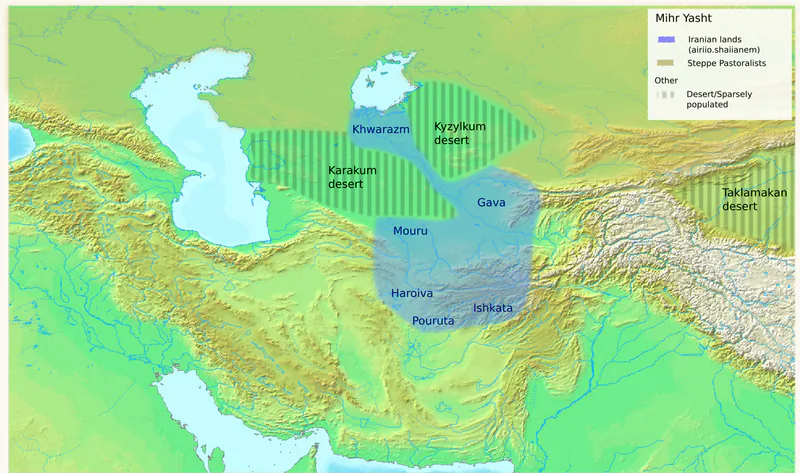
The Khorda Avesta ("Little Avesta") is a prayer book for laypeople and priests, compiled from Avestan and some Middle Persian texts. It contains the prayers for the five watches (gahs) of the day, the Nyayeshes or litanies to the sun, Mithra, moon, waters and fire, the Siroza listing the divinities presiding over the thirty days of the month, blessings and shorter Yashts. It is the part of the Avesta most Zoroastrians use daily.
The Videvdad: The Law against the Demons§
The Videvdad (from vi-daeva-data, "law against the demons", often spelled Vendidad) is a book of twenty-two chapters dealing mostly with ritual purity. It opens with a list of sixteen lands created by Ahura Mazda, each countered by a plague created by Angra Mainyu, and tells of the primeval king Yima, who built an enclosure (vara) to shelter the best of creatures from a terrible winter — a story often compared with the flood narratives of the Near East. Most of the book prescribes how to deal with impurity, above all that of corpses, and how to purify people and objects, including the long barashnom purification; it also honours the dog and sets out penalties for harming it. Recited during a night-time ritual, the Videvdad has been central to traditional practice; some modern reformist Zoroastrians question its authority, regarding its rules as later priestly accretions, while traditionalists defend it. Its purity laws underlie the customs described in Zoroastrian fire temples and ritual.
The Zand, Pahlavi Literature and the Western Discovery of the Avesta§
Because Avestan became a dead language, Sasanian priests produced the Zand, translations and commentaries in Middle Persian (Pahlavi). European scholars misread the combination "Avesta and Zand" as the name of a language, hence the old term "Zend-Avesta". Around the Zand grew a substantial religious literature in Pahlavi, mostly written down in the ninth and tenth centuries but preserving earlier traditions: the Bundahishn ("Primal Creation") on cosmology and the end of time, the Denkard, the Book of Arda Viraf describing a priest's visionary journey through heaven and hell, and the Menog-i Khrad ("Spirit of Wisdom"). These works are essential for understanding the theology outlined in Ahura Mazda and cosmic dualism.
The Avesta reached Europe through the French scholar Abraham Hyacinthe Anquetil-Duperron, who travelled to India in 1755, studied with Parsi priests in Surat and in 1771 published the first European translation. The linguist William Jones dismissed it as a forgery, but in the 1820s and 1830s Rasmus Rask and Eugène Burnouf showed that Avestan was a genuine ancient language related to Sanskrit. Karl Friedrich Geldner's critical edition (1886–96) remains a standard text, and English translations by James Darmesteter and L. H. Mills appeared in the Sacred Books of the East series between 1880 and 1887. An introduction to the religion as a whole is in What Is Zoroastrianism?
Frequently asked questions§
What is the holy book of Zoroastrianism?§
The Avesta is the sacred scripture of Zoroastrianism. Its most revered part is the Gathas, the hymns attributed to Zarathustra, which are embedded in the Yasna liturgy; the Khorda Avesta is the prayer book in everyday use.
Why is it called the Zend-Avesta?§
"Zend" comes from Zand, the Middle Persian translation and commentary that accompanied the Avestan text. Early European scholars mistook it for the name of a language, and "Zend-Avesta" became a common but inaccurate name for the scripture.
How much of the Avesta survives?§
Sasanian sources describe twenty-one books, and scholars estimate that only about a quarter of that Avesta survives, mainly the texts used in ritual and prayer. Summaries in the Pahlavi Denkard give an idea of what was lost.
Sources and further reading§
- The Zend-Avesta (Sacred Books of the East) — James Darmesteter & L. H. Mills (trans.), 1880
- Textual Sources for the Study of Zoroastrianism — Mary Boyce (ed.), 1984
- The Spirit of Zoroastrianism — Prods Oktor Skjærvø, 2011
- The Wiley Blackwell Companion to Zoroastrianism — Michael Stausberg & Yuhan Sohrab-Dinshaw Vevaina (eds.), 2015
- Zoroastrians: Their Religious Beliefs and Practices — Mary Boyce, 1979