Liber XXXVI · Zoroastrianism · Chapter III: Fire Temples & Ritual
Zoroastrian Fire Temples and Ritual: Sacred Fire and Purity
Zoroastrian fire temples and ritual explained: sacred fire, the Atash Bahram, priests and purity, the Yasna, the kusti prayer, death rites and festivals.

A Zoroastrian fire temple is a place of worship in which a consecrated fire is kept burning perpetually, tended by priests and honoured by worshippers as the visible symbol of Ahura Mazda's truth and light. Fire temples are the centres of a ritual life built around purity: priests perform the Yasna and other ceremonies, laypeople pray before the fire, and every Zoroastrian carries out the daily kusti prayer. The highest grade of fire, the Atash Bahram, is enthroned in only nine temples in the world, eight in India and one in Iran.
Fire in Zoroastrian Belief§
Fire is the creation associated with Asha Vahishta, "Best Truth", one of the Amesha Spentas who serve Ahura Mazda (see Ahura Mazda and cosmic dualism). It is understood as the purest of the elements and as a living presence that pervades all creation, giving warmth and life. The Yasna liturgy addresses the fire as the son of Ahura Mazda, and Zoroastrians pray facing a source of light — the sun, the moon, a lamp or the sacred fire. Because fire is holy, it must never be polluted: Zoroastrians traditionally would not blow on a flame with the breath, throw refuse into it or allow it to touch dead matter. Outsiders have often described Zoroastrians as "fire-worshippers", a label that Zoroastrians reject; they worship Ahura Mazda, and fire is the symbol and channel of that worship.
The History of the Fire Temple§
Ancient Iranian worship seems originally to have centred on an open-air hearth fire. The Greek historian Herodotus, writing in the fifth century BCE, observed that the Persians had no temples, altars or images and sacrificed to their gods on mountain tops. Achaemenid reliefs show the king standing before a fire altar, but fire temples in the later sense are hard to identify before the late Achaemenid or the Parthian period. Mary Boyce suggested that the temple cult of fire developed partly as an orthodox response to the image-temples introduced for the goddess Anahita under Artaxerxes II in the fourth century BCE.
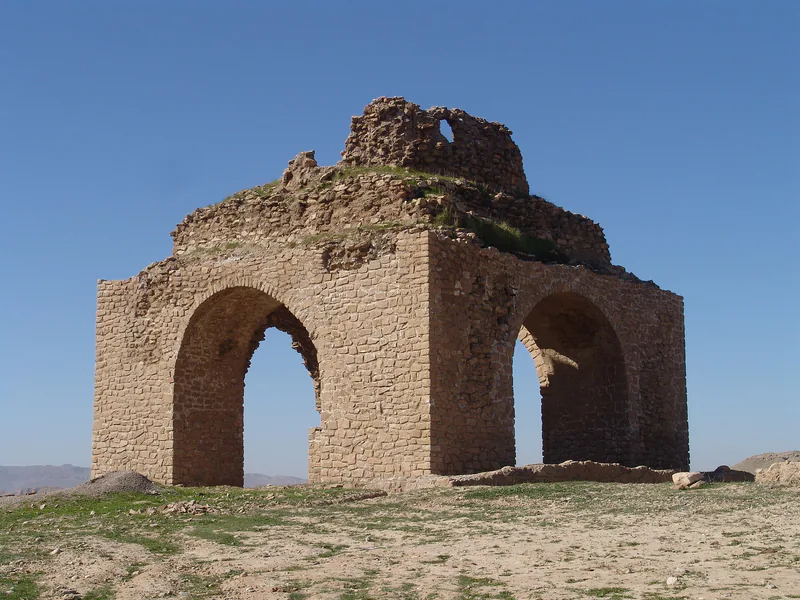
Under the Sasanian kings (224–651 CE) fire temples multiplied and became pillars of the state religion. Three great fires were especially famous: Adur Farnbag, associated with the priests; Adur Gushnasp, the fire of the warriors and kings, whose ruined sanctuary at Takht-e Soleyman in north-western Iran survives; and Adur Burzen-Mihr, the fire of the farmers. A typical Sasanian fire shrine was the chahar taq, a domed square pavilion open on four arches, many ruins of which still stand in Iran. After the Arab conquest most temples were converted or abandoned, and the surviving communities preserved their fires with great difficulty, sometimes carrying them from place to place.
The Grades of Sacred Fire§
Zoroastrians distinguish three main grades of consecrated fire. The Atash Bahram, "Fire of Victory", is the highest. It is created by gathering sixteen different fires — including fire from lightning, from a cremation pyre, and from the hearths of many trades — and purifying each through long, repeated ritual before uniting them; the whole process can take about a year and requires many priests. Once enthroned, it must be kept burning continually and tended by priests in a high state of purity. In India the most venerated is the Iranshah fire at Udvada in Gujarat, which according to Parsi tradition was first established by the refugees who came from Iran and has been housed at Udvada since 1742. The other Indian Atash Bahrams are at Navsari, Surat (two) and Mumbai (four); in Iran the Atash Bahram is at Yazd, where visitors can see the flame through a glass screen.
The Atash Adaran, "Fire of Fires", is consecrated from four fires, traditionally from the households of the four classes of society — priests, warriors, farmers and artisans — and is found in many towns. The Dadgah is the simplest grade, a consecrated fire that may be kept in a home or a small temple and tended by laypeople as well as priests.
In the sanctuary the fire burns in a large metal vessel on a stone stand, under a domed ceiling. Priests feed it with sandalwood (in India) or other dry wood and incense at each of the five watches of the day (gahs), in a short ceremony of prayer and bell-ringing called the boi. Worshippers bring sandalwood, bow before the fire and touch a little of its ash to their foreheads. In India entry to fire temples is restricted to Zoroastrians, a rule that some reformists have questioned.
Priests, Purity and the Inner Rituals§
The Zoroastrian priesthood is hereditary. Sons of priestly families are initiated in stages, the first being the navar ceremony; titles include ervad or mobed for priests and dastur for high priests. To perform the "inner" rituals, a priest must first undergo the barashnom, a purification lasting nine nights, and maintain a state of ritual purity; while tending the fire or performing ritual, priests cover their mouths with a cloth (padan) so that breath and saliva do not pollute the sacred elements.

The central inner ritual is the Yasna, performed in a special ritual precinct by two priests. During the recitation of the Yasna's seventy-two chapters, including the Gathas (see the Avesta), the chief priest prepares and consecrates the parahaoma, a liquid made by pounding twigs of the haoma plant with water, milk and pomegranate leaves, and offers it to the waters. Other inner rituals include the Visperad and the night-time Videvdad. "Outer" ceremonies, which may be performed in homes and halls, include the Jashan (thanksgiving) and Afrinagan (blessing), in which priests recite benedictions before a fire with offerings of fruit, flowers, milk and wine. The ancient priests who conducted such rites are the subject of the Magi.
Daily Prayer, the Kusti and Rites of Passage§
The most important lay ritual is the untying and retying of the kusti, the sacred cord of seventy-two threads of white lamb's wool wound three times around the waist over the white cotton undershirt, the sudreh. Zoroastrians perform this ritual on waking, before prayer, after using the toilet and before meals, untying the cord while reciting Avestan prayers, symbolically casting off evil, and retying it with knots at front and back that recall good thoughts, good words and good deeds. Prayers are said at the five gahs of the day.
Children are initiated into the faith, usually between the ages of seven and fifteen, in a ceremony called navjote among the Parsis and sedreh-pushi in Iran, at which a priest invests them with the sudreh and kusti. Weddings are performed by priests with Avestan blessings and the showering of rice; in both rites the presence of a lamp or fire marks the sacred character of the occasion.
Death, the Towers of Silence and the Festivals§
Because death is the work of Ahriman, a corpse is regarded as the most polluting of things, inhabited by the corpse demon Druj Nasu. Traditional Zoroastrian funerals therefore aimed to keep the body from contaminating earth, water and fire. After prayers and the sagdid, the "glance of the dog", which was believed to drive away the demon, the body was carried by specialist corpse-bearers to a dakhma or "tower of silence", an open circular stone structure where it was exposed to vultures and the sun; the bones were later gathered into a central pit. Prayers for the soul continue for three days, and on the fourth dawn the soul is believed to cross the Chinvat Bridge to judgement.
In Iran the use of dakhmas largely ended in the twentieth century, and burial in lined graves or cremation became common. In Mumbai the Doongerwadi towers are still used, but the collapse of India's vulture population since the 1990s has led to intense debate and to experiments such as solar concentrators; many Parsis now choose cremation or burial. These changes are part of the story told in Parsis and modern Zoroastrianism.
The Zoroastrian year includes six seasonal festivals, the gahambars, celebrated with communal meals; Nowruz, the New Year at the spring equinox; Khordad Sal, Zarathustra's birthday; the ten days of Muktad or Farvardigan at the end of the year, when the fravashis of the dead are welcomed with prayers and flowers; and, in Iran, the midwinter fire festival of Sadeh. Disagreements over the calendar have produced three reckonings — Shahenshahi, Kadmi and Fasli — so that communities sometimes celebrate the same feast on different days.
Frequently asked questions§
Why do Zoroastrians keep a sacred fire?§
Fire symbolises Ahura Mazda's truth, light and energy and is regarded as the purest of the elements. A consecrated fire provides a focus for prayer and a living presence of the sacred, so it is kept burning continually and protected from pollution.
Can non-Zoroastrians enter a fire temple?§
In India and in Parsi temples elsewhere, entry is traditionally restricted to Zoroastrians, though visitors may see the outside. In Iran rules are often more relaxed, and at the Atash Bahram in Yazd visitors can view the fire through a glass partition.
What are the towers of silence?§
They are circular stone structures, called dakhmas, in which Zoroastrians traditionally exposed their dead to vultures and the sun to avoid polluting earth and fire. Their use has declined sharply, though they remain in use in Mumbai.
Sources and further reading§
- The Religious Ceremonies and Customs of the Parsees — Jivanji Jamshedji Modi, 1922
- A Persian Stronghold of Zoroastrianism — Mary Boyce, 1977
- A Persian Offering: The Yasna, a Zoroastrian High Liturgy — Firoze M. Kotwal & James W. Boyd, 1991
- Zoroastrian Rituals in Context — Michael Stausberg (ed.), 2004
- Zoroastrians: Their Religious Beliefs and Practices — Mary Boyce, 1979