Liber XXXVI · Zoroastrianism · Chapter V: Mithra & Mithraism
Mithra and Mithraism: From Persian God to Roman Mysteries
Mithra, the Iranian god of the covenant, and the Roman mysteries of Mithras: the Mihr Yasht, the bull-slaying, the mithraeum and the seven grades.

Mithra is an ancient Indo-Iranian god of the covenant, honoured in Zoroastrianism as a yazata, a divine being worthy of worship, who watches over contracts, truth and the light of the sun. Under the Latin name Mithras he also became the god of a secret Roman mystery cult that flourished from the late first to the fourth century CE, whose initiates met in cave-like temples before an image of the god slaying a bull. How far the Roman cult really derived from Iranian religion is one of the classic debates in the history of religions.
Mitra and Mithra: The Indo-Iranian God of the Covenant§
The name goes back to the common heritage of the Indian and Iranian peoples. In the Rigveda, Mitra is usually paired with Varuna as a guardian of cosmic and social order. A treaty of about the fourteenth century BCE between the Hittite king Suppiluliuma I and the king of Mitanni in northern Mesopotamia invokes Mitra, Varuna, Indra and the Nasatyas as divine witnesses, showing that these gods were known well beyond India and Iran. The common noun mithra in Avestan means "covenant" or "contract", and the god is the personified power of the binding agreement, who sees whether it is kept or broken.
Mithra in the Avesta and Zoroastrian Worship§
Mithra is not named in the Gathas of Zarathustra, but in the Young Avestan texts he is one of the greatest yazatas, subordinate to Ahura Mazda (see the Avesta). The Mihr Yasht (Yasht 10), one of the longest and most vivid Avestan hymns, praises Mithra as "lord of wide pastures", with a thousand ears and ten thousand eyes, who rises over the mountains before the sun in a chariot drawn by white horses and smites the mithra-druj, the "deceiver of Mithra" who breaks a contract. Ahura Mazda himself is said to worship him. Mithra is linked with the sun and later in Middle and modern Persian his name, Mihr, also means "sun" and "love" or "friendship".
In Zoroastrian belief Mithra, together with Sraosha and Rashnu, judges the souls of the dead at the Chinvat Bridge. The autumn festival of Mehregan is dedicated to him, and Zoroastrian fire temples in India and Iran are often called Dar-e Mihr, "the Court of Mithra", because the god of truth presides over the ritual space and the oaths sworn there (see Zoroastrian fire temples and ritual).
Mithra in the Persian Empires and the Hellenistic East§
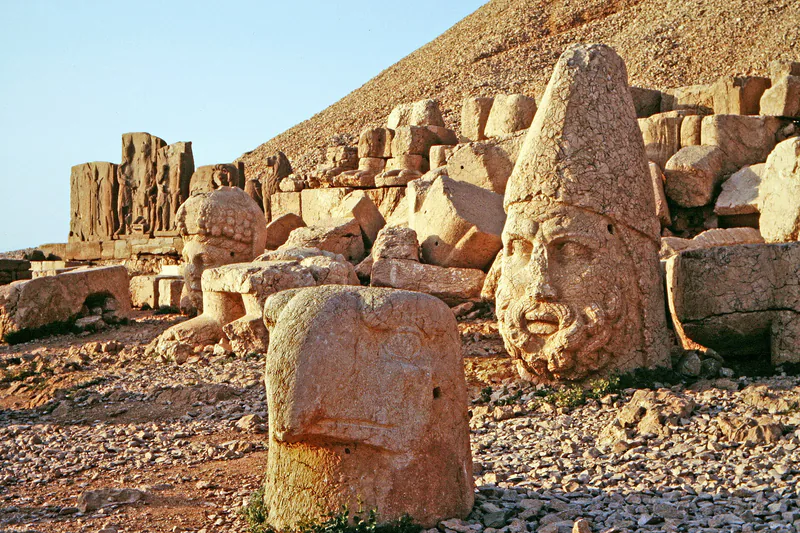
Mithra's name appears in many Persian personal names of the Achaemenid period, such as Mithradates. In the fourth century BCE Artaxerxes II became the first Persian king to invoke, alongside Ahuramazda, the deities Anahita and Mithra in his royal inscriptions. After Alexander, Iranian gods were blended with Greek ones in the kingdoms of Anatolia and the East. On the mountain sanctuary of Nemrut Dağ in Commagene (modern south-eastern Türkiye), King Antiochus I (first century BCE) erected colossal statues and reliefs showing himself shaking hands with a god called Mithras-Apollo-Helios-Hermes. Kushan coins from Bactria and north-western India depict a sun god labelled Miiro. In Armenia, Mihr remained a major god until Christianisation. In Manichaeism, which arose in Sasanian Iran, Mihr was used as a name for one of the divine emissaries of light (see Manichaeism and Mandaeism).
The Roman Mysteries of Mithras§
The Roman cult of Mithras appears suddenly in the evidence toward the end of the first century CE; the poet Statius, writing around 80–90 CE, alludes to Mithras twisting the horns of a bull in a Persian cave. It spread rapidly in the second and third centuries through the city of Rome and its port of Ostia, where more than a dozen meeting places have been found, and along the military frontiers of the Rhine, the Danube and Hadrian's Wall; the London Mithraeum, discovered on the Walbrook in 1954, is one of the best known. Its members were men only — no women are attested as initiates — and many were soldiers, imperial officials, merchants and freedmen.
Mithraists met in small groups of perhaps twenty to forty in a mithraeum, an artificial cave or vaulted underground room meant, according to the Neoplatonist Porphyry, as an image of the cosmos. Along each side ran raised benches on which the initiates reclined for ritual meals, re-enacting the feast that Mithras and the Sun shared after the slaying of the bull. At the far end stood the cult image. Inscriptions often address the god as Deus Sol Invictus Mithras, "the Unconquered Sun God Mithras".
Initiates passed through seven grades, known from a letter of St Jerome and from a mosaic in the Mithraeum of Felicissimus at Ostia, each under the protection of a planet: Raven (Corax, Mercury), Bridegroom (Nymphus, Venus), Soldier (Miles, Mars), Lion (Leo, Jupiter), Persian (Perses, the Moon), Sun-runner (Heliodromus, the Sun) and Father (Pater, Saturn). Initiation seems to have involved ordeals and symbolic acts, but because the cult left no scripture and its members kept its secrets, much about its rituals and doctrines is unknown. Its correspondences between grades and planets reflect the Greco-Roman astrology described in astrology.
The Tauroctony and the Meaning of the Mysteries§
The central image of every mithraeum is the tauroctony, the bull-slaying. Mithras, in Persian dress and Phrygian cap, kneels on a bull and plunges a dagger into its shoulder while looking away, often toward the Sun. A dog and a snake reach for the bull's blood, a scorpion attacks its genitals, a raven sits nearby, and ears of wheat often sprout from its tail. Two torch-bearers, Cautes with torch raised and Cautopates with torch lowered, flank the scene, with the Sun and Moon above. Other reliefs show Mithras born from a rock, carrying the bull, and banqueting with the Sun.
The great Belgian scholar Franz Cumont, whose collection of the monuments appeared in 1894–1900, interpreted the cult as Romanised Zoroastrianism and read the tauroctony through the Iranian myth in which the death of the primordial bull gives rise to plant and animal life. At the First International Congress of Mithraic Studies in Manchester in 1971, scholars such as Richard Gordon and John Hinnells challenged this view, noting that in Zoroastrian sources it is Ahriman, not Mithra, who kills the bull. Since then many have read the image astronomically: the bull, dog, snake, raven and scorpion correspond to the constellations Taurus, Canis Minor, Hydra, Corvus and Scorpius, and David Ulansey (1989) argued that the cult celebrated Mithras as a cosmic power responsible for the precession of the equinoxes. Roger Beck developed a sophisticated astral reading of the cult as a whole. These theories remain debated, but most scholars agree that Roman Mithraism was a new religion of the Roman Empire that used Persian names and imagery to claim ancient Eastern wisdom.
Mithras, Christianity and Modern Myths§
Early Christian writers such as Justin Martyr and Tertullian noticed resemblances between Mithraic rites and their own — a ritual meal of bread and a cup, a form of initiation — and explained them as demonic imitations. Christianity and Mithraism grew in the same empire, and the Roman feast of the Unconquered Sun on 25 December has been linked with the date of Christmas, though the relationship is debated. Popular modern claims that Mithras was born of a virgin, had twelve disciples or was crucified and resurrected have no basis in ancient evidence; in Roman iconography he is born from a rock. The cult declined in the fourth century as Christianity became the favoured religion of the emperors, and many mithraea were abandoned or destroyed.
A long Greek ritual text in the magical papyri, called the "Mithras Liturgy" by Albrecht Dieterich in 1903, describes an ascent to meet the god Helios Mithras; its relation to the Roman cult is disputed (see Greco-Roman magic). Mithraism has also attracted esoteric interpreters since the eighteenth century, from Masonic writers to modern Neoplatonists (compare Neoplatonism and theurgy). The living Iranian tradition of Mithra continues within Zoroastrianism, described in What Is Zoroastrianism?
Frequently asked questions§
Is Mithra the same as Mithras?§
They share a name and an ultimate origin: Mithras is the Greek and Latin form of the Iranian Mithra. But the Roman cult of Mithras differed greatly from Zoroastrian worship of Mithra, and most scholars treat it as a new religion that borrowed Persian imagery.
What is the tauroctony?§
The tauroctony is the image of Mithras slaying a bull, the central cult image of every Roman mithraeum. Its meaning is debated; interpretations range from an Iranian creation myth to a symbolic map of the constellations.
Could women join the cult of Mithras?§
No women are attested as members of the Roman Mithraic mysteries, which appear to have been open only to men. Women participated in other mystery cults of the period, such as those of Isis.
Is Mithra still worshipped today?§
Yes, within Zoroastrianism Mithra (Mihr) is still venerated as a yazata, especially at the festival of Mehregan, and fire temples are often called the "Court of Mithra". The Roman mysteries died out in late antiquity.
Sources and further reading§
- The Mysteries of Mithra — Franz Cumont, 1903
- The Origins of the Mithraic Mysteries: Cosmology and Salvation in the Ancient World — David Ulansey, 1989
- The Roman Cult of Mithras: The God and His Mysteries — Manfred Clauss, 2000
- The Religion of the Mithras Cult in the Roman Empire: Mysteries of the Unconquered Sun — Roger Beck, 2006
- Mithraic Studies — John R. Hinnells (ed.), 1975
- The Avestan Hymn to Mithra — Ilya Gershevitch, 1959