Liber VII · Divination · Chapter I: Astrology
Astrology: A Complete Guide to Its History and Techniques
Astrology explained: Babylonian omens, Hellenistic horoscopes, Ptolemy, Abu Ma'shar, Lilly and modern psychological astrology, with its branches and methods.
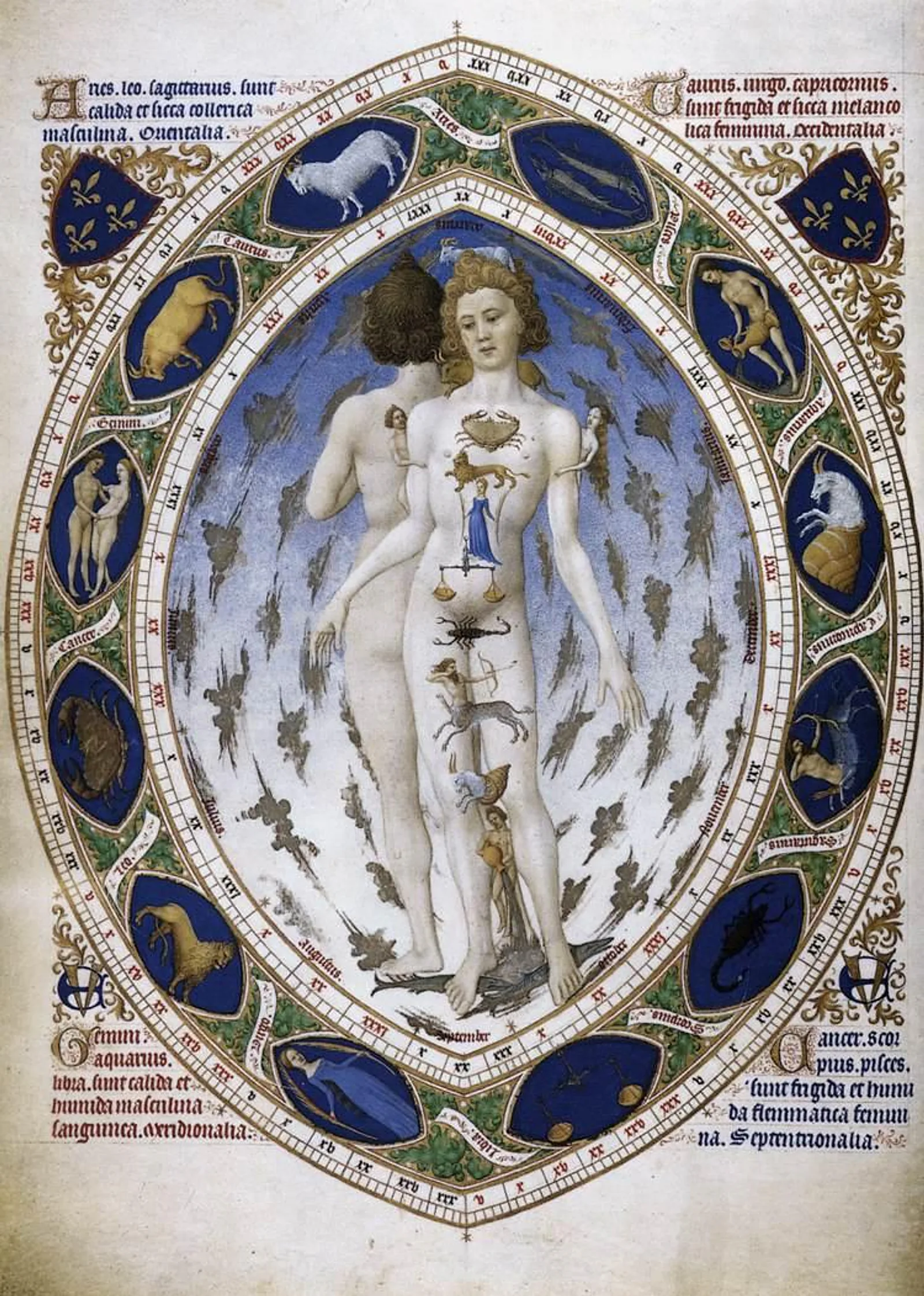
Astrology is the practice of interpreting the positions and movements of the Sun, Moon and planets as signs of events and character on earth. Its horoscopic form, which casts a chart for a precise moment and place, arose in Hellenistic Egypt in the last centuries BC from Babylonian celestial omens and Greek mathematical astronomy, and passed through Persian, Arabic, Latin and Indian hands to the many schools practised today.
From Babylonian Omens to the First Horoscopes§
Astrology's roots lie in the Mesopotamian conviction that the heavens are a kind of writing in which the gods signal coming events. Scribes compiled tens of thousands of celestial omens in the series Enūma Anu Enlil ("When Anu and Enlil"), concerned mainly with the king and the land: eclipses, the appearance of Venus, haloes around the Moon. In the first millennium BC Babylonian astronomers developed mathematical methods to predict planetary positions, and by about the fifth century BC they had divided the ecliptic into twelve equal signs of thirty degrees.
From this came the personal horoscope. The oldest known example, a cuneiform tablet for a child born in 410 BC, lists the positions of the planets at birth with brief predictions. These Babylonian birth notes lacked most of the apparatus of later astrology, but they established the idea that the sky at the moment of birth says something about a life.
Hellenistic Astrology and the Classical Synthesis§
The fully developed system appeared in Ptolemaic and Roman Egypt, where Babylonian astral science met Greek geometry, Egyptian calendrical lore such as the decans, and philosophical ideas of cosmic sympathy. Early texts circulated under the names of the legendary king Nechepso and priest Petosiris, and of Hermes Trismegistus. Its distinctive elements were the ascendant (the rising degree, in Greek hōroskopos), the twelve places or houses counted from it, the aspects between planets, and planetary rulership of signs, all explained in Zodiac & Planets.
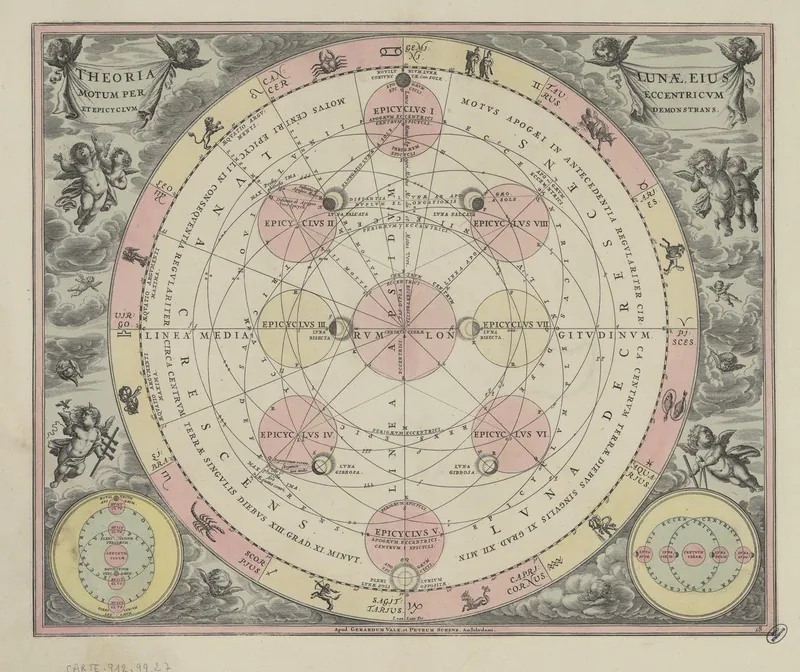
Several major authors survive:
- Dorotheus of Sidon (first century AD) wrote a verse handbook, preserved mainly in an Arabic translation, influential on later horary and electional practice.
- Vettius Valens (second century) compiled the Anthology, full of example charts from working practice.
- Claudius Ptolemy (second century), the astronomer of the Almagest, wrote the Tetrabiblos, which presented astrology as a natural science of celestial influence and became the most authoritative textbook in Europe and the Islamic world.
- Firmicus Maternus wrote the Mathesis (c. 335), the largest Latin astrological work of antiquity, shortly before he converted to Christianity.
Persian, Arabic and Medieval Latin Astrology§
Under the Sasanians and then the Abbasid caliphs, Greek and Indian astrology were translated and synthesised. Baghdad astrologers such as Māshāʾallāh (died c. 815) and Abū Maʿshar (787–886) developed historical astrology based on the conjunctions of Jupiter and Saturn, elaborated horary and electional methods, and wrote textbooks that entered Latin in the twelfth century through translators such as John of Seville and Hermann of Carinthia. Astral magic also flourished, as in the Arabic Ghāyat al-Ḥakīm, known in Latin as the Picatrix.
In medieval Europe astrology became part of university learning, tied to medicine and natural philosophy. Guido Bonatti's thirteenth-century Liber astronomiae was a standard compendium. Theologians accepted that the stars influenced bodies and weather but insisted that they could not compel the human will, a line drawn by Thomas Aquinas among others.
Renaissance Prestige and the Seventeenth-Century Decline§
Astrology reached a peak of prestige in the Renaissance. Popes and princes kept astrologers; Marsilio Ficino combined astrology with Neoplatonic medicine; and practical almanacs carried astrological forecasts to a wide readership. It also attracted powerful critics, notably Giovanni Pico della Mirandola, whose Disputations against Divinatory Astrology appeared posthumously in 1496. Johannes Kepler cast horoscopes and sought a reformed, physically grounded astrology even as his astronomy undermined the old cosmos.
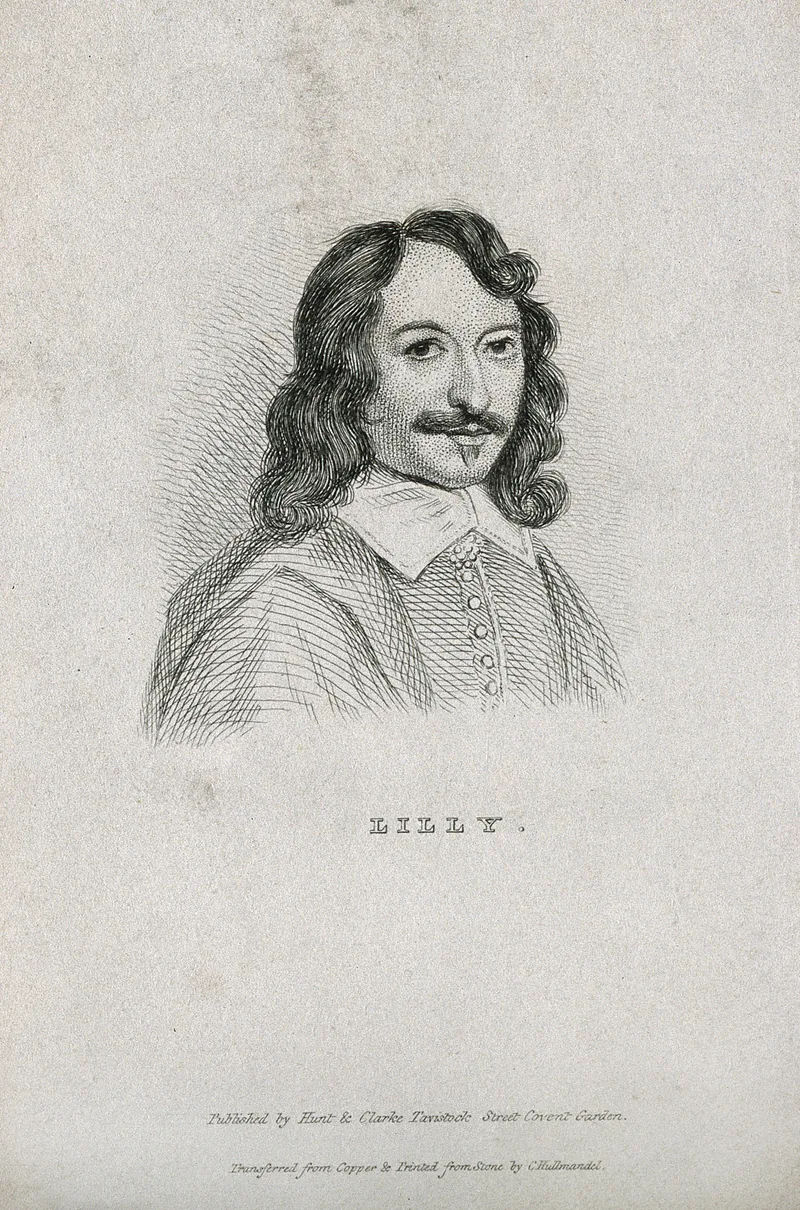
In England the Civil War period was the golden age of popular astrology. William Lilly (1602–1681) published Christian Astrology (1647), the first major astrological textbook in English, with a detailed exposition of horary practice. After the Restoration astrology lost its place among the learned, a decline historians connect to the new mechanical philosophy, the rise of scientific societies and changes in religious and political culture, though almanacs remained popular.
Branches of Astrology§
Traditional astrology is usually divided into several branches:
- Natal astrology (genethlialogy) interprets the chart for a person's birth, covering character, health, wealth, relationships and the timing of life events.
- Horary astrology answers a specific question from a chart cast for the moment it is asked or received.
- Electional astrology chooses an auspicious moment to begin an undertaking, such as a marriage, coronation or voyage.
- Mundane astrology deals with nations, weather, epidemics and history, often through eclipses, ingresses and great conjunctions.
- Medical astrology linked parts of the body to signs (the "zodiac man") and timed treatments such as bloodletting.
Related to these is the reckoning of planetary hours, in which each hour of day and night is ruled by one of the seven classical planets; the site's Almanac calculates them for any location.
Tropical and sidereal zodiacs§
Because of the precession of the equinoxes, the signs measured from the spring equinox (the tropical zodiac, standard in Western astrology) have drifted by roughly twenty-four degrees from the constellations of the same names. Indian astrology uses a sidereal zodiac tied to the stars, which is why a person's sign often differs between the two systems; see Vedic Astrology.
Modern Astrology and Its Critics§
Astrology revived in the late nineteenth century within occult and theosophical circles. The English astrologer Alan Leo (1860–1917) simplified chart interpretation and recast it in terms of character and spiritual evolution. In the twentieth century, Dane Rudhyar's The Astrology of Personality (1936) and the influence of Carl Jung shaped a psychological astrology concerned with personality and growth rather than events. Newspaper sun-sign columns, beginning in Britain in 1930, made astrology a mass phenomenon; their story is told in Horoscopes: A Complete Guide.
Other twentieth-century developments include the Hamburg school and its midpoints, the use of asteroids and newly discovered bodies, and, from the 1980s and 1990s, a revival of Hellenistic and medieval methods by translation projects that made the older texts available in English.
Scientific evaluation has been consistently negative. Controlled studies, including Shawn Carlson's double-blind test published in Nature in 1985, found that astrologers could not match charts to personality profiles better than chance, and no physical mechanism for astrological influence is known. Michel Gauquelin's statistical claims about planetary positions and professions remain disputed. Practitioners respond in different ways: some defend predictive astrology, while others treat the chart as a symbolic language for reflection. Historians, meanwhile, study astrology as a major strand of Western science, religion and culture for two millennia. You can calculate your sign under several systems with the site's Western horoscope calculator.
Frequently asked questions§
Where did astrology originate?§
Celestial divination began in Mesopotamia, where omens from the sky were recorded from the second millennium BC. Horoscopic astrology, with the ascendant, houses and aspects, developed in Hellenistic Egypt in the last two or three centuries BC, combining Babylonian, Greek and Egyptian elements.
What is the difference between astrology and astronomy?§
Today astronomy is the physical science of celestial bodies, while astrology interprets their positions as meaningful for human life. Before the seventeenth century the two were closely linked, and many astronomers, including Ptolemy and Kepler, also practised astrology.
What is horary astrology?§
Horary astrology answers a specific question using a chart cast for the moment the question is asked. It was developed by Arabic-language astrologers and became a speciality of seventeenth-century English practitioners such as William Lilly.
Is astrology scientifically proven?§
No. Controlled tests have not found that astrological predictions or character readings perform better than chance, and no known mechanism would explain such influence. Astrology is best understood historically as a system of interpretation with a long and influential tradition.
Sources and further reading§
- Tetrabiblos — Claudius Ptolemy, 2nd century (trans. F. E. Robbins, 1940)
- Christian Astrology — William Lilly, 1647
- Ancient Astrology — Tamsyn Barton, 1994
- A History of Horoscopic Astrology — James Herschel Holden, 1996
- Babylonian Horoscopes — Francesca Rochberg, 1998
- Hellenistic Astrology: The Study of Fate and Fortune — Chris Brennan, 2017
- A History of Western Astrology — Nicholas Campion, 2008–2009
- The Astrology of Personality — Dane Rudhyar, 1936