Liber IX · Gnosticism · Chapter VIII: Nag Hammadi Texts
Gospel of Mary: Mary Magdalene's Lost Gospel and Its Meaning
The Gospel of Mary explained: the Berlin Codex and Greek fragments, Mary Magdalene's vision, the soul's ascent past the powers, and her dispute with Peter.

The Gospel of Mary is an early Christian dialogue gospel, probably composed in Greek in the second century, in which Mary, almost certainly Mary Magdalene, comforts the grieving disciples after Jesus's departure and reveals a teaching he gave her privately about the ascent of the soul. Its fullest copy is a fragmentary Coptic text in the Berlin Codex (Papyrus Berolinensis 8502), with two small Greek fragments from the third century. Barely half of the work survives, but its portrait of Mary as a favoured disciple, and of Peter's resentment of her, has made it one of the most discussed non-canonical texts.
The Berlin Codex and the Greek Fragments§
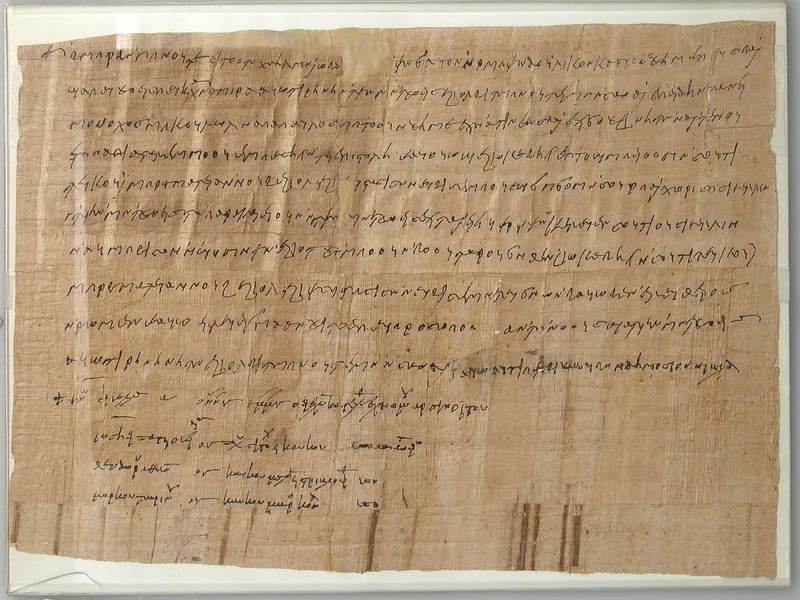
In 1896 the German scholar Carl Reinhardt bought a papyrus book in Cairo and brought it to the Egyptian Museum in Berlin, where it received the number 8502. The codex, copied in the Sahidic dialect of Coptic and usually dated to the fifth century, contains four works: the Gospel of Mary, the Apocryphon of John, the Sophia of Jesus Christ and a short Act of Peter.
Publication was delayed for more than half a century. Carl Schmidt prepared an edition, but a printing was destroyed by a burst water pipe, and then came two world wars. Walter Till finally prepared the text for publication, but when the Nag Hammadi library was discovered in 1945 it became clear that two of the Berlin works had further copies there, and Till waited to take them into account. His edition appeared in 1955, revised by Hans-Martin Schenke in 1972.
Two Greek fragments have since been identified. Papyrus Rylands 463, published in 1938, preserves part of the end of the gospel; Papyrus Oxyrhynchus 3525, published in 1983, preserves part of the middle. Both are dated to the early third century. Their wording differs at several points from the Coptic.
Contents: What Survives of the Gospel of Mary§
The Coptic manuscript begins on page 7. Pages 1 to 6 are missing, as are pages 11 to 14, so the reader enters in the middle of a conversation and loses the central part of Mary's vision.
The Saviour's Teaching on Matter and Sin§
In the first surviving section the risen Saviour answers questions from his disciples. Asked whether matter will be destroyed, he replies that all natures and creatures will be resolved back into their own root. Asked by Peter what the sin of the world is, he answers that there is no sin as such, but people produce sin when they act according to the nature of adultery, by which he appears to mean the mixing of the spiritual with what is alien to it. He then greets them with peace, warns them against those who say "Look here" or "Look there", tells them that the Son of Man is within them, and sends them to preach. Notably, he tells them not to lay down any rule beyond what he has commanded, nor to give a law like the lawgiver.
Mary Comforts the Disciples§
After he departs, the disciples weep and are afraid: if the authorities did not spare him, how will they be spared? Mary stands up, greets them, and tells them not to weep or be irresolute, because his grace will be with them and protect them. She turns their hearts towards the good, and they begin to discuss his words.
Mary's Vision of the Mind§
Peter then asks her, as the woman whom the Saviour loved more than other women, to tell them the words she remembers which they have not heard. Mary describes a vision in which she saw the Lord and asked him whether a visionary sees through the soul or through the spirit. He replies that one sees through neither, but through the mind (nous) which is between the two. At this point the manuscript breaks off.
The Ascent of the Soul Past the Four Powers§
When the text resumes, Mary is describing the journey of a soul as it rises past a series of hostile powers. The surviving portion names the second, third and fourth: Desire, Ignorance, and a power called Wrath that has seven forms, listed as darkness, desire, ignorance, zeal for death, the kingdom of the flesh, the foolish wisdom of the flesh and the wisdom of the wrathful person. The first power is lost, but is often reconstructed as Darkness.
Each power challenges the soul, demanding where it is going and claiming it as its own. The soul answers each by showing that it has seen through the power's claim. It declares that what bound it has been slain, that its desire has come to an end, and that it has been set free from the world and from the chain of forgetfulness. It ends by saying that from now on it will attain rest in silence.
This scene belongs to a wider late antique pattern in which the soul, after death or in visionary ascent, passes through hostile gatekeepers, often identified with the planets or with archons. Similar challenges and answers appear in the First Apocalypse of James and are described by the heresiologist Epiphanius; related ideas appear in Hermetic writings such as the Poimandres, where the soul surrenders its vices to the planetary zones as it rises. The Gospel of Mary interprets these powers psychologically and morally: they are passions and errors from which the soul is freed, rather than merely cosmic jailers.
Peter, Andrew and Levi: The Dispute over Mary's Authority§
When Mary falls silent, the disciples do not simply accept her teaching. Andrew says he does not believe the Saviour said these things, since they are strange ideas. Peter goes further, asking whether the Saviour really spoke privately with a woman and not openly to them, and whether they are to listen to her and turn about. Mary weeps and asks Peter whether he thinks she invented this or is lying about the Lord.
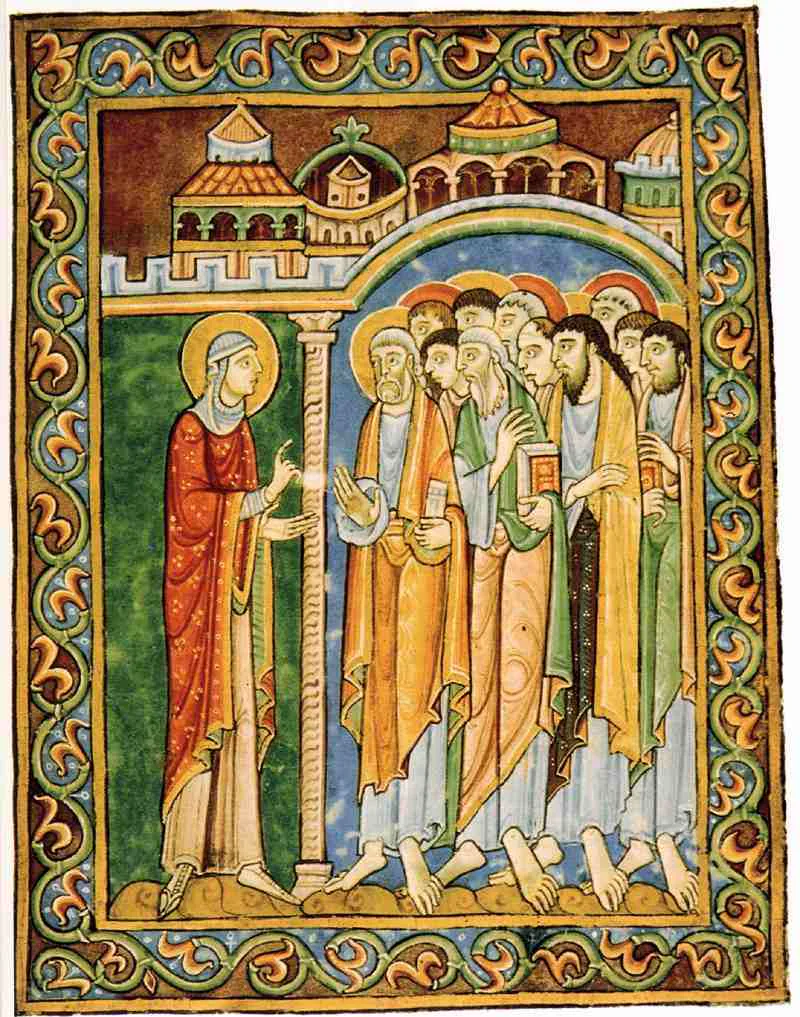
Levi then rebukes Peter as hot-tempered, and says that he is now arguing against the woman as the adversaries do. If the Saviour made her worthy, who is Peter to reject her? The Saviour knew her very well, Levi says, and for that reason loved her more than them. He urges them to put on the perfect human, to go and preach, and not to lay down any rule or law beyond what the Saviour said. The text ends with the disciples going out to proclaim (in the Greek fragment, Levi goes out alone).
Peter's hostility towards Mary also appears in the Gospel of Thomas, saying 114, and in the Pistis Sophia, where Mary is the most prominent questioner of Jesus and Peter complains that she dominates the conversation. Many scholars read these scenes as reflecting second-century debates about the authority of women, of visionary experience, and of teachings outside the apostolic mainstream.
Which Mary? Mary Magdalene in Gnostic and Early Christian Texts§
The gospel calls its heroine simply "Mary". Most scholars identify her with Mary Magdalene, whom the canonical gospels describe as a follower of Jesus, a witness to the crucifixion and the first witness to the resurrection. The Gospel of John's account of her meeting with the risen Jesus, in which he sends her to the disciples, offers a natural starting point for a tradition of her as a recipient of special revelation. A few scholars have argued for Mary the mother of Jesus, but the description of her as the woman the Saviour loved more than other women, and the parallels in the Gospel of Philip, which calls Mary Magdalene his companion, make the Magdalene much more likely.
The medieval Western image of Mary Magdalene as a repentant prostitute, which goes back to a sermon by Pope Gregory the Great in 591 conflating several women of the gospels, is absent from these early texts. For the wider history of how Christian tradition venerated holy women, see our article on saints, relics and the Virgin Mary, and for the canonical portrait of the disciples, Jesus and the apostles.
Is the Gospel of Mary Gnostic? Date and Interpretation§
The Gospel of Mary is often grouped with Gnostic literature because it was preserved alongside the Apocryphon of John and because it speaks of the soul's ascent past hostile powers. Yet it contains none of the distinctive features of the systems described in our overview of Gnosticism: there is no pleroma, no fall of Sophia and no ignorant creator god. Karen King, in her influential study, argued that the label obscures more than it reveals and preferred to read the text as one voice in the diverse Christianity of the early second century. Christopher Tuckett, by contrast, has argued that it shows dependence on the canonical gospels and fits best in the later second century, with clear affinities to Gnostic thought.
Most dates proposed fall in the second century. The Greek fragments set a firm limit at around 200 CE. What is not in doubt is the text's significance as evidence that some early Christians remembered Mary Magdalene as a teacher and visionary, and that her authority was contested.
Frequently asked questions§
Is the Gospel of Mary part of the Nag Hammadi library?§
No. It is preserved in the Berlin Codex 8502 and in two Greek fragments. It is often published with the Nag Hammadi texts because the Berlin Codex also contains copies of two Nag Hammadi works.
Was the Gospel of Mary written by Mary Magdalene?§
The title names Mary as its central figure, not as its author, and no scholar thinks she wrote it. Like other early gospels it is an anonymous work associated with a revered figure.
Why is so much of the Gospel of Mary missing?§
The Coptic manuscript has lost pages 1 to 6 and 11 to 14, perhaps removed or damaged before it reached the antiquities market. The Greek fragments add a few lines but do not fill the gaps.
Does the Gospel of Mary say Jesus and Mary were married?§
No. It says the Saviour loved Mary more than the other disciples or women, which concerns her spiritual standing. Claims of a marriage usually rely on loose readings of the Gospel of Philip, which is itself fragmentary and symbolic.
Sources and further reading§
- The Gospel of Mary of Magdala: Jesus and the First Woman Apostle — Karen L. King, 2003
- The Gospel of Mary — Christopher Tuckett, 2007
- Die gnostischen Schriften des koptischen Papyrus Berolinensis 8502 — Walter C. Till, 1955
- The Nag Hammadi Scriptures — Marvin Meyer (ed.), 2007
- The Gnostic Gospels — Elaine Pagels, 1979
- Mary Magdalene, the First Apostle: The Struggle for Authority — Ann Graham Brock, 2003