Liber VI · Christianity · Chapter XI: Saints, Relics & Mary
Saints, Relics and the Virgin Mary in Christian Tradition
The history of Christian saints, relics and devotion to the Virgin Mary: martyr cults, pilgrimage, canonisation, Marian dogmas, apparitions and their critics.

In Christian tradition saints are holy men and women believed to be with God, honoured as models of faith and invoked as intercessors; relics are their bodily remains or objects associated with them; and the Virgin Mary, mother of Jesus, is venerated above all the saints. Devotion to saints, relics and Mary grew from the cult of the early martyrs and became central to Catholic and Orthodox piety, while Protestant reformers criticised much of it as unscriptural.
The Martyrs and the Origins of the Cult of the Saints§
The first Christians honoured as saints were martyrs who died for their faith. The Martyrdom of Polycarp, describing the death of the bishop of Smyrna around the middle of the second century, records that his community gathered his bones, which they held more precious than jewels, and planned to celebrate the anniversary of his death as his "birthday" into heaven. That pattern — the tomb, the annual feast, the gathering of the faithful — became the template of the cult of the saints.
After the end of persecution in the fourth century, ascetics, bishops and confessors joined the martyrs as saints. Basilicas rose over martyrs' graves outside Roman cities, and the historian Peter Brown has shown how this broke ancient taboos separating the living from the dead: the tombs of the "very special dead" became places where heaven and earth met. Bishops such as Ambrose of Milan, who discovered and enshrined the bodies of the martyrs Gervasius and Protasius in 386, used relics to build up their churches. Saints' lives (hagiography) multiplied, culminating in medieval collections such as the Golden Legend of Jacobus de Voragine (c. 1260), one of the most widely read books of the Middle Ages.
Relics and Pilgrimage§
Kinds of relic§
Relics range from whole bodies and bones to clothing, objects touched to a saint's tomb, and fragments believed to come from the cross of Christ, discovered according to legend by the empress Helena in Jerusalem in the fourth century. Modern Catholic usage distinguishes first-class relics (parts of the body), second-class (items the saint used) and third-class (objects touched to a relic). The Second Council of Nicaea (787) required that relics be placed in altars when churches were consecrated, a practice that bound the cult of the saints to the Eucharist.
Shrines, trade and theft§
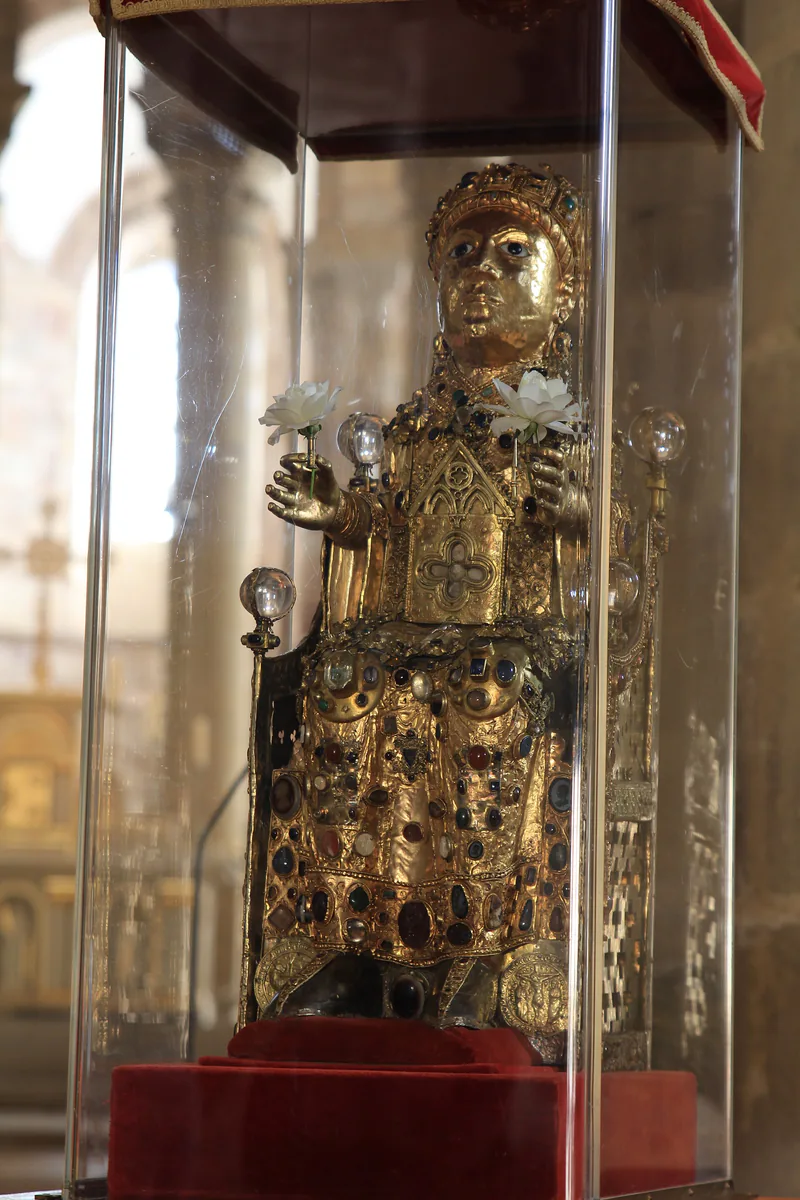
Relics were believed to work miracles of healing and protection, and shrines drew pilgrims across Christendom: to the tombs of Peter and Paul in Rome, to the Holy Sepulchre in Jerusalem, to Santiago de Compostela, and after 1170 to Canterbury, where Archbishop Thomas Becket was murdered. Relics were given as diplomatic gifts and fought over. The historian Patrick Geary has studied the "sacred thefts" of the Middle Ages, such as the removal of Saint Mark's body from Alexandria to Venice in 828 and of Saint Nicholas from Myra to Bari in 1087, which their new owners justified as the saint's own will. Reliquaries of gold, silver and enamel are among the masterpieces of medieval art. The protective power attributed to relics and to objects touched to them overlapped with the world of amulets and talismans.
Some famous relics have attracted scientific scrutiny. The Shroud of Turin, venerated by many as Christ's burial cloth, was radiocarbon-dated in 1988 by three laboratories to roughly 1260–1390; the result has been disputed by some, and the Catholic Church has never made a formal pronouncement on its authenticity.
How Saints Are Made: Canonisation§
In the first millennium saints were recognised by popular acclaim and by local bishops, who authorised a cult and translated the saint's remains to an altar. The first known papal canonisation was that of Ulrich of Augsburg by Pope John XV in 993. Over the following centuries the papacy reserved canonisation to itself, a claim made explicit in the decretals published under Gregory IX in 1234. In 1588 Sixtus V created the Congregation of Rites to handle causes, and procedures were formalised in the seventeenth and eighteenth centuries, including the role of the "promoter of the faith," popularly called the devil's advocate. A reform of 1983 simplified the process.
Today a Catholic cause moves through stages: Servant of God, Venerable (after a judgement of heroic virtue), Blessed (beatification, usually after one approved miracle, unless the person was a martyr) and Saint (canonisation, usually after a second miracle). The Orthodox churches glorify saints by synodal decision, often confirming long-standing popular veneration. Theologians distinguish the honour (dulia) given to saints and the special honour (hyperdulia) given to Mary from the worship (latria) due to God alone, a distinction rooted in the council of 787 discussed in Christian Creeds and Councils.
The Virgin Mary in Doctrine and Devotion§
Mary in scripture and dogma§
Mary appears in the Gospels at the annunciation, the birth of Jesus, the wedding at Cana and the foot of the cross. The angel Gabriel's greeting in Luke 1, together with Elizabeth's blessing, became the basis of the prayer known in English as the Hail Mary. The Council of Ephesus (431) approved the title Theotokos, "God-bearer," to safeguard the unity of Christ's person. The belief that Mary remained a virgin throughout her life was widely held by the fifth century.
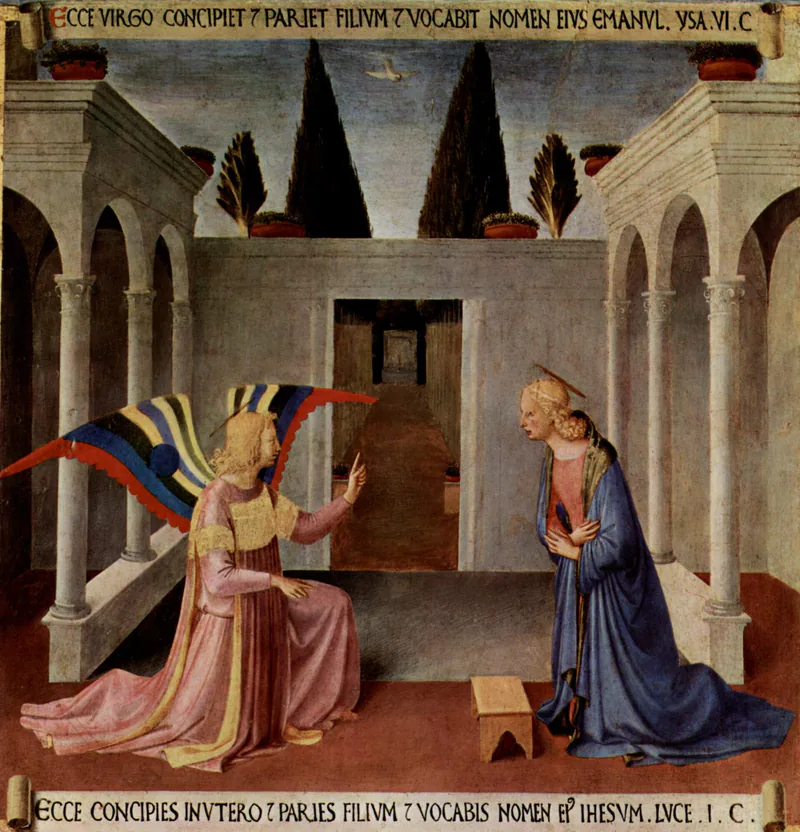
Two later doctrines are specifically Catholic dogmas. The Immaculate Conception — that Mary was preserved from original sin from the moment of her conception — was long debated by medieval theologians before Pius IX defined it in 1854. The Assumption — that at the end of her earthly life Mary was taken body and soul into heaven — was defined by Pius XII in 1950. The Orthodox celebrate the same event as the Dormition ("falling asleep") of the Mother of God on 15 August but do not define it in the same terms.
Devotion and apparitions§
Marian devotion took countless forms: feasts, hymns such as the Byzantine Akathist, icons and statues, including the Black Madonnas of medieval Europe, the rosary, popularised from the fifteenth century, and the shrines of Walsingham, Loreto and Częstochowa. Reported apparitions have created major pilgrimage centres: Our Lady of Guadalupe in Mexico (1531), Lourdes in France (1858), where Bernadette Soubirous described eighteen visions, and Fátima in Portugal (1917). The Church distinguishes between officially approved apparitions, which Catholics are free but not obliged to believe, and many others it has not recognised. Marina Warner's Alone of All Her Sex and Jaroslav Pelikan's Mary Through the Centuries trace how the image of Mary has changed with the cultures that honoured her.
Protestant Critiques and Modern Debates§
The Reformers attacked what they saw as abuses: the trade in relics and indulgences, the invocation of saints as mediators and the attribution of miraculous power to images. John Calvin's Treatise on Relics (1543) mocked the multiplication of relics, joking that the fragments of the true cross would fill a ship. In many Protestant lands shrines were dismantled and images destroyed, and Protestant churches generally honour Mary and the saints as examples of faith rather than as intercessors. Luther, however, retained a deep respect for Mary, and Anglican and Lutheran calendars still commemorate saints.
Scholars of religion study the cult of the saints as a window onto lived religion: the way communities sought healing, protection and justice from holy patrons, often in ways that blurred official and popular belief, as explored in Folk Christianity. The saints remain central to Catholic and Orthodox spirituality, described in Roman Catholicism and Eastern Orthodox Christianity.
Frequently asked questions§
Why do Catholics and Orthodox pray to saints?§
They believe that the saints are alive with God and can intercede for the living, as Christians on earth pray for one another. Their teaching distinguishes this honour and request for prayers from worship, which is given to God alone.
What is a relic?§
A relic is a part of a saint's body or an object associated with a saint or with Christ, kept and honoured in a church or shrine. Medieval Christians believed relics could convey a saint's protection and healing power.
What is the difference between the Immaculate Conception and the Virgin Birth?§
The Virgin Birth refers to Jesus being conceived by the Holy Spirit without a human father. The Immaculate Conception, a Catholic dogma defined in 1854, refers to Mary herself being conceived without original sin.
How does someone become a saint?§
In the Catholic Church, a person's life is investigated after death, and the pope may declare them Venerable, then Blessed and finally a Saint, normally after miracles attributed to their intercession have been approved. Orthodox churches recognise saints through synodal glorification.
Sources and further reading§
- The Cult of the Saints: Its Rise and Function in Latin Christianity — Peter Brown, 1981
- Furta Sacra: Thefts of Relics in the Central Middle Ages — Patrick J. Geary, 1978
- Why Can the Dead Do Such Great Things? Saints and Worshippers from the Martyrs to the Reformation — Robert Bartlett, 2013
- Alone of All Her Sex: The Myth and the Cult of the Virgin Mary — Marina Warner, 1976
- Mary Through the Centuries: Her Place in the History of Culture — Jaroslav Pelikan, 1996
- The Golden Legend — Jacobus de Voragine, c. 1260