Liber VI · Christianity · Chapter XI: Saints, Relics & Mary
Marian Apparitions: Guadalupe, Lourdes, Fátima and Beyond
Marian apparitions explained: reported visions of the Virgin Mary at Guadalupe, Lourdes and Fátima, how the Church judges them and what historians say.

A Marian apparition is a reported appearance of the Virgin Mary, the mother of Jesus, to one or more people, usually accompanied by messages, signs or healings and followed by pilgrimage to the site. The best known — Guadalupe in Mexico (1531), Lourdes in France (1858) and Fátima in Portugal (1917) — draw millions of pilgrims each year, although the Catholic Church teaches that belief in any particular apparition is never required of the faithful.
What Is a Marian Apparition?§
In Catholic and Orthodox belief, Mary, having been taken body and soul into heaven, can intercede for the living and may, by God's permission, make herself present to them, as described in Saints, Relics and the Virgin Mary. Accounts of apparitions typically describe a radiant woman, often seen first by children or humble people, who asks for prayer, penance, the building of a chapel or a procession, and sometimes gives a name or title by which she wishes to be honoured.
Catholic teaching holds that public revelation ended with the apostolic age and that private revelations add nothing to it; their role, in the words of the Catechism, is to help people live the faith more fully in a particular period. Most Protestant churches regard such claims with reserve or reject them outright, while Orthodox tradition honours many miraculous appearances, often linked to the discovery of wonder-working icons.
Early and Medieval Visions of Mary§
One of the earliest recorded visions appears in Gregory of Nyssa's Life of Gregory the Wonderworker, written around 380, which tells how Mary and John the Evangelist appeared to the third-century bishop and taught him a statement of faith. Several medieval shrines claimed apparition origins: the English shrine of Walsingham traced its "Holy House" to a vision granted to a noblewoman in the eleventh century, a tradition recorded only in a fifteenth-century ballad.
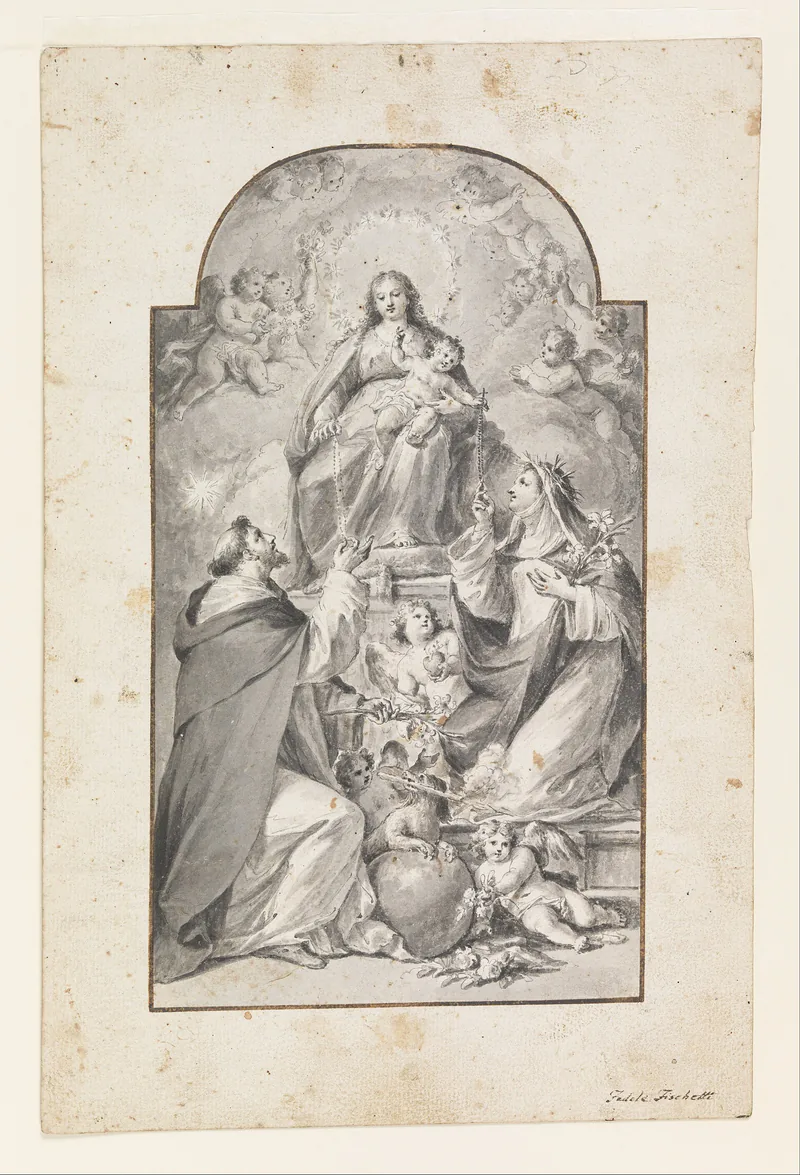
Religious orders attached their distinctive devotions to visions of Mary. Dominicans came to tell how Saint Dominic received the rosary from her, a story first spread by Alan de la Roche in the fifteenth century; the Carmelites told of the brown scapular given to Simon Stock in the thirteenth. The historian William A. Christian Jr. showed that in late medieval Castile and Catalonia apparitions to shepherds and farm workers often concerned local matters such as plague, drought and the founding of rural shrines — a pattern of local, practical religion described in Folk Christianity.
Our Lady of Guadalupe and the Americas§
According to tradition, in December 1531, ten years after the Spanish conquest of the Aztec capital, Mary appeared four times on the hill of Tepeyac near Mexico City to Juan Diego Cuauhtlatoatzin, a baptised Nahua man. She asked for a church to be built there. When Bishop Juan de Zumárraga requested a sign, Juan Diego gathered roses out of season in his cloak (tilma); when he opened it before the bishop, an image of the Virgin was found imprinted on the cloth. That image, of a young woman surrounded by rays of light and standing on a crescent moon, is venerated in the Basilica of Guadalupe, one of the most visited shrines in the world. Its iconography recalls the woman "clothed with the sun, and the moon under her feet" of Revelation 12, discussed in The Book of Revelation.
The devotion to the image at Tepeyac is documented from the mid-sixteenth century, but the full apparition narrative first appears in print in 1648, in a Spanish work by the priest Miguel Sánchez, and in 1649 in the Nahuatl account known as the Nican mopohua, published by Luis Laso de la Vega. The historian Stafford Poole has argued that the near-silence of earlier sources tells against the traditional story; defenders reply that oral tradition and lost documents may explain the gap. The Franciscan Bernardino de Sahagún, writing in the 1570s, worried that Indigenous worshippers at Tepeyac were honouring the mother goddess Tonantzin under a new name, a remark that has fuelled long debate about continuity with Mesoamerican religion. Juan Diego was canonised in 2002. Guadalupe became a symbol of Mexican identity — Miguel Hidalgo's insurgents carried her banner in 1810 — and twentieth-century popes proclaimed her patroness of the Americas.
The Age of Apparitions: Rue du Bac, La Salette and Lourdes§
The nineteenth century, sometimes called the "Marian age," brought a series of apparitions in France that shaped modern Catholic devotion. In 1830, in a convent chapel on the Rue du Bac in Paris, the novice Catherine Labouré reported visions in which Mary asked for a medal to be struck; the "Miraculous Medal" was distributed in millions of copies. In 1846 two young herders, Mélanie Calvat and Maximin Giraud, said that a weeping Lady had appeared to them on a mountain pasture at La Salette in the Alps.
The most famous apparitions occurred in 1858 at Lourdes, in the Pyrenees. Bernadette Soubirous, a fourteen-year-old girl from a poor family, reported eighteen appearances of a young lady in a grotto at Massabielle between 11 February and 16 July. At the lady's direction she dug in the ground, uncovering a spring. On 25 March the lady identified herself, in the local Occitan dialect, as "the Immaculate Conception," a title that Pope Pius IX had defined as dogma four years earlier. The local bishop declared the apparitions worthy of belief in 1862. Bernadette became a nun at Nevers, where she died in 1879; she was canonised in 1933.
Lourdes became one of the largest pilgrimage centres in the world, especially for the sick. A medical bureau, established in 1883, examines claimed cures; of thousands reported, the Church has officially recognised seventy as miraculous. The historian Ruth Harris has shown how Lourdes became a battleground between Catholic revival and secular, scientific France.
Fátima, Knock and the Twentieth Century§
In 1879 about fifteen villagers at Knock in County Mayo, Ireland, reported a silent vision of Mary, Saint Joseph, Saint John and a lamb on an altar at the gable of their church. In 1917, during the First World War and amid anticlerical politics in republican Portugal, three shepherd children at Fátima — Lúcia dos Santos and her cousins Francisco and Jacinta Marto — said that a Lady from heaven appeared to them on the thirteenth of each month from May to October, asking for the rosary to be prayed for peace. On 13 October a crowd of tens of thousands gathered, and many reported seeing the sun spin and plunge, an event known as the "Miracle of the Sun"; others present saw nothing unusual. The bishop approved the apparitions in 1930.
Lúcia, who became a Carmelite nun, later wrote down three "secrets." The first two, published in the 1940s, included a vision of hell and a call for the consecration of Russia to Mary's Immaculate Heart; the third, made public by the Vatican in 2000, was interpreted as foretelling the 1981 assassination attempt on Pope John Paul II. Popes consecrated the world or Russia to Mary in 1942, 1984 and 2022. Francisco and Jacinta, who died young in the influenza pandemic, were canonised in 2017.
Later reported apparitions include Beauraing and Banneux in Belgium (1932–33), the luminous figures seen over a Coptic church in Zeitoun, Cairo (1968–71), Akita in Japan (1973), Kibeho in Rwanda (from 1981, approved in 2001), and Medjugorje in Bosnia and Herzegovina, where six young people have reported regular visions since 1981.
How the Catholic Church Judges Apparitions§
Judgement belongs first to the local bishop, who investigates the visionaries' character and mental health, the content of the messages, any claimed healings and the spiritual fruits of the devotion. Norms issued by the Vatican in 1978 allowed a verdict that the supernatural character of an event was established, not established, or excluded. Most claims are never approved; only a small fraction have received full approval.
In May 2024 the Vatican's Dicastery for the Doctrine of the Faith issued new norms. These normally avoid declaring that an apparition is supernatural at all; the highest usual verdict is a nihil obstat, meaning that nothing prevents the faithful from taking part in the devotion, with other graded judgements down to a declaration that a phenomenon is not supernatural. In September 2024 Medjugorje received such a nihil obstat for its pastoral activity, without any ruling on the visions themselves.
Scholarly Perspectives and Debates§
Historians and social scientists approach apparitions without deciding their ultimate cause. They note recurring patterns: visionaries are often children, women or poor people; apparitions cluster in periods of war, epidemic, rapid social change or conflict between Church and state; and messages reflect the devotions and anxieties of their time. Sandra Zimdars-Swartz traced how modern apparition messages became increasingly apocalyptic, and anthropologists Victor and Edith Turner studied pilgrimage as a ritual process that creates temporary communities beyond ordinary social roles.
Psychological explanations range from suggestion and collective expectation to the visual effects of staring at the sun; such debates overlap with the history of visionary experience traced in Clairvoyance and Psychical Research. Believers reply that natural explanations cannot account for everything reported, and that the decisive test is spiritual fruit. For many Catholics these shrines remain central places of prayer, healing and national memory, as described in Roman Catholicism.
Frequently asked questions§
Do Catholics have to believe in Marian apparitions?§
No. Even when the Church approves an apparition, it is a "private revelation" that Catholics are free to accept or not. Approval means that the devotion is consistent with Catholic faith and may be practised, not that belief in it is required.
What happened at Lourdes?§
In 1858 Bernadette Soubirous reported eighteen appearances of a lady, later identified as Mary, in a grotto at Lourdes. A spring discovered there became the centre of a pilgrimage for the sick, and the Church has recognised seventy healings associated with it as miraculous.
What was the Miracle of the Sun at Fátima?§
On 13 October 1917 a large crowd gathered at Fátima for the last promised apparition. Many reported that the sun appeared to dance, change colour and fall toward the earth, while others saw nothing unusual. Believers regard it as a miracle; sceptics suggest optical effects and collective expectation.
Sources and further reading§
- Encountering Mary: From La Salette to Medjugorje — Sandra L. Zimdars-Swartz, 1991
- Lourdes: Body and Spirit in the Secular Age — Ruth Harris, 1999
- Our Lady of Guadalupe: The Origins and Sources of a Mexican National Symbol, 1531–1797 — Stafford Poole, 1995
- Apparitions in Late Medieval and Renaissance Spain — William A. Christian Jr., 1981
- When the Sun Danced: Myth, Miracles, and Modernity in Early Twentieth-Century Portugal — Jeffrey S. Bennett, 2012
- Image and Pilgrimage in Christian Culture — Victor Turner and Edith Turner, 1978
- Alone of All Her Sex: The Myth and the Cult of the Virgin Mary — Marina Warner, 1976