Liber XVI · Indigenous & Ancient Religions · Chapter V: Mesoamerican Religion
Mesoamerican Religion: Maya and Aztec Gods, Myth and Ritual
Mesoamerican religion explained: Olmec, Maya and Aztec gods, the Popol Vuh, sacred calendars, the ballgame, sacrifice and indigenous ritual today.

Mesoamerican religion is the family of religious traditions shared by the peoples of ancient Mexico and Central America, including the Olmec, Zapotec, Teotihuacanos, Maya, Mixtec and Aztec (Mexica), from about 1500 BCE to the Spanish conquest of the sixteenth century. These peoples worshipped many gods of rain, maize, sun, wind and war, kept interlocking sacred calendars, played a ritual ballgame and believed that the cosmos had been created and destroyed several times and had to be sustained through offerings, including blood. Many elements survive today in indigenous communities, often blended with Catholicism.
A Shared Religious World§
Despite many languages and states, Mesoamerican peoples held much in common. They imagined the world as a flat surface with four quarters, each with its colour, tree and deities, centred on an axis connecting the heavens above (often thirteen levels) with the underworld below (often nine). They kept the 260-day ritual count, formed by combining twenty day-signs with the numbers one to thirteen, alongside a 365-day solar year; the two meshed in a 52-year cycle, the Calendar Round. The library's article on Mayan Astrology explains these calendars and their modern popular use in detail.
Religion was bound to maize agriculture. The growth, harvest and rebirth of maize provided a model for human life and death, and rain gods were among the oldest and most widely honoured. Rulers performed rituals that linked them with the gods and ancestors, and pyramid temples recreated sacred mountains at the heart of each city. The earliest of these traditions can be glimpsed among the Olmec of the Gulf Coast (c. 1500–400 BCE), with their colossal heads and were-jaguar imagery, and at Teotihuacan (c. 100 BCE–550 CE), the vast city whose Pyramids of the Sun and Moon the Aztecs later regarded as the birthplace of the present age.
The Gods of the Maya§
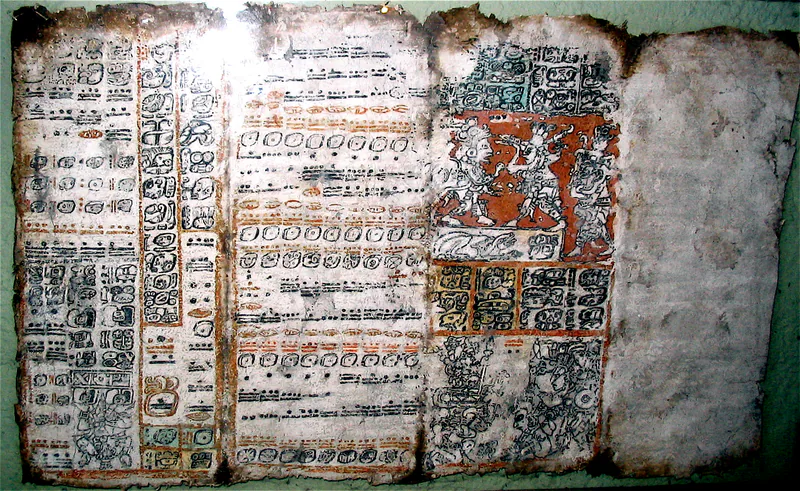
Classic Maya civilisation (c. 250–900 CE) flourished in city-states such as Tikal, Palenque, Copán and Calakmul. Hieroglyphic inscriptions, painted ceramics and the few surviving screenfold books, especially the Dresden Codex, reveal a complex pantheon. Scholars long used neutral letters (God A, God B and so on) for deities before their names could be read. Important figures include Itzamnaaj, an aged creator and priestly god; Chaak, the rain god with his axe of lightning; K'inich Ajaw, the sun god; the Maize God, young and beautiful, whose death and resurrection mirror the agricultural cycle; and K'awiil, a god of lightning and royal power held as a sceptre by kings.
Classic Maya kings bore the title k'uhul ajaw, "holy lord". They mediated with gods and ancestors, dedicated monuments at the completion of calendar periods, and performed rites in which they and their consorts offered their own blood, imagery of which appears on carved lintels at Yaxchilán. Such practices are described here historically. The Maya underworld, Xibalba, was entered through caves and still water; many caves in Belize and Guatemala contain offerings.
The Popol Vuh and the Hero Twins§
The most important Maya religious text is the Popol Vuh ("Book of the Council") of the K'iche' Maya of highland Guatemala. It was written in the K'iche' language in Latin letters in the mid-sixteenth century, probably drawing on an older hieroglyphic book, and is known from a copy made by the Dominican friar Francisco Ximénez around 1701–1703.
It tells how the creator gods tried several times to make beings who would praise them: first animals, then people of mud, then people of wood, who were destroyed in a flood. Before the final creation, the Hero Twins Hunahpu and Xbalanque descend to Xibalba to face the lords of death, who had killed their father. They survive a series of deadly houses, defeat the lords through cunning, and rise as the sun and moon. Their father, linked with the Maize God, is restored, and the gods finally make true humans from maize dough. Scenes from this story appear on Classic-period vases centuries before the text was written, which shows its antiquity.
The Ballgame and Sacred Play§
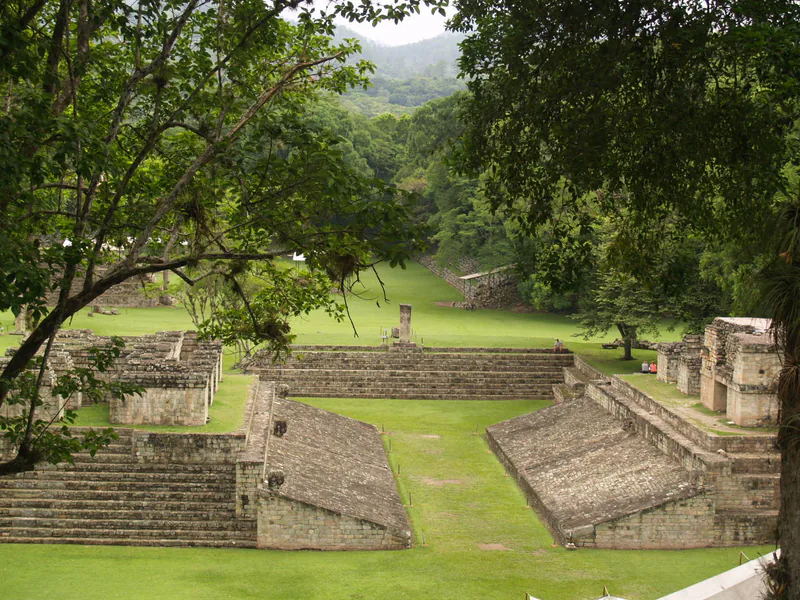
The rubber-ball game was played across Mesoamerica for over three thousand years in I-shaped masonry courts. Players struck the heavy ball mainly with their hips. The game had sporting, political and religious dimensions: its movement could represent the motion of the heavenly bodies, and the Hero Twins themselves are ballplayers summoned to Xibalba because of the noise of their game. Some games ended in the sacrifice of captives, as reliefs at Chichén Itzá and El Tajín indicate, though most were probably not lethal. A version of the game, ulama, still survives in north-western Mexico.
Aztec Religion: Suns, Gods and Sacrifice§
The Mexica, or Aztecs, founded Tenochtitlan in the Valley of Mexico in about 1325 and by 1500 dominated much of central Mexico. Their religion drew on older traditions. According to the myth of the Five Suns, the world had been created and destroyed four times; the present age, the Fifth Sun, began when the gods gathered at Teotihuacan and sacrificed themselves to set the sun in motion. Humans were indebted to the gods and repaid them with offerings to keep the cosmos alive.
The Templo Mayor at the heart of Tenochtitlan bore twin shrines to Huitzilopochtli, the Mexica patron god of sun and war, and Tlaloc, the rain god, joining the two pillars of the state: conquest and agriculture. Other major deities included Quetzalcoatl, the feathered serpent, god of wind, priesthood and learning; Tezcatlipoca, "Smoking Mirror", the powerful and capricious god of night and fate; Xipe Totec, god of renewal; and earth and mother goddesses such as Coatlicue. The Aztecs used the word teotl for sacred power manifest in gods, people and things.
Human sacrifice, usually of war captives, was performed at the major festivals of the 365-day year. Spanish accounts give inflated figures and served to justify conquest, but excavations at the Templo Mayor since 1978, including the skull rack (tzompantli) uncovered from 2015, confirm that sacrifice took place on a large scale. Historians now seek to understand it within Mexica cosmology rather than as mere cruelty. The New Fire ceremony, held at the end of each 52-year cycle, extinguished all fires until priests kindled a new flame on the Hill of the Star; the last was celebrated in 1507.
Conquest, Survival and Modern Practice§
Spanish conquest after 1519 destroyed temples and burned most indigenous books. Paradoxically, much of what is known about Aztec religion comes from friars, above all Bernardino de Sahagún, whose General History of the Things of New Spain (the Florentine Codex, completed around 1577) recorded Nahua testimony in Nahuatl and Spanish. Indigenous people adapted Catholicism to their own needs, associating saints with older powers and continuing agricultural rites in hills and caves.
Today K'iche' and other Maya daykeepers (aj q'ij) still count the 260-day calendar for divination and ceremony in highland Guatemala, and since the 1990s Maya spirituality has been publicly revived as part of a broader indigenous movement. In Mexico, the Day of the Dead combines Catholic All Souls' observances with indigenous traditions of honouring the dead, and the Virgin of Guadalupe's shrine stands at Tepeyac, a hill long associated with an earlier mother goddess. For calendar divination see Mayan Astrology and What Is Divination?.
Frequently asked questions§
What is the difference between Maya and Aztec religion?§
They shared a common Mesoamerican framework, including the 260-day calendar and gods of rain, maize and sun, but differed in language, history and emphasis. The Classic Maya flourished centuries earlier in city-states ruled by holy kings; the Aztecs built an empire in central Mexico with a state cult centred on Huitzilopochtli.
Did the Aztecs really practise human sacrifice?§
Yes. Spanish chronicles, Aztec codices and archaeology all confirm it, especially of war captives at major festivals. The numbers given by conquerors are often exaggerated, and historians interpret the practice in light of Aztec beliefs about sustaining the sun and cosmos.
What is the Popol Vuh?§
It is the sacred book of the K'iche' Maya, written in the sixteenth century in K'iche' using the Latin alphabet. It contains creation myths, the adventures of the Hero Twins in the underworld and the history of K'iche' lineages.
Sources and further reading§
- Popol Vuh: The Definitive Edition of the Mayan Book of the Dawn of Life — Dennis Tedlock (trans.), 1985
- Florentine Codex: General History of the Things of New Spain — Bernardino de Sahagún, c. 1577
- The Gods and Symbols of Ancient Mexico and the Maya — Mary Miller and Karl Taube, 1993
- Religions of Mesoamerica — Davíd Carrasco, 1990
- A Forest of Kings: The Untold Story of the Ancient Maya — Linda Schele and David Freidel, 1990
- Aztec Thought and Culture — Miguel León-Portilla, 1963
- Time and the Highland Maya — Barbara Tedlock, 1982