Liber VII · Divination · Chapter VII: Mayan & Aztec Astrology
Mayan Astrology: The Tzolk'in, Day Signs and Daykeepers
Mayan astrology explained: the 260-day Tzolk'in, the twenty day signs and thirteen numbers, the Haab', Long Count and Venus tables, K'iche' daykeepers and modern myths.

"Mayan astrology" usually means reading a person's character and destiny from their day of birth in the 260-day sacred calendar of the Maya, the Tzolk'in. Each day combines one of twenty named day signs with a number from one to thirteen, and among the K'iche' Maya of highland Guatemala, where the count has been kept without interruption, the sign of one's birthday — one's nawal — is believed to shape temperament and calling. Alongside it the ancient Maya kept a solar year, a Long Count of days and precise tables of Venus and eclipses.
The 260-day count§
The heart of the Maya calendar is the cycle of 260 days, called Tzolk'in ("count of days") by modern scholars and Cholq'ij by the K'iche'. Two smaller cycles run together: the numbers 1 to 13, and twenty named days from Imix to Ajaw. Day 1 Imix is followed by 2 Ik', 3 Ak'b'al and so on; after 13 B'en the numbers start again with 1 Ix, while the names continue. Only after 13 × 20 = 260 days does 1 Imix return.
Why 260 days? Several explanations are offered, and they are not mutually exclusive: the period approximates nine months of human pregnancy; it matches the agricultural cycle of highland maize; it is the interval between the sun's two zenith passages at around 15° north latitude, the latitude of some early Maya cities; and it combines the sacred numbers 13 and 20. The calendar is far older than the Maya themselves — it appears in Zapotec inscriptions of the first millennium BCE and was shared across Mesoamerica, where the Aztecs called it the tonalpohualli.
The twenty day signs§
Each day sign has its own glyph, meaning and associations. In the Yucatec names used by scholars, with the K'iche' equivalents, they are: Imix (Imox, crocodile/water), Ik' (Iq', wind), Ak'b'al (Aq'ab'al, night/dawn), K'an (K'at, maize/net), Chikchan (Kan, serpent), Kimi (Kame, death), Manik' (Kej, deer), Lamat (Q'anil, star/seed), Muluk (Toj, water/offering), Ok (Tz'i', dog), Chuwen (B'atz', monkey/thread), Eb' (E, road), B'en (Aj, reed/maize stalk), Ix (I'x, jaguar), Men (Tz'ikin, eagle/bird), K'ib' (Ajmaq, owl/forgiveness), Kab'an (No'j, earth/thought), Etz'nab' (Tijax, flint), Kawak (Kawoq, storm) and Ajaw (Ajpu, lord/sun). The day signs were also linked to the four directions and their colours in a repeating cycle: east and red, north and white, west and black, south and yellow.
Each sign has a page in our horoscope section, where you can also calculate your own day sign.
The Haab', the Calendar Round and the Long Count§
Alongside the Tzolk'in ran the Haab', a year of 365 days made of eighteen months of twenty days plus a short period of five days, Wayeb', regarded as dangerous. A day therefore had two names — for example 4 Ajaw 8 Kumk'u — and the same combination recurs only after 18,980 days, about 52 years: the Calendar Round.
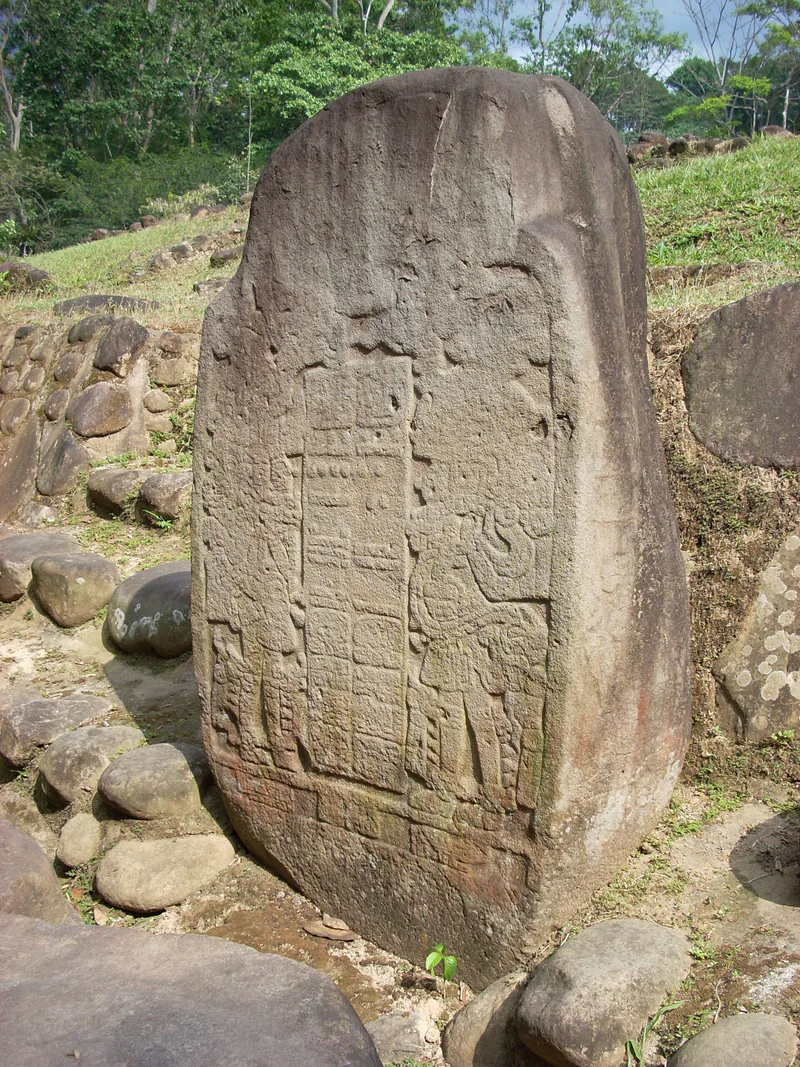
For dates beyond 52 years, the Classic Maya (about 250–900 CE) used the Long Count, a tally of days from a mythical starting date in August 3114 BCE. It is written in five places — baktun (144,000 days), katun (7,200), tun (360), winal (20) and k'in (1) — so that 9.12.11.5.18 means 9 baktuns, 12 katuns, 11 tuns, 5 winals and 18 days. Monuments recorded the births, accessions and wars of kings in this way, often together with a Lord of the Night (one of nine deities who ruled successive nights) and the phase of the moon.
The date 13.0.0.0.0 4 Ajaw 3 K'ank'in, which fell on 21 December 2012 in the standard correlation, completed thirteen baktuns. Popular books predicted catastrophe or spiritual transformation; Maya inscriptions, such as Monument 6 at Tortuguero, treat it as a significant period-ending, and other texts refer to dates thousands of years later. The world did not end.
Venus, eclipses and the sky§
The Maya were skilled astronomers. The Dresden Codex, one of only four surviving Maya books, contains a table of the cycles of Venus accurate over centuries and an eclipse table predicting when eclipses were possible. The appearance of Venus as morning star was considered dangerous and was associated with war; some Classic-period battles appear to have been timed to Venus events. This was astrology in the sense of reading omens in the sky for kings and communities rather than personal horoscopes.
The daykeepers of the K'iche' Maya§
In the highlands of Guatemala the 260-day count has survived as a living tradition. Daykeepers — ajq'ij, "they of the day" — use it to divine with seeds and crystals, choose days for ceremonies, interpret dreams and counsel people. Barbara Tedlock's classic study Time and the Highland Maya (1982), based on her own training as a daykeeper in Momostenango, describes how the day signs are read: the day of birth gives a person a nawal and a disposition; some days (such as Kej, Kame or Ajpu) are traditional birth days of daykeepers; and particular days are suited to particular prayers — Toj for "paying" debts to the world, Ajmaq for asking forgiveness, Kawoq for the community. The great ceremony of Wajxaqib' B'atz' (8 B'atz') marks the initiation of new daykeepers.

The meanings are not fixed horoscopes but associations read together with the number of the day: low numbers are considered gentle, high numbers strong and potentially excessive, and the combination matters more than the sign alone.
Modern "Mayan astrology"§
Since the 1970s many popular books have presented "Mayan astrology" as a system of sun signs comparable to Western astrology, with personality profiles for each day sign. Some draw on Tedlock and other ethnography; others invent freely. The most influential modern system, José Argüelles' Dreamspell (late 1980s and 1990s), uses its own colours, "galactic" names (such as "Red Magnetic Dragon") and a count that skips 29 February, so its dates no longer match the traditional Maya count kept in Guatemala. Maya daykeepers and scholars regard Dreamspell as a New Age creation rather than Maya tradition.
The calculators on this site use the traditional count with the "GMT" correlation (584283), the standard among scholars, which links the Maya calendar to our own through colonial records, astronomy and radiocarbon dating.
Frequently asked questions§
What is my Mayan sign?§
Your Mayan sign is the day of the 260-day Tzolk'in on which you were born — a number from 1 to 13 and one of the twenty day signs, such as 7 Imix or 4 Ajaw. You can find it with the Mayan birth sign calculator.
Did the Maya predict the end of the world in 2012?§
No. 21 December 2012 completed a cycle of thirteen baktuns in the Long Count. Maya inscriptions mention it as a period-ending and also refer to much later dates; the idea of an apocalypse came from modern popular books.
Is Mayan astrology still practised?§
Yes. Among the K'iche' and other highland Maya of Guatemala, daykeepers (ajq'ij) still keep the 260-day count for divination, ceremonies and healing, and Maya spiritual organisations have revived public calendar ceremonies.
What is the difference between Dreamspell and the Maya calendar?§
Dreamspell is a 1990s system created by José Argüelles with its own names, colours and leap-year rule. Its day count differs from the traditional Maya count still used in Guatemala, which this site follows.
Sources and further reading§
- Time and the Highland Maya — Barbara Tedlock, 1982
- Maya Calendar Origins — Prudence M. Rice, 2007
- Reading the Maya Glyphs — Michael D. Coe and Mark Van Stone, 2001
- The Ancient Maya — Robert J. Sharer and Loa P. Traxler, 2006
- Skywatchers — Anthony F. Aveni, 2001
- The Order of Days: The Maya World and the Truth about 2012 — David Stuart, 2011