Liber XVI · Indigenous & Ancient Religions · Chapter V: Mesoamerican Religion
Quetzalcoatl: The Feathered Serpent of Mesoamerican Religion
Quetzalcoatl, the Feathered Serpent: his origins at Teotihuacan, his roles in Aztec religion, the legend of Topiltzin of Tula and the myth of Cortés's return.

Quetzalcoatl, "Feathered Serpent" or "Precious Serpent" in Nahuatl, was one of the most important gods of ancient Mesoamerica: a creator, a wind god, a patron of priests and learning, and the name of a legendary priest-king of the Toltec city of Tollan. The image of a serpent covered in the green plumes of the quetzal bird is at least two thousand years old, and versions of the deity were worshipped by the Maya as Kukulkan and Q'ukumatz. In the sixteenth century Spanish and Indigenous writers wove a famous but probably post-conquest story that the Aztec ruler Moctezuma mistook Hernán Cortés for the returning Quetzalcoatl.
The Name and Image of the Feathered Serpent§
The Nahuatl name joins quetzalli, the long, shimmering green tail feather of the resplendent quetzal bird and by extension anything precious, with coatl, "serpent" (also "twin"). The combination unites the bird of the sky with the snake of the earth, and feathered serpents in Mesoamerican art have been interpreted as symbols of fertility, water and wind, of rulership and of the movement between levels of the cosmos.
Quetzalcoatl had many aspects. As Ehecatl, the wind, he wore a projecting red mask through which he blew to clear the way for the rain gods, and his temples were often round so as not to obstruct the wind. As Tlahuizcalpantecuhtli, the lord of the dawn, he was associated with Venus as morning star. He was a patron of the calmecac, the schools where priests and nobles learned the calendar, writing and ritual song, and Aztec high priests bore his name as a title. He was also connected with the day sign Wind in the 260-day ritual calendar described in the tonalpohualli.
Origins at Teotihuacan and the Classic Period§
The feathered serpent is far older than the Aztecs. Some art historians see precursors in Olmec art of the first millennium BCE, though the identification is uncertain. Its first unmistakable monumental appearance is at Teotihuacan, the great city of central Mexico, where the Temple of the Feathered Serpent, built around 200–250 CE, is faced with sculpted serpent heads framed by feathers alternating with another headdress-like figure. Excavations beneath and around it found the remains of some two hundred people, many apparently sacrificed and buried as warriors at its dedication, which shows that the serpent was bound to warfare and state power from early on.

After Teotihuacan declined, the motif flourished in the city of Xochicalco (about 650–900 CE), whose main pyramid is wrapped in great feathered serpents, and at Toltec Tula and Maya Chichen Itza. Its spread suggests that the feathered serpent became a symbol of legitimate rule shared by elites across regions and languages.
Quetzalcoatl in Aztec Religion: Wind, Creation and Priesthood§
The Mexica (Aztecs) of Tenochtitlan, whose religion is outlined in Mesoamerican religion, gave Quetzalcoatl a central place in their myths of creation. According to the cosmogony recorded in sixteenth-century sources such as the Legend of the Suns (1558), the world had passed through several ages or "suns", each destroyed in turn; Quetzalcoatl and his rival and partner Tezcatlipoca took turns presiding over them.
When the present age, the Fifth Sun, began, Quetzalcoatl descended to Mictlan, the land of the dead, to recover the bones of earlier humans from its lord Mictlantecuhtli. After tricks and mishaps he escaped with them, and the goddess Cihuacoatl ground them into a meal. Quetzalcoatl let blood from his own body over it, and from this mixture the present humanity was formed. Another myth tells how, as an ant, he found the mountain where maize was hidden and brought it to people. In these stories Quetzalcoatl is the god who gives human beings their bodies and their food, and bloodletting, a central Mesoamerican offering, repays a divine sacrifice.
The two chief priests of the Templo Mayor in Tenochtitlan, who served Huitzilopochtli and Tlaloc, bore the title Quetzalcoatl. The great centre of his cult was Cholula, east of the Valley of Mexico, whose immense pyramid, the largest by volume in the ancient world, had been built over centuries and whose temple to the god attracted pilgrims from far afield.
Topiltzin Quetzalcoatl, Priest-King of Tollan§
Alongside the god stands a culture hero: Ce Acatl Topiltzin Quetzalcoatl, "One Reed, Our Prince, Feathered Serpent", ruler of Tollan, the city of the Toltecs, usually identified with Tula in Hidalgo. Aztec tradition remembered the Toltecs as masters of all arts, and their priest-king as a pious ruler who did penance, built houses of jade and feathers and, in some versions, rejected human sacrifice in favour of offerings of birds, butterflies and snakes.
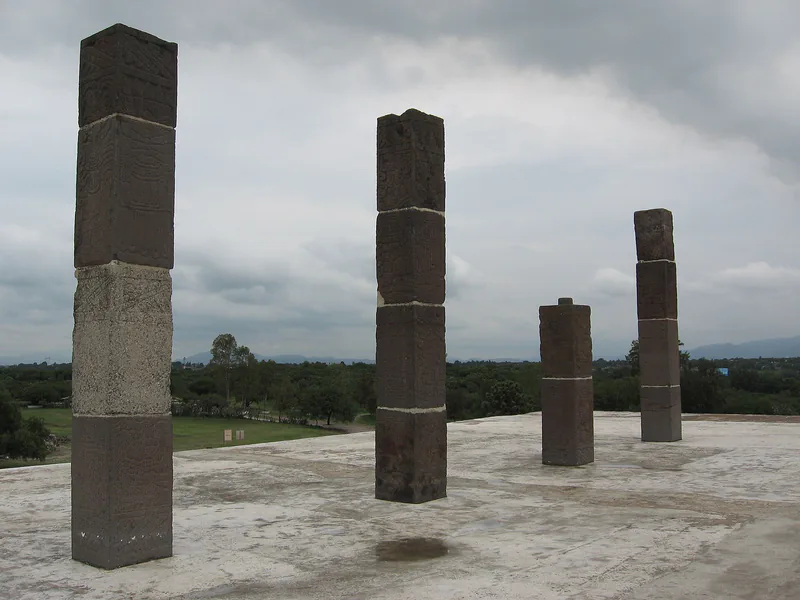
The accounts of his fall, preserved in the Annals of Cuauhtitlan and the Florentine Codex, have Tezcatlipoca and other sorcerers trick him. Shown a mirror, he is horrified by his aged body; made drunk on pulque, he breaks his vows. Shamed, he leaves Tollan and travels east to the sea. In one version he immolates himself and his heart rises to become the morning star; in another he departs over the water on a raft of serpents.
How much history lies behind the legend is disputed. H. B. Nicholson argued for a real Toltec ruler whose story was mythologised, while others see Topiltzin largely as a projection of the god into the past or as a model for later kings, who claimed Toltec legitimacy. The Maya chronicles of Yucatán tell of a lord called Kukulkan who arrived from the west, and Chichen Itza shows strong central Mexican influence in its art. At Chichen Itza the pyramid called El Castillo was dedicated to Kukulkan; the play of light and shadow on its north stairway at the equinoxes, now a famous spectacle, may or may not have been intended by its builders. Among the K'iche' Maya the Popol Vuh names Q'ukumatz, "quetzal serpent", as one of the creators who brought the world out of the primordial sea.
Did Moctezuma Think Cortés Was Quetzalcoatl?§
A widely repeated story says that Quetzalcoatl had promised to return from the east in a year One Reed, that 1519, when Cortés landed on the Gulf coast, was such a year, and that Moctezuma II therefore welcomed the Spaniard as the god and surrendered his empire. The story appears in Book 12 of the Florentine Codex, compiled in the 1550s–1570s by Bernardino de Sahagún with Nahua collaborators, and in later Spanish chronicles.
Many historians now doubt it. Cortés's own letters of 1519–1526 never mention Quetzalcoatl, although he does attribute to Moctezuma a speech about ancestors who had come from afar and whose lord would one day return, a speech that served Cortés's legal claim that Moctezuma had voluntarily accepted Spanish rule. Susan Gillespie, Matthew Restall and Camilla Townsend have argued that the "returning god" narrative was constructed after the conquest, from Spanish expectations, providentialist theology and Nahua attempts to explain defeat, rather than describing what Moctezuma believed. Others think some pre-conquest tradition about Topiltzin's return may have been adapted. The question remains one of the most debated in the history of the conquest.
Afterlives: Saint Thomas, Novels and Movements§
The feathered serpent continued to fascinate after the conquest. Some colonial clergy, and in 1794 the Dominican Servando Teresa de Mier in a famous sermon, identified Quetzalcoatl with the apostle Saint Thomas, supposedly sent to evangelise America, an idea that gave Mexico a Christian antiquity independent of Spain. Some Latter-day Saint writers have suggested a connection between Quetzalcoatl and the visit of Christ to the Americas described in the Book of Mormon, a view that is not official church teaching; see Latter-day Saints.
D. H. Lawrence's novel The Plumed Serpent (1926) imagined a revival of the Aztec gods in modern Mexico, and twentieth-century Mexican nationalism made the feathered serpent an emblem of Indigenous heritage. In the late twentieth century New Age writers associated Quetzalcoatl with prophecies of spiritual renewal, sometimes linked to the end of a Maya calendar cycle in 2012, discussed in Mayan astrology. Scholars of Mesoamerica regard these as modern constructions. Nahua, Maya and other Indigenous communities of Mexico and Central America today maintain their own religious lives, often combining Catholic and older practice, and many Mexican dance groups (concheros and Mexica dancers) honour the old gods in their ceremonies.
Frequently asked questions§
What was Quetzalcoatl the god of?§
He was a god of wind (as Ehecatl), creation, the morning star, learning and priesthood, and was also connected with maize, rulership and the calendar. His exact roles varied between peoples and periods across Mesoamerica.
Is Kukulkan the same as Quetzalcoatl?§
Kukulkan is the Yucatec Maya name meaning "feathered serpent", and Q'ukumatz is the K'iche' Maya equivalent. They share the imagery and some roles with the central Mexican Quetzalcoatl, but each belonged to its own religious and political setting.
Did the Aztecs think Cortés was a god?§
The idea comes from post-conquest sources, especially Book 12 of the Florentine Codex. Many historians now think it was created after the conquest to explain Spanish victory, and that Moctezuma treated Cortés as a dangerous foreign leader rather than a returning god.
Sources and further reading§
- Florentine Codex: General History of the Things of New Spain — Bernardino de Sahagún, c. 1577
- Quetzalcoatl and the Irony of Empire: Myths and Prophecies in the Aztec Tradition — Davíd Carrasco, 1982
- Topiltzin Quetzalcoatl: The Once and Future Lord of the Toltecs — H. B. Nicholson, 2001
- The Aztec Kings: The Construction of Rulership in Mexica History — Susan D. Gillespie, 1989
- The Gods and Symbols of Ancient Mexico and the Maya — Mary Miller and Karl Taube, 1993
- When Montezuma Met Cortés: The True Story of the Meeting that Changed History — Matthew Restall, 2018
- Fifth Sun: A New History of the Aztecs — Camilla Townsend, 2019
- Popol Vuh: The Definitive Edition of the Mayan Book of the Dawn of Life — Dennis Tedlock, 1985