Liber XVI · Indigenous & Ancient Religions · Chapter VI: Mesopotamian Religion
Enuma Elish: The Babylonian Epic of Creation and Marduk
Enuma Elish, the Babylonian Epic of Creation: its seven tablets, Marduk's battle with Tiamat, the making of the world and humankind, dating and Genesis.

Enuma Elish, "When on high", is the Babylonian Epic of Creation, a poem of about 1,100 lines on seven clay tablets that tells how the god Marduk defeated the primeval sea-goddess Tiamat, made heaven and earth from her body, created humankind and was proclaimed king of the gods. It was composed in Akkadian, most likely in the late second millennium BCE, to celebrate Marduk and his city of Babylon. Since its rediscovery in the 1870s it has been read both as a key to Mesopotamian religion and as a point of comparison with the creation stories of the Bible.
Discovery and Dating of Enuma Elish§
The first fragments were identified among the tablets from the library of the Assyrian king Ashurbanipal (reigned 668–around 631 BCE) at Nineveh, excavated in the mid-nineteenth century and brought to the British Museum. George Smith, who had already caused a sensation with the Babylonian flood story from the Epic of Gilgamesh, published fragments of the creation epic in The Chaldean Account of Genesis (1876). Further copies were found at Ashur, Kish, Sultantepe, Uruk and Babylon itself, and L. W. King's The Seven Tablets of Creation (1902) presented the poem more completely. Today almost the whole text is known.
Most surviving manuscripts date from the first millennium BCE, but the poem is older. It draws on earlier Sumerian and Akkadian traditions, including the myth of the god Ninurta's victory over monsters and the poem of Anzu, in which a hero recovers the stolen Tablet of Destinies. Because the epic exalts Marduk above the older chief god Enlil, scholars connect it with periods when Babylon's god was being promoted. W. G. Lambert argued for the reign of Nebuchadnezzar I (around 1125–1104 BCE), who brought back Marduk's statue from captivity in Elam; others prefer the Kassite period or an even earlier date in the Old Babylonian age. The question remains open.
The Primeval Waters: Apsu, Tiamat and the First Gods§
The poem opens before heaven and earth had names. Only two waters existed, mingling together: Apsu, the sweet underground waters, and Tiamat, the salt sea. Within them the gods were born in pairs, Lahmu and Lahamu, then Anshar and Kishar, then Anu, the sky, and his son Ea (also called Nudimmud), the wise god of magic and fresh water.
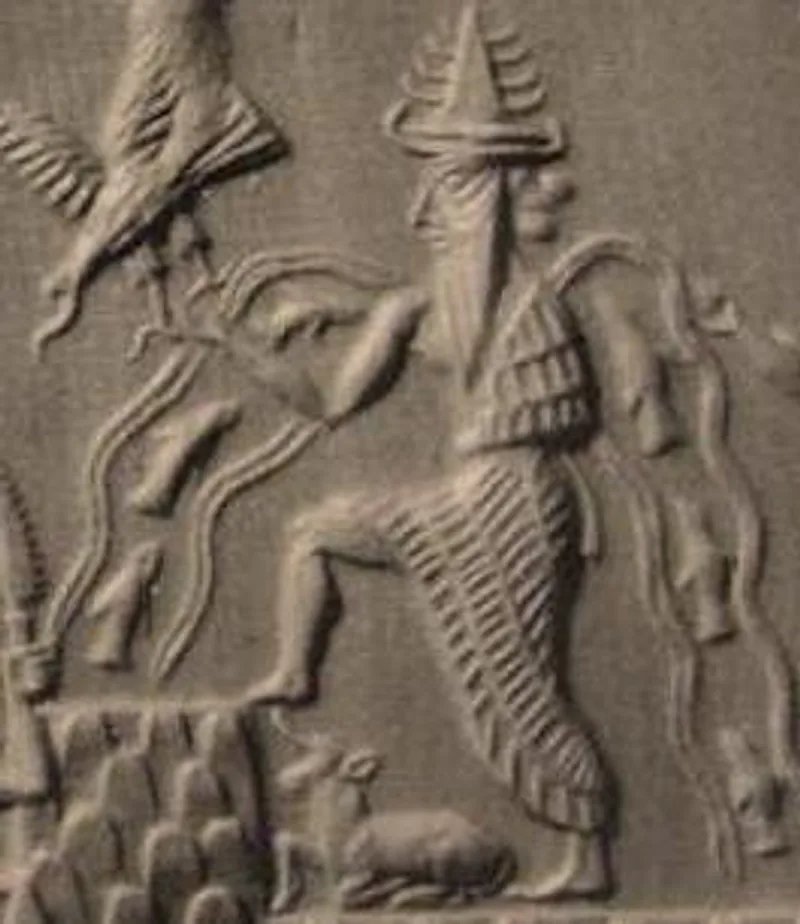
The young gods were noisy, and their clamour disturbed Apsu, who resolved to destroy them despite Tiamat's protest. Ea learned of the plan, cast a spell that sent Apsu to sleep, killed him and built his own dwelling upon him. There, in the Apsu, Ea and his wife Damkina produced Marduk, a child of overwhelming stature with four eyes and four ears, whose radiance outshone the other gods.
The story already shows a characteristic Mesopotamian pattern, in which order is achieved by the younger, active gods against the inert or hostile primeval powers, and in which Ea's skill with spells, the basis of Mesopotamian magic, is as decisive as force.
Tiamat's Army and Marduk's Rise§
Provoked by other gods and by grief for Apsu, Tiamat prepared for war. She bore eleven kinds of monsters, among them horned serpents, a lion-demon, a scorpion-man and a fish-man, filled their bodies with venom, and appointed one of her offspring, Qingu, as their commander, fastening the Tablet of Destinies to his breast.
The older gods were terrified. Ea and then Anu went out against her and turned back. Finally Marduk agreed to fight, on one condition: that the assembly of the gods grant him supreme authority, so that his word should determine destinies. At a banquet the gods tested his power by asking him to make a garment, or in some readings a constellation, vanish and reappear at his command. When he succeeded they proclaimed him king and gave him the sceptre, throne and weapons.
Armed with a bow, a mace, a net held by the four winds and a storm-chariot drawn by fearsome steeds, Marduk confronted Tiamat. When she opened her mouth to swallow him, he drove the winds into her body, shot an arrow through her belly and split her heart. He captured her army in his net, took the Tablet of Destinies from Qingu, and fixed it on his own breast.
Making the World from Tiamat's Body§
Marduk then split Tiamat's body in two "like a fish for drying". One half he raised to form the sky, setting bolts and guards so that her waters could not escape; the other half became the earth. From her eyes flowed the Tigris and the Euphrates, and her breasts became mountains.
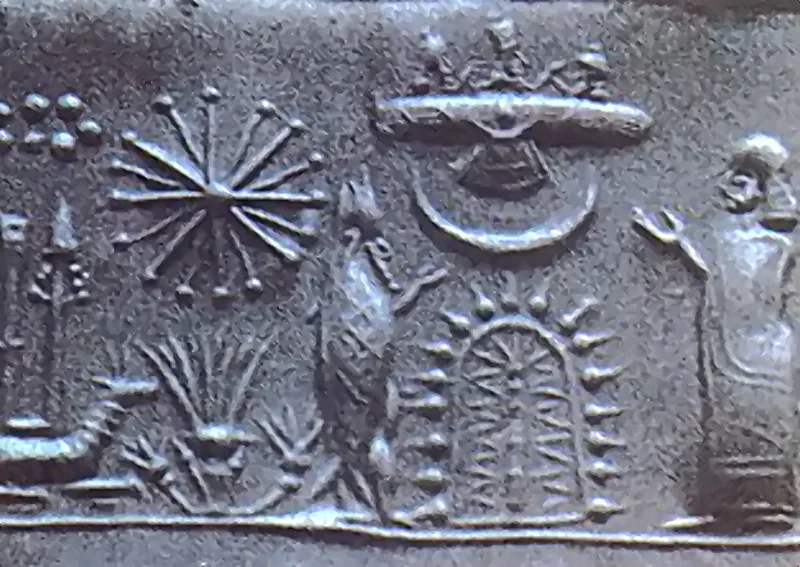
The fifth tablet describes the ordering of the heavens. Marduk established stations in the sky for the great gods as constellations, fixed the year and its twelve months with three stars for each, made the moon shine and appointed its phases to mark the days of the month, and set the paths of the sun. This passage reflects the Babylonian astronomy and celestial divination from which later astrology developed.
In the sixth tablet Marduk proposes to make humankind so that the gods may be relieved of their labour. Qingu, judged guilty of inciting the war, is executed, and from his blood Ea fashions the first humans, who are to bear the toil of the gods. The grateful gods build Babylon and Marduk's temple Esagila, with its temple tower, as his earthly residence and their own meeting place. The idea that humans exist to serve the gods by providing food and care in their temples is central to Mesopotamian religion.
The Fifty Names of Marduk and the Akitu Festival§
The final tablet, almost a hymn in itself, gives Marduk fifty names, each interpreted through learned wordplay as expressing one aspect of his power; several names belonged to other gods, whose attributes are thereby absorbed into Marduk. The number was significant, since fifty had been the number of the god Enlil, whose primacy Marduk took over. An epilogue asks that the names be remembered, that the wise discuss them and fathers teach them to their sons.
The epic had a public, ritual life. A late ritual text from Babylon, copied in the Seleucid period, prescribes that on the fourth day of the New Year festival in the month of Nisannu the priest should recite Enuma Elish before Marduk's statue. How far the festival re-enacted the battle is debated, but the poem clearly served to renew Marduk's kingship each year, and with it the king of Babylon's. When Assyria dominated Babylonia, Assyrian scribes produced a version in which their own god Ashur takes Marduk's place.
Knowledge of the story outlived cuneiform. The Babylonian priest Berossus summarised it in Greek in the third century BCE, and the Neoplatonist Damascius in the sixth century CE recorded the names of its first gods in Greek forms.
Enuma Elish and Genesis§
Soon after its discovery the epic was drawn into debates about the Bible. In 1895 Hermann Gunkel argued that Israelite texts preserved echoes of a battle between a creator god and a chaos monster of the sea, a theme scholars now call the Chaoskampf. Psalm 74 speaks of God dividing the sea and breaking the heads of the dragons, and Job 26 of smiting Rahab. The Hebrew word tehom, "the deep", in Genesis 1 is linguistically related to the name Tiamat, and both accounts describe a separation of the waters above from the waters below.
Many scholars, however, now stress the differences. Genesis has no battle, no theogony and no divine rivalry; its deep is not a goddess, and humans are made in God's image rather than to relieve divine labour. The relationship is generally explained as a shared Near Eastern stock of imagery, with similar storm-god combat myths known from Ugarit and elsewhere, rather than direct borrowing. The German Assyriologist Friedrich Delitzsch's lectures Babel und Bibel (1902), which claimed Babylonian priority for much of the Bible, provoked fierce controversy, and the comparison remains part of the study of the Hebrew Bible.
Frequently asked questions§
What does Enuma Elish mean?§
Enūma eliš is Akkadian for "when on high", the opening words of the poem. Like many Mesopotamian compositions, it is named after its first line.
Who wrote Enuma Elish?§
The author is unknown. The poem was composed by learned Babylonian scribes, probably in the late second millennium BCE, and survives in copies from several cities, especially the Assyrian royal library at Nineveh.
What is the main story of Enuma Elish?§
It tells how the young god Marduk defeats Tiamat, the primeval sea, and her army, becomes king of the gods, creates the world from her body and humans from the blood of her general Qingu, and is honoured with fifty names and the city of Babylon.
Is Genesis copied from Enuma Elish?§
Most scholars do not think Genesis copied the epic directly. Both draw on a shared ancient Near Eastern tradition about creation and the waters, but Genesis differs fundamentally in having one God, no battle and a different view of humankind.
Sources and further reading§
- Babylonian Creation Myths — W. G. Lambert, 2013
- The Seven Tablets of Creation — L. W. King, 1902
- The Babylonian Genesis: The Story of Creation — Alexander Heidel, 1942
- Myths from Mesopotamia: Creation, the Flood, Gilgamesh, and Others — Stephanie Dalley, 1989
- The Treasures of Darkness: A History of Mesopotamian Religion — Thorkild Jacobsen, 1976
- Before the Muses: An Anthology of Akkadian Literature — Benjamin R. Foster, 1993
- Creation and Chaos in the Primeval Era and the Eschaton — Hermann Gunkel, 2006