Liber XVI · Indigenous & Ancient Religions · Chapter VI: Mesopotamian Religion
The Epic of Gilgamesh: Story, Versions and Religious Meaning
The Epic of Gilgamesh explained: the king of Uruk, Enkidu, Utnapishtim's flood story, the Sumerian and Babylonian versions and the search for immortality.

The Epic of Gilgamesh is the great narrative poem of ancient Mesopotamia, telling how Gilgamesh, king of Uruk, loses his friend Enkidu and journeys to the ends of the earth in search of a way to escape death. It grew over more than a thousand years, from Sumerian poems of around 2000 BCE to the twelve-tablet Standard Babylonian version found in the library of the Assyrian king Ashurbanipal at Nineveh. Its account of a great flood, survived by the sage Utnapishtim, made it famous in the nineteenth century because of its close parallels with the story of Noah.
The Historical Gilgamesh, King of Uruk§
Uruk, in what is now southern Iraq, was one of the first true cities in the world. The Sumerian King List names Gilgamesh as one of its early rulers, assigning him a reign of 126 years, and calls his father a lillu-demon; other traditions make him the son of the deified king Lugalbanda and the goddess Ninsun. Most historians accept that a king of this name ruled Uruk around 2700 BCE, although no inscription of his own survives. A Sumerian poem, Gilgamesh and Aga, remembers a conflict with the city of Kish whose king, Aga (Akka), is himself attested in the king list.
Within a few centuries Gilgamesh had become a figure of religion as well as history. Offerings were made to him in the third millennium, and in later belief he served in the underworld as a judge of the dead. The Sumerian poem The Death of Gilgamesh explains how, although he could not escape death, he was granted a place among the powers below. The epic, in other words, tells the life of a man whom its audience also honoured as a god.
From Sumerian Poems to the Standard Babylonian Epic§
The oldest Gilgamesh literature consists of five separate Sumerian poems, preserved mainly on tablets copied in scribal schools of the Old Babylonian period (about 1800–1700 BCE) but probably composed earlier, perhaps at the court of the Ur III kings around 2100 BCE, who claimed Gilgamesh as a brother. They tell of the expedition against Huwawa, the guardian of the cedar forest; the Bull of Heaven; the war with Aga; Enkidu's descent to the underworld; and Gilgamesh's death.

Around the eighteenth century BCE a Babylonian poet combined several of these episodes into a single Akkadian epic, known from its opening words as Surpassing All Other Kings. Only fragments survive, but they show that the story of friendship and the search for life was already in place. Versions and translations travelled widely: fragments have been found at Hattusa, the Hittite capital, in Hittite and Hurrian, at Emar and Ugarit in Syria, and at Megiddo in the Levant.
The best-known form is the Standard Babylonian version, called He Who Saw the Deep after its first line. Later Mesopotamian tradition credited it to Sîn-lēqi-unninni, an exorcist-scholar of Uruk who probably worked late in the second millennium BCE. It fills eleven tablets, with a twelfth that adds an Akkadian translation of part of the Sumerian Enkidu and the Netherworld. The text is still being recovered: a fragment of Tablet V acquired by the Sulaymaniyah Museum in Iraq and published in 2015 added new lines describing the noise of birds and monkeys in the cedar forest.
The Story: Friendship, Monsters and the Gods§
The Standard Babylonian epic opens by inviting the reader to walk the walls of Uruk. The king is two-thirds divine and one-third human, magnificent but oppressive: he exhausts the young men and claims the young women of his city. The people cry out, and the gods answer by having the mother goddess Aruru form from clay a rival, Enkidu, who lives among the animals of the steppe.
Enkidu is drawn into human life by Shamhat, a woman of the temple of Ishtar, who teaches him to eat bread, drink beer and wear clothing; the animals then flee from him. He comes to Uruk, wrestles Gilgamesh in the street, and the two become inseparable friends. Together they travel to the cedar forest and kill its guardian Humbaba (Huwawa), whom the god Enlil had appointed, and cut down the sacred cedars. When the goddess Ishtar offers to marry Gilgamesh, he insults her by recounting the fates of her former lovers. She sends the Bull of Heaven against Uruk, and the friends kill it too.
These deeds offend the gods. In council they decide that one of the heroes must die, and Enkidu falls sick. Before his death he dreams of the underworld as a house of dust, where the dead sit in darkness, clothed like birds in feathers, and eat clay. The Mesopotamian picture of the afterlife, described more fully in Mesopotamian religion, is bleak, and the epic makes Enkidu's fate its turning point.
The Search for Immortality and the Flood§
Grief-stricken and afraid of his own death, Gilgamesh dresses in skins and wanders beyond the edge of the world in search of Utnapishtim, the one man to whom the gods gave eternal life. He passes the scorpion people who guard the mountain of the sunrise, travels through a long darkness, and meets the tavern-keeper Siduri by the sea. In the Old Babylonian version she advises him to accept the human lot: to eat, enjoy himself, wash, wear fine clothes and cherish his wife and child. With the boatman Urshanabi he crosses the waters of death.
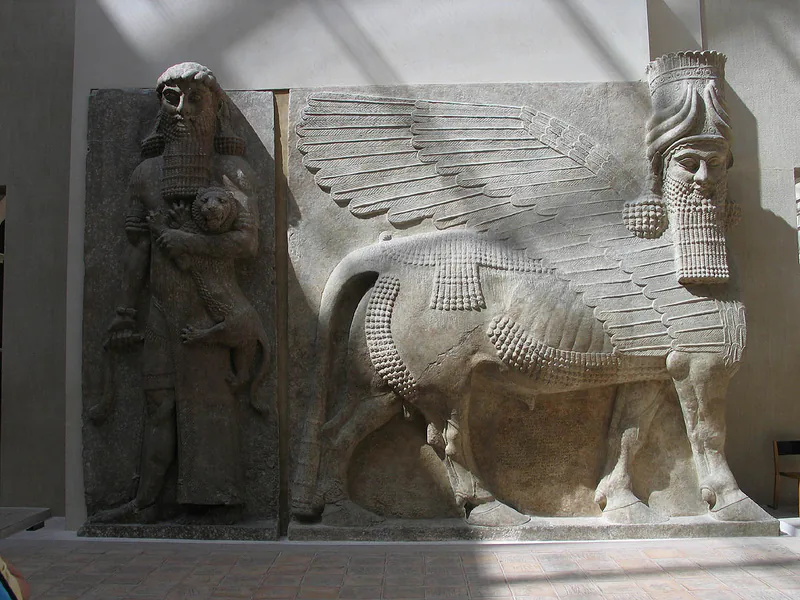
Utnapishtim's reply, on Tablet XI, is the story of the flood. The gods resolved to destroy humankind, but the wise god Ea warned Utnapishtim by speaking to the reed wall of his house, telling him to build a great boat and take aboard his family, craftsmen and living creatures. The storm raged for six days and seven nights; afterwards the boat rested on Mount Nimush, and Utnapishtim sent out a dove, a swallow and a raven. When he made an offering, the gods gathered over it like flies. Enlil, furious at the survival, was rebuked by Ea, and granted Utnapishtim and his wife immortality. The episode adapts an older Babylonian poem, Atrahasis, which sets the flood in a fuller account of creation.
Utnapishtim then challenges Gilgamesh to stay awake for a week. He falls asleep at once. As a parting gift he learns of a plant at the bottom of the sea whose name means "the old man becomes young"; he dives and gets it, but while he bathes a serpent carries it off and sloughs its skin. Gilgamesh returns empty-handed to Uruk and shows Urshanabi its walls, the lasting work of human hands with which the poem began.
Death, the Underworld and Gilgamesh as a God§
The epic is often read as a meditation on mortality, and its religious assumptions are characteristically Mesopotamian. Humans were created to serve the gods, and life, not eternity, is their portion. The gods are powerful, quarrelsome and not always just: Ishtar's anger and Enlil's flood show divine will as dangerous rather than benevolent. Wisdom lies in recognising limits, honouring the gods and leaving a name through great works.
Yet the poem also belongs to a world of ritual. Dreams are omens, interpreted by Gilgamesh's mother Ninsun; offerings, laments and funerary gifts are carefully described after Enkidu's death; and the hero who fails to win immortality becomes a lord of the dead in cult. Tablet XII, with its account of Enkidu's report from the netherworld about how the dead fare according to their burial and their descendants' care, links the epic to the practice of offerings for ancestors. Mesopotamian anxieties about restless ghosts and demons, discussed in Lamashtu and Pazuzu and the wider Mesopotamian magic tradition, form the background.
Gilgamesh's name outlived cuneiform. Aramaic fragments of the Book of Giants from Qumran, a work connected with the Book of Enoch and later adapted by the Manichaeans, include a giant called Gilgamesh.
Rediscovery at Nineveh and the Bible Debate§
The epic was lost for almost two thousand years. In the 1850s Austen Henry Layard and Hormuzd Rassam excavated thousands of tablets from Ashurbanipal's palaces at Nineveh for the British Museum. In 1872 the self-taught Assyriologist George Smith recognised among them a fragment describing a ship on a mountain and a bird sent out to find land, and announced it to the Society of Biblical Archaeology that December.
The parallels with Genesis 6–9 are close: a divine decision to destroy humanity, a warning to one righteous man, a great vessel carrying animals, a landing on a mountain, birds released (in the King James Version Noah "sent forth a raven" and then a dove) and a sacrifice whose smell pleases the deity. Victorian commentators used the tablet both to defend and to challenge the Bible. Most scholars today conclude that the biblical writers knew and reworked a widespread Mesopotamian flood tradition, recasting it in monotheistic and moral terms, rather than that either text simply copied the other.
Gilgamesh is now among the most translated works of ancient literature. Its manuscripts remain a matter of cultural heritage too: in 2021 the so-called Gilgamesh Dream Tablet, looted from Iraq and sold to a museum in the United States, was returned to Baghdad.
Frequently asked questions§
Was Gilgamesh a real person?§
Probably. The Sumerian King List and other early texts place a king Gilgamesh at Uruk around 2700 BCE, and most historians accept that he existed, though no contemporary inscription of his has been found. The epic surrounds him with legend and treats him as partly divine.
Who wrote the Epic of Gilgamesh?§
No single author. The stories began as Sumerian poems, were combined into an Akkadian epic around 1800 BCE and were revised into the Standard Babylonian version, which Mesopotamian tradition attributed to the scholar Sîn-lēqi-unninni, probably in the late second millennium BCE.
Is the Gilgamesh flood the same as Noah's flood?§
The two stories share many details, including the warning, the boat, the animals, the birds and the sacrifice. Most scholars think the biblical account draws on a common Mesopotamian tradition also preserved in the poem Atrahasis, but reshapes it with a different theology.
Sources and further reading§
- The Babylonian Gilgamesh Epic: Introduction, Critical Edition and Cuneiform Texts — A. R. George, 2003
- The Epic of Gilgamesh — Andrew George, 1999
- The Evolution of the Gilgamesh Epic — Jeffrey H. Tigay, 1982
- Myths from Mesopotamia — Stephanie Dalley, 1989
- The Treasures of Darkness: A History of Mesopotamian Religion — Thorkild Jacobsen, 1976
- The Buried Book: The Loss and Rediscovery of the Great Epic of Gilgamesh — David Damrosch, 2007