Liber II · Ancient Magic · Chapter VI: Mesopotamian Magic
Lamashtu and Pazuzu: Demons and Amulets of Ancient Mesopotamia
Lamashtu and Pazuzu explained: the demoness who threatened mothers and infants, the wind demon used against her, and their incantations and amulets.

Lamashtu (Lamaštu) and Pazuzu are the two best-known demonic figures of ancient Mesopotamia. Lamashtu was a fearsome demoness, called the daughter of the sky god Anu, who was believed to attack pregnant women and newborn children; Pazuzu, king of the evil wind spirits, was himself a dangerous being but was widely used in the first millennium BCE as a protective power against her, so that amulets combining the two hung in many Assyrian and Babylonian households.
Lamaštu, Daughter of Anu§
Among the many demons of Mesopotamian belief, Lamaštu held a special place. Most demons were regarded as agents sent by the gods to punish wrongdoing, but Lamaštu was said to act on her own initiative, out of sheer malevolence. Incantations call her the daughter of Anu, the sky god, and describe how she was cast down from heaven because of her wicked plans. Her Sumerian name was Dimme, and she is mentioned in incantations from the Old Babylonian period, in the early second millennium BCE, onward.
Her victims were above all pregnant women, mothers in childbirth and infants. Incantations describe her slipping into houses through doors and windows, touching the bellies of pregnant women, snatching babies from the wet nurse, and drinking blood and gnawing flesh. She was also blamed for fevers and wasting illnesses in adults and for diseases of animals. In a world of high maternal and infant mortality, she gave a name and a face to the most feared losses of family life. The wider demonology of Mesopotamia, and the exorcists who dealt with it, are introduced in Mesopotamian Magic.
Texts and images describe her as a monstrous composite: a lion's head, donkey's teeth or ears, a hairy body, bird's talons and hands that clutch snakes. She is often shown suckling a dog and a pig, animals regarded as unclean, a grim inversion of the nursing mother whose children she threatened.
The Lamaštu Incantations and Rituals§
The main source for Lamaštu is a standard series of incantations and rituals in three tablets, known from first-millennium copies in Assyrian and Babylonian libraries, with forerunners going back to the second millennium. Walter Farber's edition of 2014 gathered the texts and showed how stable the tradition was over many centuries. The series was used by the āšipu, the professional exorcist, and contained incantations to be recited over the patient and instructions for accompanying rituals.
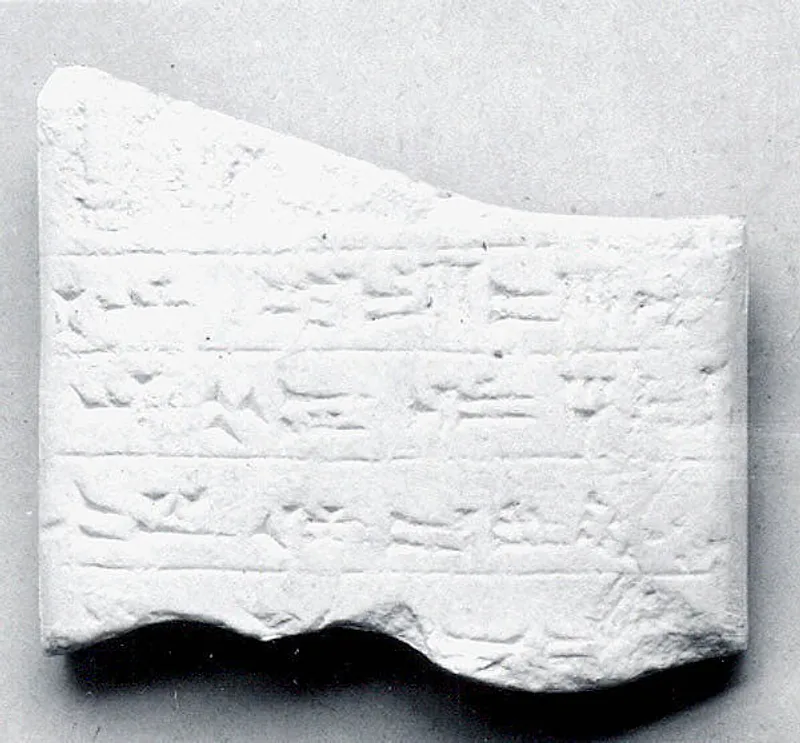
A characteristic feature of the rituals is that Lamaštu was not only driven away but sent off with provisions. A clay figurine of the demoness was made and given gifts suited to a woman going on a journey: a comb, a spindle, a flask of oil, sandals, a brooch and food. The figure might be placed beside the patient for several days and then removed, buried by a wall or sent away into the steppe. Other rites involved knotted cords, ointments and the wearing of stone beads strung on coloured threads. The logic resembles that of the anti-witchcraft ceremony described in Maqlû: a dangerous power was given a body in clay so that it could be addressed, judged and expelled. A historical description of these practices appears in the spellbook entry on Lamashtu amulets.
Lamaštu Plaques and Their Imagery§
The most striking evidence for Lamaštu comes from small amulet plaques of bronze or stone, most dating from the first millennium BCE, which were hung in houses or worn. The best-known example, a bronze plaque in the Louvre, is arranged in horizontal registers like a miniature cosmos. At the top, the symbols of the great gods watch over the scene. Below them a row of demons with animal heads, probably the Seven, are shown in procession. In the central register a sick person lies on a bed, attended by figures dressed in fish-skin cloaks, representing the apkallū, the primeval sages associated with exorcism. In the lowest register Lamaštu kneels on a donkey in a boat, holding snakes and suckling animals, surrounded by the gifts given to her, as she is driven away down the river towards the underworld. Over the top edge of the plaque the head of Pazuzu peers down, his body on the reverse, as if gripping the whole scene.
Simpler plaques show only Lamaštu with her attributes and an incantation inscribed on the back. Together these objects show how text, image and ritual worked together in Mesopotamian protection: the amulet both depicted the expulsion of the demoness and was believed to bring it about.
Pazuzu, King of the Wind Demons§
Pazuzu is attested mainly from the early first millennium BCE, though his origins may be earlier. A famous bronze statuette in the Louvre bears an inscription in which he introduces himself as Pazuzu, son of Hanbu, king of the evil wind demons, who rose violently from the mountains. Wind in Mesopotamian thought could carry disease, and Pazuzu was associated with the destructive winds that blew across the land.
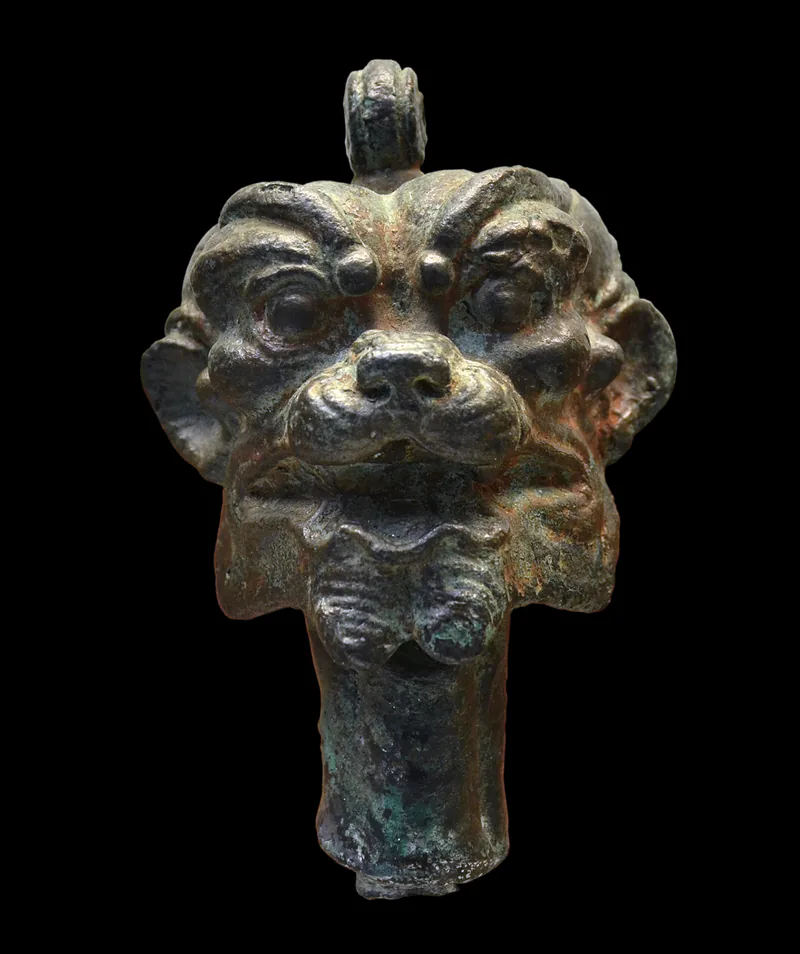
His appearance is unmistakable: a snarling, dog-like or lion-like face with bulging eyes, four wings, the talons of a bird of prey, a scorpion's tail and, in some images, a serpent-headed phallus. He usually stands upright with his right hand raised and his left lowered. Nils Heeßel's comprehensive study of the surviving Pazuzu objects and texts has clarified his iconography, date range and functions.
Pazuzu was dangerous, but his ferocity could be turned to protective use. Mesopotamian magic often set one demon against another, and Pazuzu became the most effective opponent of Lamaštu, perhaps because, as lord of the winds, he could force her back to the underworld. Incantations invoke him for this purpose, and his image was placed wherever her attacks were feared.
Pazuzu Heads and Protective Amulets§
The commonest Pazuzu objects are small heads of bronze, stone, faience or clay, pierced or fitted with a loop so that they could be hung on a cord. Many were worn by pregnant women or hung near beds, and some have been found in graves and houses. Larger heads and statuettes stood in homes, and Pazuzu also appears on the Lamaštu plaques, his head appearing above the edge. These objects spread across Mesopotamia and into neighbouring regions during the Neo-Assyrian and Neo-Babylonian periods, and they probably continued to be made into the Persian era.
The use of Pazuzu shows a recurring feature of ancient protective magic: the guardian is often as frightening as the threat. Similar logic lies behind the grotesque Egyptian god Bes, a household protector of mothers and infants discussed in Ancient Egyptian Amulets, and behind the many monstrous guardian figures placed at the doors of Assyrian palaces. The general history of such objects is traced in Amulets and Talismans.
Lamaštu, Pazuzu and Later Child-Stealing Demons§
Lamaštu belongs to a family of female demons who threaten mothers and children across the ancient Mediterranean and Near East. Scholars have compared her with the Greek Gello, the Byzantine Gylou, and above all with Lilith, who in Jewish tradition became the principal danger to newborns. The Aramaic incantation bowls of late antique Mesopotamia, discussed in Jewish Incantation Bowls, often name Lilith and her kind and use legal formulas of divorce and expulsion that recall the much older Mesopotamian practice of sending a demon away.
Medieval Jewish childbirth amulets naming the three angels Sanoi, Sansanoi and Semangelof against Lilith continue the same concern; their history is described in the spellbook entry on the Sanoi and Sansanoi amulet. Direct lines of descent are hard to prove, but the long persistence of the theme shows how deeply the dangers of childbirth shaped protective magic in the region.
Modern Afterlives: From Museum to Film§
Lamaštu plaques and Pazuzu heads entered European museums during the excavations of the nineteenth and twentieth centuries and have since become familiar images of ancient Mesopotamia. Pazuzu gained a much wider fame through William Peter Blatty's novel The Exorcist (1971) and the 1973 film, which open with the discovery of a Pazuzu figure in northern Iraq and make him the possessing demon. This modern image, which presents Pazuzu as purely evil, reverses his principal ancient role as a protector of mothers and children. The cultural setting of both figures is described in Mesopotamian Religion.
Frequently asked questions§
Who was Lamashtu?§
Lamashtu, or Lamaštu, was a Mesopotamian demoness called the daughter of the sky god Anu. She was blamed for miscarriage, the death of infants and mothers in childbirth, and fevers, and was fought with incantations, rituals and amulets.
Was Pazuzu good or evil?§
Pazuzu was a dangerous demon of the winds, but in practice he was mainly used as a protective figure. His image was worn and displayed to drive away Lamaštu and other evils, especially during pregnancy and childbirth.
What does a Pazuzu amulet look like?§
Most Pazuzu amulets are small heads of bronze, stone or faience with a snarling, dog-like face, bulging eyes and a loop for hanging. Full-figure statuettes show him with four wings, bird talons and a scorpion's tail.
Sources and further reading§
- Lamaštu: An Edition of the Canonical Series of Lamaštu Incantations and Rituals and Related Texts from the Second and First Millennia B.C. — Walter Farber, 2014
- Pazuzu: Archäologische und philologische Studien zu einem altorientalischen Dämon — Nils P. Heeßel, 2002
- Gods, Demons and Symbols of Ancient Mesopotamia — Jeremy Black and Anthony Green, 1992
- Mesopotamian Protective Spirits: The Ritual Texts — F. A. M. Wiggermann, 1992
- Mesopotamian Witchcraft: Toward a History and Understanding of Babylonian Witchcraft Beliefs and Literature — Tzvi Abusch, 2002