Childbirth Amulet of Sanoi, Sansanoi and Semangelof
The Jewish childbirth amulet naming the angels Sanoi, Sansanoi and Semangelof: how it is customarily kept, Sefer Raziel, the Lilith legend and its history.
- TraditionJewish amulet tradition: Alphabet of Ben Sira (c. 8th–10th century); Sefer Raziel ha-Malakh (Amsterdam, 1701)
- ForProtection, Blessings
- DifficultySimple
- TimeKept from late pregnancy until some days after the birth
- WhenPrepared in the last weeks of pregnancy and kept through the birth and the first days of the child's life (often until the brit milah or naming)

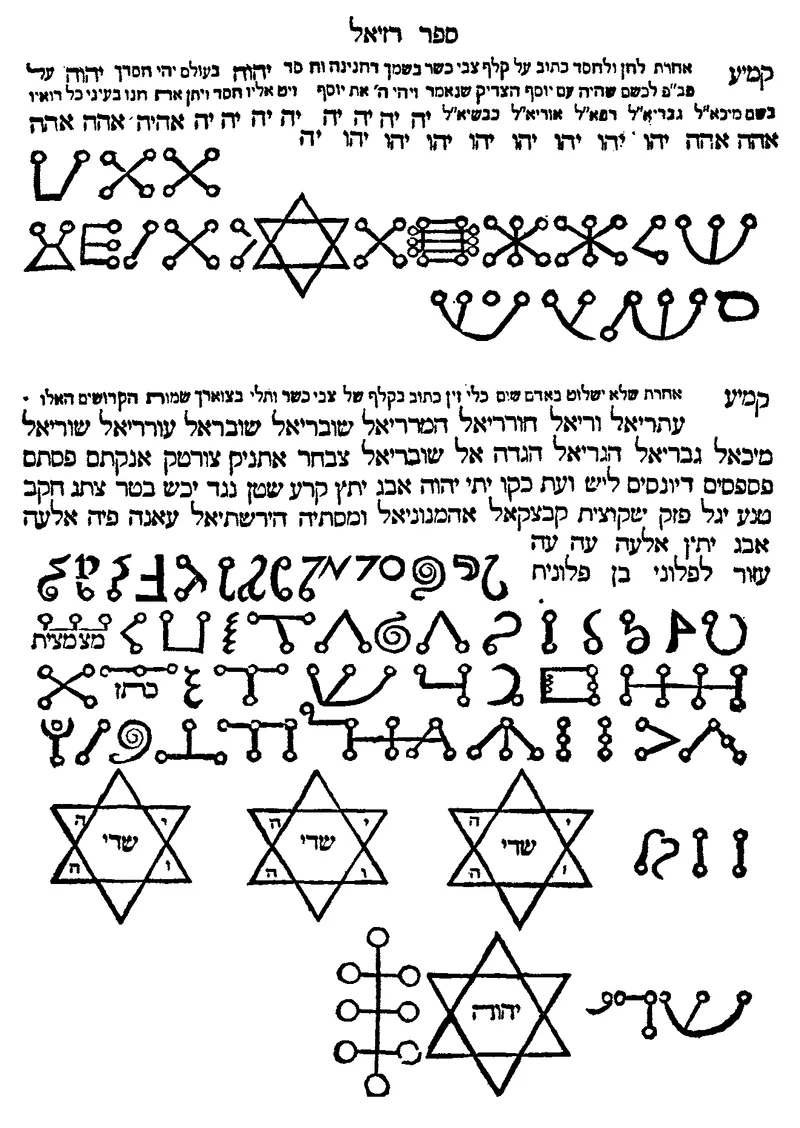
For many centuries Jewish families placed a protective amulet in the room of a woman about to give birth and beside the newborn's cradle. The most famous form names three angels, Sanoi, Sansanoi and Semangelof, together with Adam and Eve and the words "Lilith, out!", and a celebrated version was printed in the kabbalistic book Sefer Raziel ha-Malakh in 1701. It is a religious object rather than a spell in the usual sense: an expression of prayer for mother and child, written with divine names and kept with reverence. This entry describes the custom as it is observed, respectfully and in the community's own terms.
How to do it§
Customs vary among Ashkenazi, Sephardi, Mizrahi and Italian communities, and observant families usually ask their rabbi which practice to follow.
- Obtaining the amulet. Because it contains divine names, a traditional amulet (kamea) is written by a qualified scribe, a sofer, on parchment or paper, or a printed version is used. Many families today use a simpler printed card headed Shir ha-Ma'alot, bearing Psalm 121 and the angels' names, sometimes called by the Yiddish kimpet-brivl, "childbed letter".
- Placing it. In the last weeks of pregnancy the amulet is placed in the room where the mother will give birth, or packed in the hospital bag. Some hang copies on each wall or door of the room.
- Prayer. Family and friends recite psalms for the mother; Psalm 20 ("The LORD hear thee in the day of trouble") and Psalm 121 are customary during labour. Some give tzedakah, charity, on the mother's behalf.
- After the birth. The amulet is moved beside the cradle and kept there during the first days of life, traditionally until the circumcision (brit milah) on the eighth day for a boy or the naming of a girl, and in some communities for thirty days.
- Afterwards. The amulet is kept among family keepsakes, or, if worn, placed in a genizah or buried, as is done with any paper bearing the divine name. It is never simply thrown away.
Origins and history§
Fear of demonic harm to mothers and infants is very old in the Near East. The Mesopotamian demoness Lamashtu was blamed for miscarriage and infant death, and Aramaic incantation bowls buried under houses in Sasanian Mesopotamia (fifth to seventh centuries) invoke protection against "liliths". The Talmud knows Lilith as a female night demon.
The specific story behind the amulet comes from the Alphabet of Ben Sira, a satirical and folkloric Hebrew work usually dated between the eighth and tenth centuries. In it, Lilith is Adam's first wife, who left him rather than accept subordination. God sent three angels, Snvi, Snsnvi and Smnglf, to bring her back; she refused, but swore that wherever she saw their names or likenesses on an amulet, she would not harm the newborn. Scholars note close parallels with Christian Byzantine and Ethiopic charms in which Saint Sisinnios and his companions defeat a child-stealing demoness, and many think the two traditions share a common source.
Sefer Raziel ha-Malakh, "The Book of the Angel Raziel", was printed at Amsterdam in 1701 from older kabbalistic and magical material, some of it going back to medieval German pietists. It contains a full-page childbirth amulet with the figures and names of the three angels, the names of Adam and Eve, and formulas banishing Lilith. The printed book itself was widely kept in homes in the belief that it protected the house, and its amulet was copied countless times by scribes and printers in eastern Europe, North Africa and the Middle East. Examples survive in the collections of Jewish museums.
Rabbinic attitudes to amulets have always varied. The Mishnah (Shabbat 6:2) permits an "approved amulet" to be worn on the Sabbath, while Maimonides criticised amulets as superstition. In practice the childbirth amulet remained a beloved part of family life well into the twentieth century and continues in many communities today.
Variations§
Some amulets add Psalm 121, the priestly blessing (Numbers 6:24–26), a hamsa or a Star of David. Italian Jewish communities printed decorated shemirot for the birth room. In Kurdistan and North Africa, amulets were often silver cases containing a written text.
Safety and good sense§
An amulet expresses prayer and hope; it never replaces antenatal care. Follow the advice of your midwife and doctor, attend appointments and seek urgent help for any warning signs in pregnancy or after birth. Keep cords, chains and small objects out of reach of babies, and do not tie anything around an infant's neck or place loose items in the cot.
Sources and further reading§
- Jewish Magic and Superstition — Joshua Trachtenberg, 1939
- Sepher Raziel: Liber Salomonis — Don Karr & Stephen Skinner, 2010
- Sepher Rezial Hemelach: The Book of the Angel Rezial — Steve Savedow, 2000
- Amulets and Magic Bowls: Aramaic Incantations of Late Antiquity — Joseph Naveh & Shaul Shaked, 1985
- Ancient Jewish Magic: A History — Gideon Bohak, 2008
- Kabbalah — Gershom Scholem, 1974