The Hand of Fatima: Khamsa Protection in Muslim Custom
The Hand of Fatima (khamsa) in Muslim custom: hanging it against the evil eye, the protective suras, debates over amulets, its symbolism and history.
- TraditionPopular Muslim custom of the Maghreb and the Middle East, medieval to modern; Shi'i devotion to the Five of the Prophet's household
- ForProtection, Home & hearth, Luck
- DifficultySimple
- Time15–20 minutes
- WhenOn moving house, at weddings and births, or whenever a family's good fortune might attract envy; Friday is a blessed day for new undertakings

The Hand of Fatima, called khamsa ("five") across North Africa, is an open hand hung over doorways, painted on walls and worn as jewellery to repel the evil eye. It is named for Fatima al-Zahra, daughter of the Prophet Muhammad, and in Shi'i devotion the five fingers also recall the five members of the Prophet's household. Muslims hold differing views about such objects: many scholars teach that protection should be sought through the Qur'an and prayer alone, while popular custom in much of the Muslim world has long combined the two. This entry describes both, in believers' own terms.
How to do it§
- Begin with intention and remembrance. Make ablution (wudu) if you wish, and say Bismillah, "In the name of God". In Muslim understanding, protection comes from God alone; any object is at most a reminder of that.
- Recite the protective suras. The Prophet is reported in the hadith collections to have sought refuge by reciting the two "refuge" suras, al-Falaq (113) and al-Nas (114), together with al-Ikhlas (112), especially at night. Many also recite the Throne Verse, Ayat al-Kursi (2:255). Recite them for yourself and your household.
- Hang the khamsa (if your practice includes it). Fix it inside the main entrance, over a shop door, or above a child's bed. Families in the Maghreb often choose silver, the "pure" metal, sometimes with a blue stone or an eye at the centre.
- Say the words against envy. When admiring something, Muslims say ma sha' Allah, "what God wills", following Qur'an 18:39, and la quwwata illa billah, "there is no power except with God", so that admiration does not become envy. Many say this as they hang a khamsa.
- Give thanks and charity. Thank God for the blessings of the home and give sadaqa, voluntary charity, which many regard as a protection in itself.
- Keep it respectfully. If the khamsa bears Qur'anic words, keep it clean and above floor level; when it is worn out, it may be buried or wrapped and disposed of respectfully, as one does with worn pages of the Qur'an.
Origins and history§
The evil eye (al-'ayn) is affirmed in Islamic sources: the hadith collections of al-Bukhari and Muslim report the Prophet saying "the eye is real", and recommend seeking refuge by recitation. The Qur'an's last two suras, the Mu'awwidhatayn, are traditionally linked with protection against envy and hidden harm.
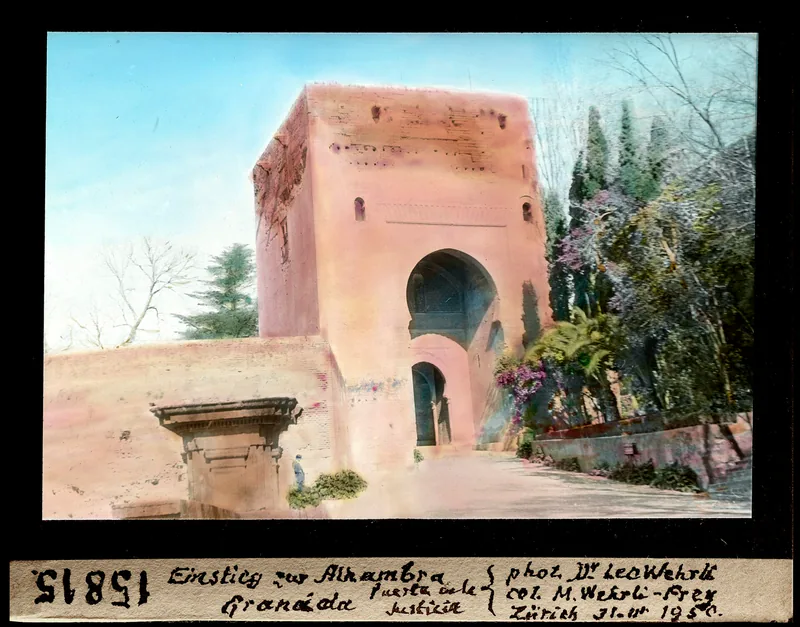
The open hand as an apotropaic sign is older than Islam and found around the Mediterranean, but its continuous history is unclear. Clear Islamic examples become plentiful from the later Middle Ages. A hand is carved on the keystone of the outer arch of the Gate of Justice of the Alhambra in Granada, built in 1348 under Yusuf I, with a key on the inner arch; its meaning is debated, with some reading the five fingers as the five pillars of Islam. In the Maghreb the expression khamsa fi 'aynik, "five in your eye", is still used to deflect envy, and khamsas were made by both Muslim and Jewish craftsmen.
The name "Hand of Fatima" (yad Fatima) is used in parts of the Maghreb and became common in European writing about North Africa. In Shi'i tradition, hands crown the standards ('alam) carried in Muharram processions and recall both the Panjtan, the five of the Prophet's household (Muhammad, Ali, Fatima, Hasan and Husayn), and the severed hands of Abbas ibn Ali at Karbala in 680.
Islamic scholars have long debated amulets (tama'im). A hadith in the Musnad of Ahmad ibn Hanbal condemns hanging amulets, and many Sunni scholars, especially in reformist and Salafi movements, regard the khamsa as impermissible or superstitious. Others permit amulets containing only Qur'anic verses or the names of God. In practice the khamsa remains part of everyday material culture across North Africa and beyond.
Variations§
Some households prefer a framed calligraphy of Ayat al-Kursi or ma sha' Allah over the door instead of a hand. In Turkey the blue glass eye (nazar boncuğu) is more common than the hand. Khamsas are pinned to babies' clothing, sewn into bridal textiles, and hung from car mirrors.
Safety and good sense§
Fix any hanging object securely, keep small pendants and chains out of reach of babies, and do not tie cords around a child's neck. Spiritual protection is no substitute for ordinary safety measures, medical care, or legal and practical help when it is needed.
Sources and further reading§
- The Evil Eye: A Casebook — Alan Dundes (ed.), 1981
- Magic and Divination in Early Islam — Emilie Savage-Smith (ed.), 2004
- Islamic Occultism in Theory and Practice — Liana Saif, Francesca Leoni, Matthew Melvin-Koushki & Farouk Yahya (eds.), 2021
- Islam, Arabs, and the Intelligent World of the Jinn — Amira El-Zein, 2009
- And Muhammad Is His Messenger: The Veneration of the Prophet in Islamic Piety — Annemarie Schimmel, 1985
- An Introduction to Shi'i Islam: The History and Doctrines of Twelver Shi'ism — Moojan Momen, 1985