The Spellbook · Black & White Magic
Vegvísir: Drawing the Icelandic Wayfinder Stave
How to draw and carry the Vegvísir, the Icelandic wayfinder stave from the 19th-century Huld manuscript, and why it is not a Viking-age symbol at all.
- TraditionIcelandic galdrastafir (magical staves), Huld manuscript, mid-19th century
- ForTravel, Protection
- DifficultySimple
- Time30 minutes
- WhenBefore a journey; the manuscript gives no timing

The Vegvísir ("way-shower" or "signpost") is an Icelandic magical stave: eight branched arms radiating from a centre, each ending in a different mark. A short note in a nineteenth-century manuscript says that whoever carries it will not lose their way in storms or bad weather, even when the way is unknown. Since the 1990s it has become one of the most popular "Norse" symbols in the world, often wrongly called a Viking compass. This entry explains how to draw and carry it as a travel charm and sets out its real history.
How to do it§
- Find a good image. Work from a reproduction of the Huld manuscript form or a careful modern drawing of it. The eight arms are not identical: each has its own pattern of crossbars, forks and circles, and copying them faithfully is part of the tradition of galdrastafir.
- Draw the frame. With pencil and compass draw a small central circle. With a ruler draw eight lines out from it at equal angles, like the points of a compass rose. Many modern versions add an outer ring or a ring of runes; these are not in the manuscript and are optional.
- Add the terminals. At the end of each arm draw its distinctive mark — tridents, crossbars, small circles and hooks — following your model.
- Ink it. Go over the pencil lines in black ink, or burn them into wood. Icelandic staves were often drawn or carved, and some instructions specify particular materials; plain ink or carving is enough.
- Speak your purpose. Holding the finished stave, say aloud in your own words what it is for: "Show me my way; keep me from losing my road in storm or fog."
- Carry it. Fold the paper and keep it in a wallet, bag or glovebox, or carry the wooden piece in a pouch. The manuscript's note speaks of "carrying" the sign.
- Return and renew. When it becomes worn, burn it respectfully in a hearth or fire-proof dish and draw a new one.
Origins and history§
Icelandic magical staves (galdrastafir, singular galdrastafur) are known from manuscripts of roughly the seventeenth to the nineteenth centuries. They combine elements from runes, Latin letters, Christian crosses, and the seals and characters of continental grimoires such as the Key of Solomon. Iceland had its own witch trials between about 1625 and 1685, in which around twenty people, nearly all men, were burned; possession of staves and magical papers featured in several cases. See sigils.
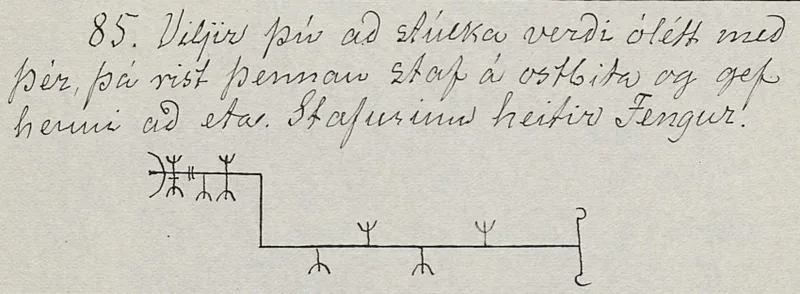
The Vegvísir itself is known from the Huld manuscript, ÍB 383 4to, now in the National and University Library of Iceland in Reykjavík. It was assembled in the mid-nineteenth century by Geir Vigfússon, usually dated around 1860, and is a compilation of older magical material. Similar forms are reported in one or two other late manuscripts. It does not appear in the sagas, in runic inscriptions, or in any archaeological find of the Viking Age, and there is no evidence that Norse seafarers used it. It is also not found in the better-known Galdrabók, a sixteenth- to seventeenth-century manuscript of Icelandic spells now in Stockholm.
Its modern fame dates from the late twentieth century, when Icelandic folklore books and later tattoo culture, video games and Viking-themed fashion made it a symbol of Norse identity. Stephen Flowers' translation of the Galdrabók (1989) and the opening of the Museum of Icelandic Sorcery and Witchcraft at Hólmavík (2000) drew international attention to the staves. Scholars and Icelandic museums regularly point out that the "Viking compass" label is anachronistic, and that the symbol has also been taken up by some far-right groups, though most people who use it have no such associations. See runes and Norse and Germanic religion.
Variations§
- With a runic ring: many modern designs encircle the stave with the Elder Futhark; this is a modern addition.
- Carved in wood: some Icelandic staves were to be carved on wood or drawn in specific inks; wood or paper are good modern choices.
- Related staves: the Ægishjálmur or "helm of awe" belongs to the same family of galdrastafir.
Safety and good sense§
- A charm is no substitute for a map, a charged phone, weather checks and telling someone your route, especially in mountains or at sea.
- If you burn an old stave, do it in a fireplace or fire-proof dish and never leave it unattended; take care with wood-burning pens.
- Tattoos are permanent; if you are considering a Vegvísir tattoo, understand its history and the design you choose.
- Present the symbol honestly as nineteenth-century Icelandic folk magic rather than as an ancient Viking emblem.
Sources and further reading§
- The Galdrabók: An Icelandic Grimoire — Stephen E. Flowers, 1989
- Runes: A Handbook — Michael P. Barnes, 2012
- Norse Mythology: A Guide to the Gods, Heroes, Rituals, and Beliefs — John Lindow, 2001
- Grimoires: A History of Magic Books — Owen Davies, 2009
- Magic in the Middle Ages — Richard Kieckhefer, 1989