The Spellbook · Witchcraft & Wicca
Sailors' Wind Knots: Three-Knot Cord for a Safe Voyage
The northern sea custom of wind knots: tying three knots in a cord as a blessing for a safe voyage, with the history of Finnish, Sámi and Orkney wind-sellers.

For centuries, writers on the far north of Europe told of wise women and men who "sold the wind" to sailors in a knotted cord. Untie the first knot and a gentle breeze would rise; the second, a strong wind; the third, a storm. The custom is recorded among Finnish and Sámi wizards, in Shetland, Orkney and the Isle of Man. The modern working below keeps the three knots as a travel blessing for any journey by water or land, without the storm.
How to do it§
- Choose the cord. Use natural twine or cord, about an arm's length. Sailors' wind-cords were often described as a thread or a strip of cloth; anything that will hold a firm knot will do.
- Sit quietly with the cord across your knees and think of the journey ahead: its route, its purpose, the people you will meet and leave.
- Tie the first knot near one end, saying in your own words: "A fair wind to carry me out."
- Tie the second knot in the middle: "A steady way, without storm or hindrance."
- Tie the third knot near the other end: "A safe harbour and a safe return." Unlike the old charms, the third knot here is for arrival, not for a gale.
- Carry the cord in a pocket, bag or the boat's chart table for the whole journey.
- Untie on arrival. When you reach your destination, untie the first two knots with thanks. Untie the third when you arrive home.
- Return the cord. Coil it and keep it for the next journey, or bury it in a garden.
Origins and history§
The idea that winds could be bound in knots appears in late medieval and early modern descriptions of the north. The fourteenth-century chronicler Ranulf Higden, in his Polychronicon, reports that on the Isle of Man women sold winds to sailors enclosed in knots of thread. The Swedish churchman Olaus Magnus, in his History of the Northern Peoples (Historia de gentibus septentrionalibus, 1555), describes Finns and Sámi who tied three knots in a cord or thong for merchants detained by contrary winds: loosening the first gave a moderate wind, the second a stronger one, and the third a tempest. The accompanying woodcuts became famous and were reproduced for centuries.
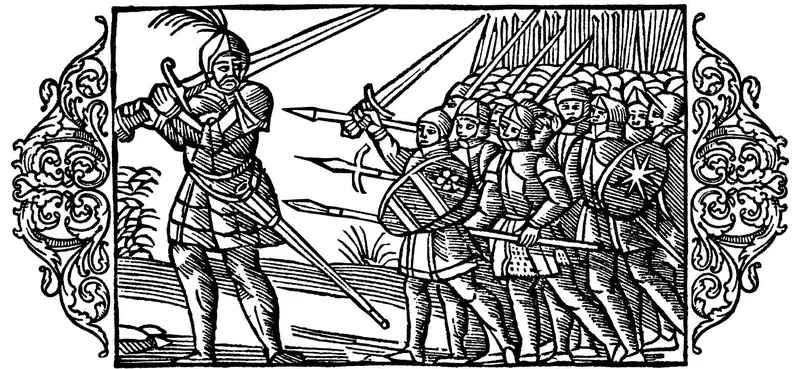
The theme passed into English literature: the witches in Macbeth (c. 1606) offer one another winds, and accounts of Lapland "wind-sellers" were a commonplace of travel writing. In Scotland the custom was attached to particular wise women. The best known is Bessie Millie of Stromness in Orkney, an old woman who sold favourable winds to sailors for a small sum in the early nineteenth century; Walter Scott met her during a voyage in 1814 and drew on her for the character of Norna in The Pirate (1821). Similar sellers of wind are reported from Shetland and the Hebrides.
James George Frazer gathered many of these accounts in The Golden Bough under the heading of knot magic, placing them alongside the belief, found in many cultures, that knots can bind or release forces. Historians of witchcraft note that the same idea had a dark side: in Scottish trials, notably the North Berwick case of 1590–91, accused witches were charged with raising storms against the king's ship, and knots were also feared as a means of causing impotence or hindering childbirth. The benign wind-selling of the old sailors' world existed side by side with these fears. See folk magic and the history of witchcraft.
Variations§
- Seven or nine knots: some knot charms use more knots, each with its own request.
- Knotted handkerchief: carried by fishermen's families as a token for a safe return.
- Ladder or cord charms: other knot-and-cord workings for general intentions; see knot magic.
- Untying knots at childbirth: in much of Europe all knots in a house were loosened when a woman was in labour, to ease the birth.
Safety and good sense§
- Check weather and sea forecasts, carry life jackets and safety equipment, and tell someone your plans; no charm commands the weather.
- Never tie cords around your neck or a child's, and keep loose cords away from moving machinery and rigging.
- If you bury the cord, use natural fibre only.
- Travel anxiety that is severe deserves practical help; a token can comfort, but planning and support do more.
Sources and further reading§
- Description of the Northern Peoples (Historia de gentibus septentrionalibus) — Olaus Magnus, 1555
- The Golden Bough — James George Frazer, 1890
- Popular Magic: Cunning-Folk in English History — Owen Davies, 2003
- The Witch: A History of Fear — Ronald Hutton, 2017
- Religion and the Decline of Magic — Keith Thomas, 1971