Psalm 121 Blessing for Safe Travel and Journeys
How Psalm 121 is prayed for a safe journey in Jewish and Christian tradition, with the traveller's prayer, the Itinerarium, charity customs and history.
- TraditionJewish and Christian travellers' devotions: Tefillat ha-Derekh (Talmud, Berakhot 29b–30a) and the Itinerarium of the Latin breviary
- ForTravel, Protection, Blessings
- DifficultySimple
- Time5–10 minutes
- WhenBefore setting out on a journey; Jewish custom says the traveller's prayer once one is on the road

Psalm 121, "I will lift up mine eyes unto the hills", is the traveller's psalm of the Bible. Its promise that God will keep the pilgrim's "going out and coming in" made it a natural prayer before a journey for Jews and Christians alike, alongside the Jewish Tefillat ha-Derekh (the Wayfarer's Prayer) and the Latin Itinerarium said by clergy setting out on the road. This short blessing gathers those customs into a simple form anyone of either faith can use.
How to do it§
- Before you leave. Pause at the door with your bags packed. Some families gather for a moment around the traveller.
- Set aside charity. An old Jewish custom gives the traveller a coin to donate at the destination, making them a shaliach mitzvah, an emissary on a good errand, whom the Talmud says comes to no harm. Christians may likewise set aside an offering.
- Read Psalm 121. Read it slowly, aloud if you can. Its last verse runs, in the King James Version: "The LORD shall preserve thy going out and thy coming in from this time forth, and even for evermore."
- Say a traveller's prayer. Jews add the Tefillat ha-Derekh from the prayer book once on the road, asking to be led in peace and brought home in life, joy and peace. Catholics may say the Itinerarium, which begins with the antiphon In viam pacis ("May the almighty and merciful Lord direct us into the way of peace") and the Benedictus. Others may simply pray in their own words for the journey, the driver or pilot, and those waiting at home.
- Carry the psalm. Write the psalm, or just its last verse, on a card and keep it in your wallet, passport case or glove compartment.
- On return. Give thanks. Jews who have completed a dangerous journey, such as crossing the sea or desert, recite the blessing Birkat ha-Gomel in the synagogue; others may read Psalm 121 again or say a prayer of thanksgiving, and give the charity they set aside.
Origins and history§
Psalm 121 is one of the fifteen "Songs of Ascents" (Psalms 120–134), which many scholars think were sung by pilgrims going up to Jerusalem for the festivals. Its imagery (hills, a foot that does not slip, the sun by day and the moon by night) suits the hazards of ancient travel. In Jewish life it became one of the most widely used protective psalms: it is printed on cards hung in the rooms of mothers and newborns, it is recited for the sick, and it stands among the psalms of many Shimmush Tehillim traditions that assign psalms to particular needs.
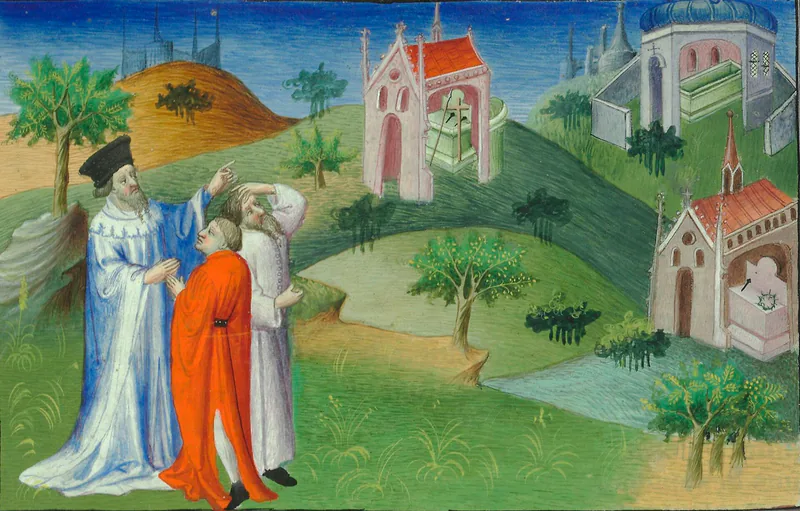
The Wayfarer's Prayer is discussed in the Babylonian Talmud (Berakhot 29b–30a), which gives its wording and debates when and how it should be said, for example that it should be recited once one has left the town. Medieval and modern prayer books expanded it, and many add Psalm 121 or Genesis 32:2–3, where angels meet Jacob on the road. The custom of giving a traveller charity money rests on a Talmudic teaching that those on a religious errand are not harmed (Pesachim 8b).
In Latin Christianity, the Itinerarium Clericorum was printed in the Roman Breviary as the prayer of clergy setting out on a journey. It combines the Benedictus (Luke 1:68–79), versicles and prayers recalling the journeys of Abraham, the Israelites in the desert and the three Magi, and asks for the company of an angel, as Raphael accompanied Tobias in the Book of Tobit. Popular devotion added saints associated with travel, especially St Christopher, whose image was believed to keep the viewer from sudden death that day, and pilgrims wore badges and carried written blessings.
Variations§
Some Christians make the sign of the cross over the traveller or sprinkle the car with holy water. Jewish families may give the traveller a small Tefillat ha-Derekh card. Psalm 91 is sometimes read with Psalm 121, and Anglicans may use the collect for travellers in their prayer book.
Safety and good sense§
A blessing is no substitute for safe practice: plan your route, rest before driving, wear seat belts, check travel advice and insurance, and keep emergency numbers to hand. Those who pray believe God works through such ordinary care, not instead of it.
Sources and further reading§
- Jewish Magic and Superstition — Joshua Trachtenberg, 1939
- Secrets of the Psalms — Godfrey Selig, 1788
- Sefer Shimmush Tehillim: Buch vom magischen Gebrauch der Psalmen — Bill Rebiger, 2010
- Binding Words: Textual Amulets in the Middle Ages — Don C. Skemer, 2006
- The Holy Bible (King James Version) — Anonymous, 1611
- Magic in the Middle Ages — Richard Kieckhefer, 1989