Anglo-Saxon Journey Charm for a Safe Road
The Old English Journey Charm for protection on the road: how to speak it with a staff before setting out, its manuscript, its Gospel armour and its meaning.
- TraditionAnglo-Saxon England, Old English charm recorded in the 11th century
- ForTravel, Protection
- DifficultySimple
- Time10 minutes before setting out
- WhenBefore any journey, ideally at the threshold just as you leave; no lunar rule is recorded

The Journey Charm, sometimes called by its editors Siðgaldor ("journey-song"), is an Old English protective prayer copied into the margins of an eleventh-century manuscript. The traveller encloses himself within a rod, places himself under God's protection, and asks to be armed by the four evangelists and guarded by patriarchs and angels against every terror of the road. It can be used today, as it was then, as a spoken blessing at the start of a journey.
How to do it§
- Prepare before you leave. Pack, check your route and tell someone where you are going. The charm assumes the traveller has already done the ordinary things.
- Take the staff. Stand at the door of your house with a walking stick or straight rod in your hand. In the Old English poem the rod (gyrd) is the first word of protection: the speaker "encloses" himself in it. Hold it upright before you.
- Speak the opening. The first line in Old English is Ic me on þisse gyrde beluce — "I enclose myself in this rod" — and it continues by commending the speaker to God's keeping. You may say the Old English line and then continue in your own words, for example: "I enclose myself in this staff and give myself into God's protection, against every hurt and every fear on the way."
- Call the four evangelists as armour. The charm asks for Matthew as a helmet, Mark as a coat of mail, Luke as a sword and John as a shield. Touch head, chest, right hand and left arm in turn as you name each one.
- Name the guardians. The poem goes on to call on biblical figures — among them Abraham, Isaac, Moses, Jacob, David and Joseph, holy women including Mary, and the apostles Peter and Paul — together with thousands of angels. Name those you wish, or simply say "all the saints and angels."
- Ask for a good outcome. The poem closes by asking for a good journey under God's protection and safety from those who would do harm. Ask in a sentence of your own for a safe arrival.
- Close. End with the Lord's Prayer or "Amen," step over the threshold with the staff in hand, and carry the written words with you.
- On arrival. Give thanks briefly in your own words. Keep the paper for the next journey or let it go in a household fire.
Origins and history§
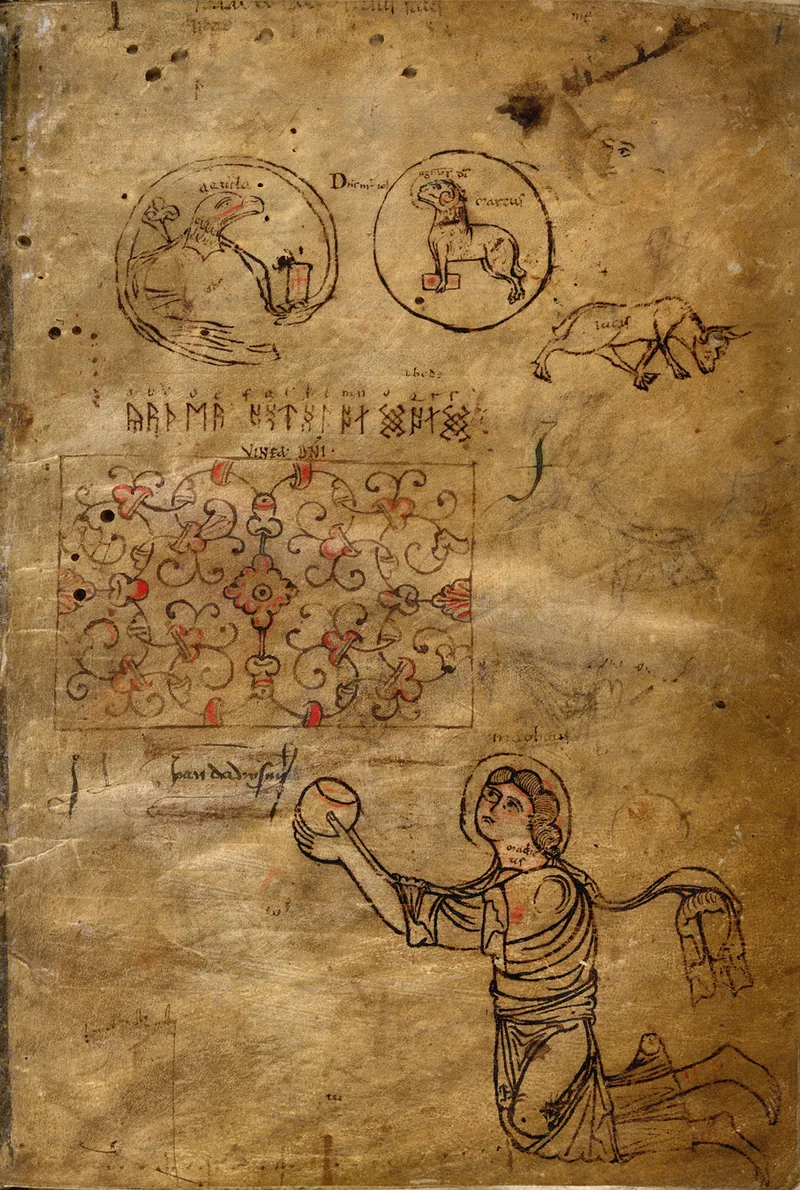
The charm survives in Cambridge, Corpus Christi College MS 41, a copy of the Old English translation of Bede's Ecclesiastical History made in the first half of the eleventh century. Its blank margins were filled by a later scribe with a remarkable miscellany: parts of the Mass, homiletic pieces and several metrical charms, including this one and a charm for recovering stolen cattle. The poem is usually printed among the Old English "metrical charms" in the Anglo-Saxon Poetic Records, edited by Elliott Van Kirk Dobbie in 1942.
In content the Journey Charm is thoroughly Christian. It invokes the God of heaven, saints, angels and biblical figures, and its image of the evangelists as pieces of armour belongs to the tradition of the lorica or "breastplate" prayer, best known from Irish texts such as the Lorica of Laidcenn and the hymn attributed to St Patrick, and ultimately from Ephesians 6, where the believer puts on "the whole armour of God" (Ephesians 6). Scholars such as Karen Jolly have used poems like this one to argue that "charm" and "prayer" were not separate categories for Anglo-Saxon Christians: the same clergy who copied the liturgy copied these verses, and they were meant to be said, not merely read.
What the speaker fears is vivid. The poem asks for protection from the "sore stitch" — a sudden pain — and from grim horror and terror, things that a traveller on foot or horseback through forest and fen would understand. Its opening gesture, enclosing oneself in a rod, is the most ancient-looking element; some commentators connect it with the drawing of a protective circle, others simply with the staff every traveller carried.
See folk Christianity for the wider world of blessings and charms used by lay believers, and protective magic for comparable travel protections.
Variations§
- The lorica prayers of early medieval Ireland and Britain work the same way and can be said in place of the charm.
- Psalm 121, "The Lord shall preserve thy going out and thy coming in," was the standard traveller's psalm in later English devotion (Psalm 121).
- Gaelic encompassing: in the Hebrides travellers drew a circle around themselves while praying; see the separate entry on the caim.
Safety and good sense§
- A spoken blessing is no substitute for road sense, a roadworthy vehicle, weather checks or travel insurance.
- If you carry a staff on a walk, choose one suited to your height and the terrain.
- If you burn the written words afterwards, do it in a hearth or heat-proof dish, never unattended.
- People of other faiths, or of none, may adapt the wording; the poem itself is explicitly Christian, and it should be presented as such.
Sources and further reading§
- The Anglo-Saxon Minor Poems (Anglo-Saxon Poetic Records VI) — Elliott Van Kirk Dobbie, 1942
- Popular Religion in Late Saxon England: Elf Charms in Context — Karen Louise Jolly, 1996
- Anglo-Saxon Magic — Godfrid Storms, 1948
- Magic in the Middle Ages — Richard Kieckhefer, 1989
- Religion and the Decline of Magic — Keith Thomas, 1971