The Spellbook · Solomonic Magic
A Protective Pentacle from the Key of Solomon
How to make a protective pentacle from the Key of Solomon as a paper talisman: choosing the figure, the hour of Mercury, consecration and its history.
- TraditionClavicula Salomonis, Italian and French manuscripts of the 15th–18th centuries; S. L. MacGregor Mathers's edition (1889)
- ForProtection
- DifficultyModerate
- Time1 hour, at the hour of Mercury
- WhenThe Key prescribes the day and hour of Mercury (Wednesday), with the Moon increasing and in an airy or earthy sign; many also prefer Monday for a pentacle of the Moon

The Key of Solomon (Clavicula Salomonis), the most influential of the Renaissance grimoires, contains a set of forty-odd "pentacles": circular seals inscribed with divine names, Hebrew letters, figures and verses of scripture, each assigned to a planet and credited with a particular virtue. Several are described as protective, and the pentacle as a whole descends from the legendary seal ring with which King Solomon was said to command evil spirits. This working shows how to make one protective pentacle as a paper talisman, following the grimoire's timing and consecration in a simplified, safe form.
How to do it§
- Choose the pentacle. Read the pentacles in the Key of Solomon (S. L. MacGregor Mathers's 1889 edition is in the public domain). Choose one whose described virtue is protection. Mathers's text says, for instance, that the Fourth Pentacle of the Moon defends against evil sorceries and against injury to soul or body. Avoid any pentacle whose stated purpose concerns harming, compelling or binding another person.
- Choose the time. The Key directs that pentacles be made in the day and hour of Mercury, with the Moon waxing and in an airy or earthy sign. Find a Wednesday with a waxing Moon and use the planetary hours table to choose an hour of Mercury.
- Prepare. Clean the table and wash your hands; the grimoire insists on bodily and moral purity, and many practitioners fast lightly from rich food beforehand and pray. Light frankincense or mastic on charcoal.
- Draw the pentacle. With compass and ruler, draw the double circle and copy the figure, letters and verse exactly as printed, slowly and without hurry. The Key assigns colours by planet; for a pentacle of the Moon, silver or grey ink is used.
- Consecrate. Pass the finished pentacle through the smoke and pray in your own words to God, under whose names the pentacle is made, asking that it be a shield against evil. Mathers's text consecrates the pentacles with prayers and the recitation of psalms; you may read a protective psalm such as Psalm 91 from your own Bible.
- Wrap and keep it. The Key orders pentacles to be kept wrapped in clean silk. Fold the cloth around it and keep it by the bed, in the house, or carried in a bag.
- Finish. Let the charcoal burn out under watch. Treat the pentacle with respect, since it bears divine names; when it is worn out, many burn it reverently or bury it rather than throwing it away.
Origins and history§
The Solomonic grimoires grew from late antique legends that God gave Solomon a ring engraved with a seal that bound demons, a story told in the Testament of Solomon (perhaps third to fifth century) and echoed in the Talmud and in Islamic tradition, where the seal of Sulayman is often drawn as a six-pointed or five-pointed star. A Greek Hygromanteia of Solomon circulated in Byzantium, and Latin works attributed to Solomon were known by the thirteenth century.
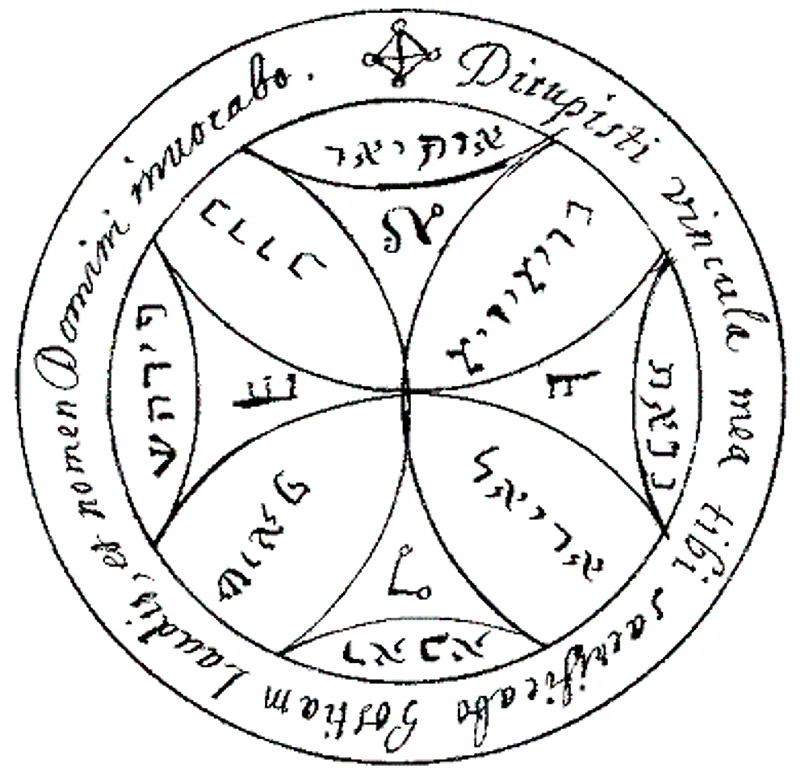
The Key of Solomon as we have it took shape in Italy in the fifteenth and sixteenth centuries; the earliest manuscripts are Italian and Latin, followed by many French copies of the seventeenth and eighteenth centuries. A Hebrew version, Mafteah Shelomoh, was published in facsimile by Hermann Gollancz in 1914 and is now generally thought to derive from the Latin tradition. In 1889 Mathers published an English version compiled from manuscripts in the British Museum, with redrawn pentacles; scholars note that his edition mixes manuscript families and adds his own corrections, so it is a Victorian occultist's reconstruction rather than a critical text.
In the Key the pentacles served two purposes: to protect the operator during the conjuration of spirits, and as talismans for particular ends. The book's long rituals for summoning spirits are not part of this working. Its insistence on new materials, fasting, prayer and planetary timing is shared with the rest of medieval ritual magic.
Variations§
Some practitioners use the general "Pentacle of Solomon" (a figure of divine names often drawn on the operator's garment) or a hexagram as a simple protective seal. Others engrave pentacles on the metal of their planet. Folk magicians in Europe and the Americas copied pentacles into charm books and wore them sewn into clothing.
Safety and good sense§
Burn incense on charcoal only in a heat-proof censer, with ventilation, away from fabrics and paper, and never leave it unattended. Copy only the pentacles; do not attempt the grimoire's conjurations. A protective talisman is no substitute for practical safety, medical care, or legal help if you feel threatened by someone.
Sources and further reading§
- The Key of Solomon the King (Clavicula Salomonis) — S. L. MacGregor Mathers, 1889
- The Veritable Key of Solomon — Stephen Skinner & David Rankine, 2008
- Sepher Maphteah Shelomoh (Book of the Key of Solomon) — Hermann Gollancz (ed.), 1914
- Grimoires: A History of Magic Books — Owen Davies, 2009
- The Magical Treatise of Solomon, or Hygromanteia — Ioannis Marathakis, 2011
- Solomon the Esoteric King: From King to Magus — Pablo A. Torijano, 2002