Liber XXVIII · Solomonic Magic · Chapter IV: Key of Solomon
Hygromanteia: The Byzantine Magical Treatise of Solomon
The Hygromanteia, or Magical Treatise of Solomon: a Byzantine Greek grimoire addressed to Rehoboam, its manuscripts, planetary hours and link to the Key.

The Hygromanteia, also called the Magical Treatise of Solomon, is a Byzantine Greek handbook of ritual magic presented as King Solomon's instruction to his son Rehoboam. Surviving in manuscripts from the fifteenth and sixteenth centuries, it sets out the angels and demons of the planetary hours, the herbs of the planets, prayers, purifications, the tools and circle of the operator, and methods of divination, and most scholars regard it as the closest known ancestor of the Latin Key of Solomon.
What the Hygromanteia Is§
The Hygromanteia is not one fixed book but a family of related Greek texts. Modern editors give it different names because the manuscripts do. Some copies call it the Hygromanteia of Solomon; others present it as an epistle or "treatise" of Solomon to Rehoboam; in later Greek popular usage a magic book of this type was simply a Solomonikē, "a Solomonic [book]". The word hygromanteia combines hygros, "wet" or "liquid", with manteia, "divination", and refers to the practice of seeing visions in a vessel of water or oil, one of the operations the text describes.
Its most important predecessor is the Testament of Solomon, a late antique narrative in which the king interrogates demons and learns the angel that defeats each one. The Hygromanteia turns that story into a working manual. In place of a tale it gives tables, prayers and procedures arranged by planet and hour, written in a medieval vernacular Greek with many technical words and names of spirits.
It is best understood as a bridge: behind it stand the Greek Magical Papyri and Jewish and Christian exorcism, in front of it the European grimoires and, above all, the Key of Solomon.
Manuscripts and Dating§
The Hygromanteia survives in more than a dozen manuscripts, which differ considerably in order and content. Among the best known are Harley MS 5596 in the British Library, Monacensis Graecus 70 in the Bavarian State Library in Munich, a manuscript in the University Library of Bologna, and several codices in the National Library of Greece in Athens. The oldest are usually dated to the fifteenth century; others were copied in the sixteenth century and later, in the Greek lands under Venetian and Ottoman rule.
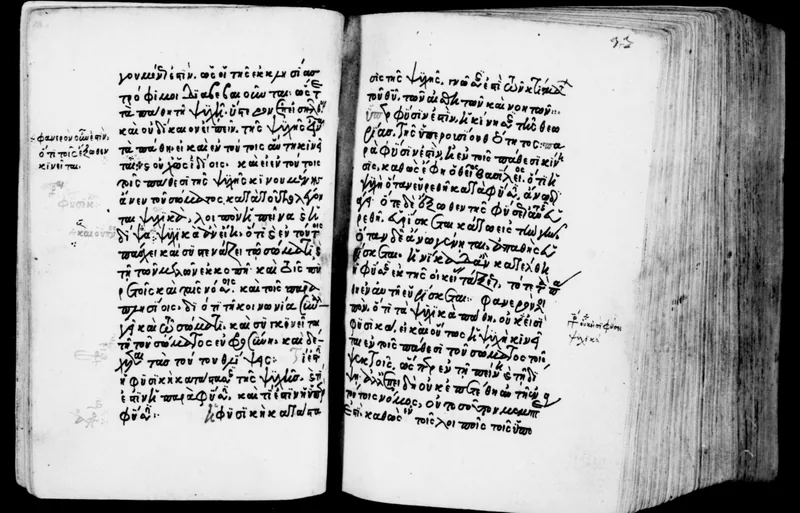
Dating the composition itself is harder. The material is plainly older than the earliest manuscripts: its demonology continues the Testament of Solomon, its planetary scheme reflects Byzantine astrology, and some of its operations resemble those of late antique papyri. At the same time, the compilation as we have it seems to have taken shape in the late Byzantine period. Scholars therefore speak of an older core reworked over several centuries rather than a single author writing at a single moment. Claims that the text goes back to Solomon himself are part of its framing, not history.
Byzantine sources confirm that Solomonic books of magic existed and were feared. The twelfth-century historian Niketas Choniates tells of Aaron Isaakios, an interpreter at the court of Manuel I Komnenos, who was said to own a "Solomonic book" whose reading summoned legions of demons; he was punished by blinding. The surviving manuscripts were copied despite such hostility, often alongside medical recipes, astrology and prayers.
The Letter to Rehoboam and the Frame of the Book§
Many copies open with Solomon addressing his son Rehoboam, urging him to keep the teaching carefully and to use it with piety and secrecy. This frame matters for two reasons. It places the book inside the biblical story, where Rehoboam is Solomon's heir (1 Kings 11:43), and it gives the instructions the authority of a royal father passing on a secret inheritance.
The same device reappears in the Latin and Italian Clavicula Salomonis. In the version translated by S. L. MacGregor Mathers in 1889, the preface tells how Solomon wrote the work for Rehoboam and ordered it to be buried with him, and how it was later found and passed from hand to hand. The continuity of this frame is one of the clearest signs that the Western Key grew out of a Greek original.
The frame is religious: Solomon presents his knowledge as a gift of God, and power over spirits is understood to come from divine names and angels, not from the operator's own nature.
Planetary Hours, Angels and Demons§
The heart of the treatise is an elaborate system of time. Each day of the week belongs to a planet, and each of the day's hours is ruled in turn by the seven planets in the traditional "Chaldean" order: Saturn, Jupiter, Mars, Sun, Venus, Mercury and Moon. The Hygromanteia assigns to each planetary hour a governing angel and a demon placed under that angel's authority, and it lists the kinds of work considered suitable for each hour: matters of love and favour under Venus, of war and enmity under Mars, of travel and speech under Mercury, and so on.

This pairing of angel and demon is the direct heir of the Testament of Solomon, where each demon confesses the name of the angel that "thwarts" it. In the Hygromanteia the pairing has been fitted into the astrological week, producing a calendar of spiritual powers. The same logic, simplified, governs the planetary days and hours of the Key of Solomon, the Heptameron and many later grimoires, and it lies behind the planetary angels discussed in Planetary Angels in Agrippa and the Heptameron.
The treatise also gives the plants of the planets and of the zodiacal signs and prayers addressed to the planets or their angels, showing how closely Byzantine magic was tied to medicine and astrology.
Rites, Tools and the Divination by Liquid§
The later parts of the treatise describe the preparation of the operator and his equipment. The manuscripts call for periods of purity and fasting, clean garments, a knife, a pen and ink prepared at the proper hour, and a circle inscribed with divine names in which the operator stands. Names and characters are to be written on parchment, and prayers are recited over each instrument to consecrate it. These requirements are described in the texts as conditions of holiness; their purpose in the authors' minds was to make the operator fit to command spirits in God's name.
The operation that gave the work its name is a form of lecanomancy: a vessel is filled with water or oil, and a seer, often a young boy considered pure, looks into it to see figures who answer questions. Similar child-medium divinations appear in the Greek magical papyri and later in Latin necromantic manuals such as the Munich Manual of Demonic Magic, which suggests a continuous practical tradition across many centuries and languages.
The manuscripts also contain conjurations of spirits, operations for finding hidden things and occasional harmful rites of the kind that drew ecclesiastical condemnation. Historians read them as evidence of what practitioners and clients wanted, within the history of condemned magic described in Demonic Magic: A History.
From the Greek Treatise to the Latin Key of Solomon§
The Clavicula Salomonis appears in Latin and Italian manuscripts from the fifteenth and sixteenth centuries, the same period as the earliest copies of the Hygromanteia. Comparison of the two shows shared material: the address to Rehoboam, the system of planetary hours, the emphasis on purification and fasting, the consecration of a knife and other instruments, the circle, the use of parchment and ink made at set times, and many of the prayers. Scholars such as Pablo Torijano and Ioannis Marathakis have argued that the Key is a Western adaptation of Greek Solomonic material, reworked by Latin Christian clerics and enriched with Hebrew names and with the Solomonic pentacles that become its most recognisable feature.
The route of transmission is not fully known. Italy, with its Greek communities, its trade with the Venetian territories in Crete and the Aegean, and its humanist interest in Greek manuscripts, is the most likely meeting place. What is clear is that the "Key" was not an ancient Hebrew book, as Mathers and many readers after him assumed, but the product of a long chain of Greek, Latin and vernacular reworkings in which the Hygromanteia is an essential link.
Editions and Modern Study§
For a long time the Hygromanteia was known only to specialists. The Belgian scholar Armand Delatte published Greek texts from Athenian manuscripts in his Anecdota Atheniensia (1927), and Chester McCown discussed later Byzantine Solomonic manuscripts in the introduction to his edition of the Testament of Solomon (1922). Pablo Torijano's Solomon the Esoteric King (2002) included an English translation of the Munich version and a study of Solomon's transformation from wise king to magus. In 2011 Ioannis Marathakis published a full English translation drawing on many manuscripts, which made the work widely available.
These editions showed that the Solomonic tradition did not leap from late antiquity to Renaissance Europe but passed through Byzantium, which makes the Hygromanteia indispensable for the story told in What Is Solomonic Magic?. The catalogue entry on the Magical Treatise of Solomon lists the principal editions.
Frequently asked questions§
What does "Hygromanteia" mean?§
It means "divination by liquid", from the Greek hygros (wet) and manteia (divination). The name refers to a rite described in the text in which a seer looks into a vessel of water or oil to receive answers. The title was then applied to the whole treatise.
Is the Hygromanteia the same as the Key of Solomon?§
No, but they are closely related. The Hygromanteia is a Greek text from the Byzantine world, while the Key of Solomon is a Latin and Italian grimoire of the Renaissance. Many scholars consider the Greek treatise the main source of the Key, which shares its address to Rehoboam, its planetary hours and much of its ritual preparation.
How old is the Hygromanteia?§
The earliest surviving manuscripts date from the fifteenth century. The material they contain is older, drawing on the late antique Testament of Solomon and Byzantine astrology, but the compilation as it survives probably took shape in the late Byzantine period.
Sources and further reading§
- Solomon the Esoteric King: From King to Magus, Development of a Tradition — Pablo A. Torijano, 2002
- The Magical Treatise of Solomon, or Hygromanteia — Ioannis Marathakis, 2011
- Anecdota Atheniensia — Armand Delatte, 1927
- The Testament of Solomon — Chester Charlton McCown, 1922
- Byzantine Magic — Henry Maguire (ed.), 1995
- Grimoires: A History of Magic Books — Owen Davies, 2009
- The Key of Solomon the King — S. L. MacGregor Mathers, 1889