Liber XXVIII · Solomonic Magic · Chapter IV: Key of Solomon
Solomonic Pentacles: The Planetary Seals of the Key of Solomon
Solomonic pentacles explained: the 44 planetary seals of the Key of Solomon, their Hebrew names and Psalm verses, how grimoires made them, and later uses.

Solomonic pentacles are the circular seals, each dedicated to one of the seven planets, that fill the pages of the Key of Solomon. Drawn with divine and angelic names, Hebrew letters, geometric figures and a verse of scripture around the rim, they were meant to protect the magician and to compel spirits, and in Mathers' 1889 edition they number forty-four. They became the grimoire tradition's most copied images and survive today on amulets, jewellery and the parchments of folk magic.
What a Pentacle Is in the Grimoires§
In the language of the grimoires a pentacle is a consecrated figure, usually round, bearing holy names and signs, which the operator carries or displays as a shield and a token of authority. It is not the same thing as a pentagram. The five-pointed star may appear on a pentacle, but most Solomonic pentacles contain no star at all, and the word was applied to any sacred seal of this kind. The etymology is uncertain: the medieval Latin pentaculum has been explained both from the Greek penta-, "five", and from the French pendre, "to hang", as an object worn hanging from the neck. The confusion between the two words, which still persists, is discussed in the article on the pentagram.
The pentacle also differs from the astrological talisman. A planetary talisman of the kind described in the Picatrix usually carries an image — a crowned king, a man on a dragon — engraved at a favourable moment to draw down the virtue of a star. The Solomonic pentacle relies less on images than on names: the power it represents is that of God, his angels and his word, to which the planets serve mainly as an organising framework.
The pseudo-Agrippan Fourth Book of Occult Philosophy, printed in Latin in 1559 and in English in 1655, gave a useful contemporary definition: pentacles are holy signs that guard against evil and bind spirits, made of divine names, characters of good spirits, geometrical figures and images taken from scripture. Its discussion can be read in the Fourth Book of Occult Philosophy.
The Forty-Four Pentacles of Mathers' Edition§
The best-known set comes from The Key of Solomon the King, translated and edited by S. L. MacGregor Mathers from several manuscripts in the British Museum and published in 1889. Mathers arranges the pentacles by planet: seven for Saturn, seven for Jupiter, seven for Mars, seven for the Sun, five for Venus, five for Mercury and six for the Moon. Each is accompanied by a short note on its use and, in many cases, on the names and verse it bears.
The uses follow the traditional character of the planets. Broadly, the pentacles of Saturn are associated with adversity, terror and the subjugation of spirits; those of Jupiter with honour, riches and the finding of treasure; those of Mars with war, discord, protection against enemies and sickness; those of the Sun with fame, rank and the favour of the great; those of Venus with grace, friendship and love; those of Mercury with knowledge, eloquence and hidden things; and those of the Moon with journeys, waters, dreams and protection from dangers at sea. Mathers' first pentacle of Saturn, said to strike terror into spirits, places four four-letter names of God in a square and surrounds them with a verse from Psalm 72 about enemies bowing down and licking the dust.
These descriptions reflect the hopes of early modern clients; the pentacles belong to the history of belief and were never a substitute for medicine, law or prudence.
Names, Letters and Verses: How the Designs Work§
Although the pentacles look like abstract geometry, their contents can usually be read. Most combine four kinds of material.
Divine and angelic names§
Names of God — the Tetragrammaton, Adonai, El, Eheieh, Shaddai and others — are written in Hebrew characters, often in the four arms of a cross or the corners of a square. Angels of the planet appear beside them. This continues the Jewish practice of protective amulets built from divine names, described in Practical Kabbalah, which Christian magicians admired and imitated.
Letters, squares and characters§
Some pentacles contain grids of letters or numbers related to the planetary magic squares, or rows of mysterious characters in so-called celestial or angelic alphabets. The planetary squares themselves have their own history, told in Magic Squares and Planetary Seals.
The verse around the rim§
Around the edge of most pentacles runs a verse of scripture, usually from the Psalms, chosen because its words fit the purpose: a verse about enemies being scattered for a pentacle against foes, a verse about God's protection for one against danger. The habit of using Psalms for protection and healing had deep roots in both Jewish and Christian practice, and the pentacle in effect turns a verse into a portable prayer.
In many manuscripts the Hebrew is badly corrupted, copied by scribes who did not know the language. Mathers, who had some Hebrew, restored names and verses where he could, and his clean printed figures look more coherent than many of the originals. Readers should therefore remember that the "Hebrew pentacles of Solomon" familiar today are partly a Victorian reconstruction.
Making and Consecrating Pentacles in the Manuscripts§
The Key of Solomon treats the making of pentacles as a sacred craft bound by time, material and prayer. In Mathers' version they are to be made in the day and hour of Mercury with the Moon waxing and in an airy or earthy sign, in a quiet place, by an operator who has prepared himself by purification. Each planet has its colour — black for Saturn, sky blue for Jupiter, red for Mars, gold for the Sun, green for Venus, mixed colours for Mercury, silver for the Moon — and the pentacles may be drawn on virgin parchment or engraved on the metal of the planet.
Once made, the pentacles are consecrated with incense and with prayers and psalms, and kept wrapped in silk when not in use. During the operations described in the book, the magician carries them on his breast or displays them toward the spirits from within the protective circle; the text describes spirits submitting at the sight of them. This role as a shield explains why the same manuscripts insist so strongly on the operator's purity: the pentacle's authority was understood to depend on the holiness of the names it bore and of the person who held it.
The method had antecedents. The Greek Hygromanteia already ties the making of instruments and inscriptions to planetary hours, and medieval works such as the Sworn Book of Honorius centre on a great consecrated seal, the Sigillum Dei. The pentacles of the Key systematise this inheritance into a planetary series.
Variation Across the Manuscripts§
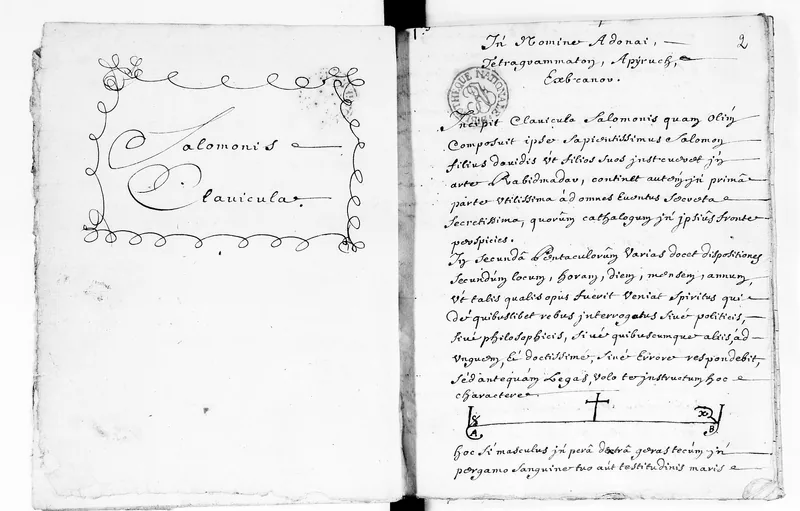
There is no single canonical set of Solomonic pentacles. The Latin, Italian and French manuscripts of the Clavicula Salomonis differ greatly in the number of pentacles, their order, their assignment to planets and their designs. Some give a short list of protective seals with no planetary arrangement; others give elaborate painted figures. The French manuscripts used by Mathers, and the related texts later edited by Stephen Skinner and David Rankine as The Veritable Key of Solomon, show how freely copyists combined and redrew them.
The pentacles were thus living material, adapted by each owner, whose authority came from looking ancient and Hebrew rather than from an unbroken line of transmission. The broader story of the manuscripts is told in the main article on the Key of Solomon.
Pentacles After the Key: Occultism, Tarot and Folk Magic§
Through Mathers the pentacles entered the teaching of the Hermetic Order of the Golden Dawn, where the word "pentacle" was also used for the disc-shaped elemental weapon of Earth. That usage passed into the Rider-Waite-Smith tarot, whose suit of coins became the suit of Pentacles, and into Wicca, where a pentacle is a disc engraved with symbols that rests on the altar.
The Solomonic seals also had a long popular life. Cheap printed editions of the Key, together with the seals of the Sixth and Seventh Books of Moses, supplied images to German-American folk magic and to African American hoodoo, where printed "Solomon seals" were sold on parchment as charms for luck, protection and success. Jewellers and craftsmen continue to reproduce the planetary pentacles as medallions. In each setting the same figures were reinterpreted: as Hebrew prayers, as planetary talismans, as symbols of the elements, or as tokens of a legendary king. For the wider history of such protective objects, see Amulets and Talismans.
Frequently asked questions§
How many pentacles are in the Key of Solomon?§
Mathers' 1889 edition has forty-four: seven each for Saturn, Jupiter, Mars and the Sun, five each for Venus and Mercury, and six for the Moon. Other manuscripts of the Key contain different numbers and designs, so the figure of forty-four belongs to Mathers' edition rather than to the tradition as a whole.
Is a pentacle the same as a pentagram?§
No. A pentagram is a five-pointed star, while a pentacle in the grimoires is any consecrated seal bearing holy names and figures, usually circular. Some pentacles include a pentagram, but most do not. Modern Wicca uses "pentacle" for a disc engraved with a pentagram, which has encouraged the confusion.
What language is written on the pentacles of Solomon?§
Mostly Hebrew, sometimes in corrupt or garbled form, together with occasional Latin and invented magical characters. The Hebrew usually gives names of God and angels and a verse of scripture, frequently from the Psalms.
What were Solomonic pentacles used for?§
In the grimoires they served as protective shields for the magician and as signs of authority before spirits, and each was also linked to purposes associated with its planet, such as favour, knowledge or safe travel. Historians treat these claims as evidence of belief and practice in early modern Europe, not as demonstrated effects.
Sources and further reading§
- The Key of Solomon the King — S. L. MacGregor Mathers, 1889
- The Veritable Key of Solomon — Stephen Skinner and David Rankine, 2008
- Grimoires: A History of Magic Books — Owen Davies, 2009
- Jewish Magic and Superstition: A Study in Folk Religion — Joshua Trachtenberg, 1939
- Hebrew Amulets: Their Decipherment and Interpretation — Theodore Schrire, 1966
- Magic in the Middle Ages — Richard Kieckhefer, 1989
- The Fourth Book of Occult Philosophy — Stephen Skinner (ed.), 1978