Liber XX · Kabbalah · Chapter VII: Practical Kabbalah
Practical Kabbalah: Divine Names, Amulets and Jewish Magic
Practical Kabbalah explained: divine names and amulets, Sefer Raziel, Shimmush Tehillim, the golem legend, the baalei shem and rabbinic views of Jewish magic.

Practical Kabbalah (kabbalah maʿasit) is the Jewish tradition of using sacred names, Hebrew letters, angels and biblical verses to bring about effects in the world: healing, protection, love, success or knowledge. It is distinguished from speculative or contemplative Kabbalah (kabbalah ʿiyyunit), which seeks to understand God and the cosmos. Its roots lie in ancient Jewish magic, older than Kabbalah itself, and it has been practised alongside persistent rabbinic warnings about its dangers.
Practical and Speculative Kabbalah§
The term "practical Kabbalah" acknowledges that Jewish esoteric knowledge was not only contemplative. The same names and letters that mystics meditated on were believed to carry creative power: according to the Sefer Yetzirah, God created the world through the twenty-two letters and ten numbers, and rabbinic tradition held that the divine name could perform wonders. Medieval and early modern Kabbalists increasingly separated a speculative Kabbalah concerned with the sefirot and the inner life of God from a practical Kabbalah concerned with using names to affect the world. Gershom Scholem noted that in practice the boundary was porous, and that much "practical Kabbalah" in fact draws on magical traditions older than the Kabbalah of the twelfth and thirteenth centuries.
Ancient Roots: Names, Bowls and Magical Books§
Jewish magic is well documented in late antiquity. Gideon Bohak's survey of ancient Jewish magic draws on amulets inscribed on thin sheets of metal, Greek magical papyri that invoke the God of Israel, and, above all, hundreds of Aramaic incantation bowls from Sasanian Mesopotamia (roughly fifth to seventh centuries), inscribed in spirals with protective formulas and buried under houses to trap demons. These bowls name angels, cite biblical verses and sometimes include divorce writs addressed to demons.
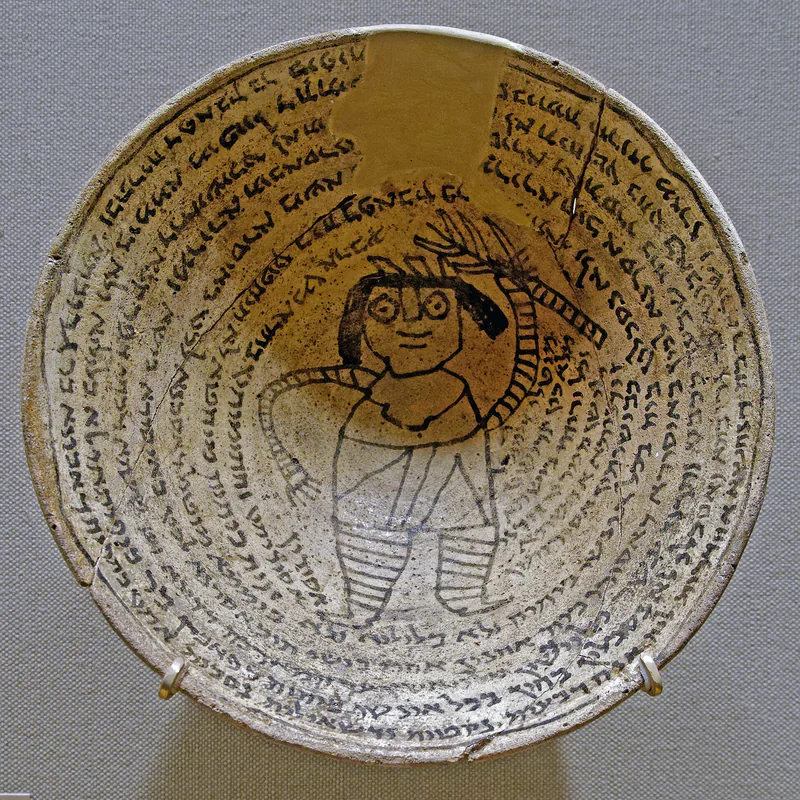
Two late antique Hebrew and Aramaic texts are especially important. Sefer ha-Razim ("Book of Mysteries"), reconstructed by Mordecai Margalioth from Genizah fragments and other sources and published in 1966, describes seven firmaments filled with angels who can be enlisted for practical purposes. Harba de-Moshe ("The Sword of Moses") contains a long list of secret names and their uses. The Hekhalot literature also mixes heavenly ascent with adjurations of angels such as the "Prince of the Torah," who was invoked to grant learning. The documents of the Cairo Genizah, a storeroom of discarded manuscripts, preserve a large quantity of medieval Jewish magical recipes and amulets, showing how widely such practice spread.
Divine Names and Amulets§
The core of practical Kabbalah is the power of the name. Beyond the seven names of God that may not be erased, the tradition knows the twelve-, forty-two- and seventy-two-letter names, the last derived from three consecutive verses of Exodus 14 (19–21), each of seventy-two letters, and widely associated with seventy-two angels. Letters were also permuted and combined according to methods related to gematria. The ecstatic Kabbalist Abraham Abulafia (thirteenth century) used letter combination for meditation, though he himself rejected magical uses of the names.
Names were written on amulets (kameʿot, singular kameaʿ) on parchment, paper or metal, for protection against illness, the evil eye, miscarriage and demons. Among the most common were childbirth amulets invoking the three angels Sanoi, Sansanoi and Semangelof against Lilith, a tradition linked to the medieval Alphabet of Ben Sira. Other widespread protective objects include the hand-shaped hamsa and, in modern times, the red thread associated with Rachel's tomb, both shared with or adapted from neighbouring cultures. Rabbinic law already discussed amulets in the Mishnah, which permits going out on the Sabbath with an amulet "from an expert," that is, one proven effective.
Classic Texts of Practical Kabbalah§
Several books became standard references:
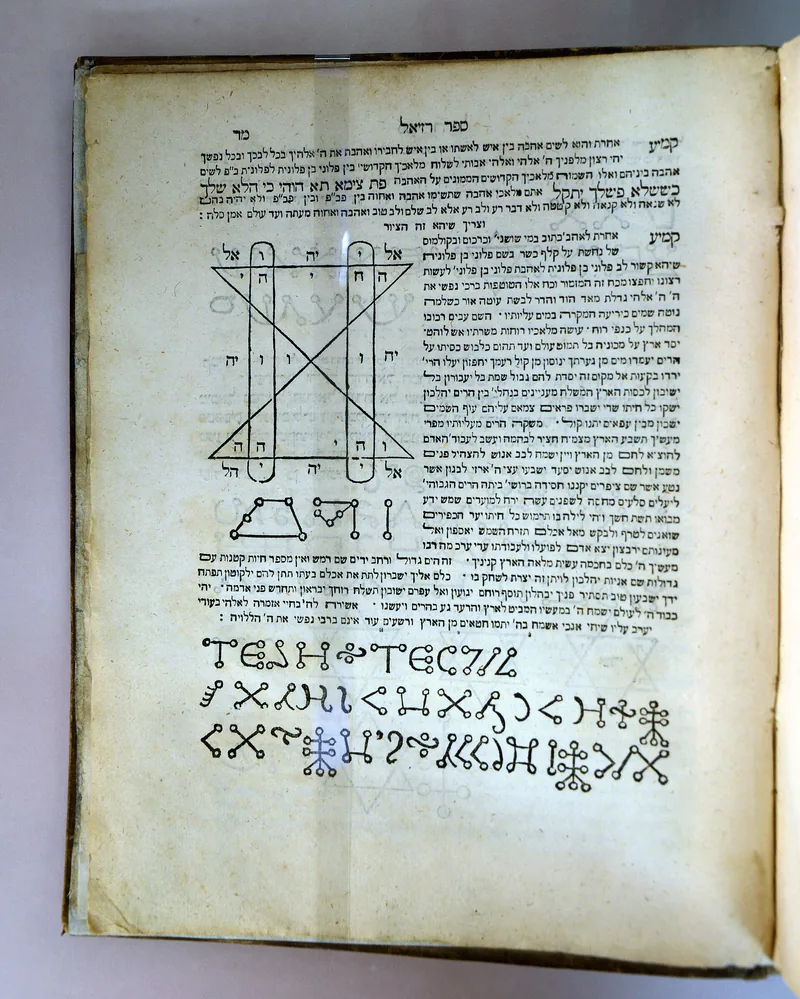
- Sefer Raziel ha-Malakh ("The Book of the Angel Raziel"), printed in Amsterdam in 1701 but compiled from much older material, including parts of Sefer ha-Razim, which presents itself as the book the angel Raziel gave to Adam. Owning a copy was believed to protect a house from fire. A distinct Latin work, the Liber Salomonis or Sepher Raziel, circulated in Christian magic.
- Shimmush Tehillim ("The Use of the Psalms"), which prescribes particular psalms, recited with associated names, for specific needs such as safe travel or recovery from illness.
- Collections of segulot (protective or beneficial remedies) and handwritten practical notebooks, of which thousands survive from Europe, North Africa and the Middle East.
Practical Kabbalah also influenced Christian magic. The Latin grimoire tradition, from the Key of Solomon to the pentacles of the Seal of Solomon, borrowed Hebrew names and letter-squares, often garbled, as signs of authority.
The Golem and Other Legends§
The most famous legend of practical Kabbalah is the golem, an artificial human animated by holy names. The Babylonian Talmud (Sanhedrin 65b) tells that the sage Rava created a man and sent him to another rabbi, who recognised that it could not speak and returned it to dust. Medieval commentators on the Sefer Yetzirah, especially among the German pietists (Ḥasidei Ashkenaz), described rituals of letter combination for creating a golem, which Moshe Idel has interpreted as primarily mystical experiences. The well-known story of Rabbi Judah Loew, the Maharal of Prague (d. 1609), creating a golem to protect the Jewish community is a later legend, first attested in the eighteenth and nineteenth centuries and popularised in literature and film.
Baalei Shem, Rabbinic Caution and Modern Practice§
From the sixteenth to the eighteenth centuries, itinerant healers called baalei shem ("masters of the name") wrote amulets, exorcised spirits (dybbukim) and provided remedies in the Jewish communities of central and eastern Europe. The founder of Hasidism, Israel ben Eliezer, was known as the Baal Shem Tov, "Master of the Good Name," and began his career in this role; see Hasidism and the Baal Shem Tov.
Leading authorities were ambivalent. The Safed Kabbalists around Isaac Luria taught that practical Kabbalah should not be used in the present age because the means of ritual purification, such as the ashes of the red heifer, had been lost since the destruction of the Temple, though Hayyim Vital's own writings record practical recipes. In the 1750s a bitter controversy broke out when Rabbi Jacob Emden accused Rabbi Jonathan Eybeschütz of writing amulets containing hidden allusions to the false messiah Sabbatai Zevi, a dispute that divided communities across Europe.
Practical Kabbalah continues today in some traditional communities, especially among Sephardi and Mizrahi Jews, where revered Kabbalist rabbis provide blessings, amulets and segulot. Historians such as Joshua Trachtenberg, Gideon Bohak and Yuval Harari have made Jewish magic a serious field of study, treating it as an integral part of Jewish religious history rather than a marginal superstition. For the broader tradition see What Is Kabbalah?
Frequently asked questions§
What is practical Kabbalah?§
Practical Kabbalah is the Jewish tradition of using divine names, angels, Hebrew letters and verses for effects in the world, such as protection and healing. It contrasts with speculative Kabbalah, which focuses on understanding God, creation and the soul.
Is practical Kabbalah allowed in Judaism?§
Rabbinic authorities have been ambivalent. Amulets from proven experts were accepted in Jewish law, but many Kabbalists, including Isaac Luria's circle, warned against practical Kabbalah because the required ritual purity is no longer attainable.
What is a kamea?§
A kameaʿ is a Jewish amulet, usually a parchment or metal inscription with divine and angelic names, biblical verses or letter-squares. Amulets were used for protection in childbirth, against illness and against the evil eye.
Did the Maharal of Prague really make a golem?§
There is no contemporary evidence. The story of the Maharal's golem first appears in sources from the eighteenth and nineteenth centuries and developed into a popular legend, although the idea of a golem goes back to the Talmud and medieval commentaries.
Sources and further reading§
- Jewish Magic and Superstition: A Study in Folk Religion — Joshua Trachtenberg, 1939
- Ancient Jewish Magic: A History — Gideon Bohak, 2008
- Jewish Magic before the Rise of Kabbalah — Yuval Harari, 2017
- Golem: Jewish Magical and Mystical Traditions on the Artificial Anthropoid — Moshe Idel, 1990
- Kabbalah — Gershom Scholem, 1974
- Sepher ha-Razim: The Book of the Mysteries — trans. Michael A. Morgan, 1983
- Magic Spells and Formulae: Aramaic Incantations of Late Antiquity — Joseph Naveh and Shaul Shaked, 1993