Liber XXIX · Superstitions · Chapter VII: Luck, Omens & Portents
The Evil Eye: History of the Belief and Its Protective Charms
The evil eye from Mesopotamia and Rome to the Bible, Islam and Turkey: what the belief holds, how it was explained, and the charms used against it.

The evil eye is the belief that a look, especially an envious or admiring one, can harm a person, an animal or a possession, causing illness, bad luck, a failed harvest or a broken object. It is one of the oldest and most widespread superstitions in the world, documented in Mesopotamian incantations, Greek and Roman literature, the Bible, the Talmud and the hadith, and still alive from Italy and Greece to Turkey, the Middle East, South Asia and Latin America, where blue-eye beads, hands, horns and red threads are worn against it.
What the Evil Eye Is: Envy, Praise and the Harmful Gaze§
In most of the traditions where it is found, the evil eye is not primarily a deliberate curse. It is the side effect of envy. A neighbour admires a healthy baby, a fine cow or a new house, and the admiration, tinged with desire, carries harm; the baby sickens, the cow stops giving milk, the house cracks. The person who casts the eye may be unaware of it and may even be a relative or friend. Some people were thought to have a naturally strong eye.
Praise is therefore dangerous and is qualified: Muslims say mashallah ("what God has willed"), Jews of Yiddish-speaking background say keyn ayin hore ("no evil eye"), Greeks mimic spitting, Italians touch a horn charm. Good fortune is understated and children are sometimes given unflattering nicknames. Anthropologists link this to George Foster's "image of limited good": in small communities one family's gain seemed another's loss.
The belief is not universal. A cross-cultural survey by the anthropologist John M. Roberts, published in Clarence Maloney's collection The Evil Eye (1976), found it in roughly a third of the societies sampled, concentrated in the Mediterranean, the Near East, North and East Africa, Europe and South Asia, and largely absent from the indigenous Americas, Australia and much of the Pacific before European contact. Where it occurs in Latin America as mal de ojo, it came with Spanish and Portuguese settlers; see Superstitions of the Americas.
The Evil Eye in Mesopotamia, Greece and Rome§
Sumerian and Akkadian incantation texts already deal with an "evil eye" that roams the land, attacks the house and the stall, and must be driven out by the gods and the exorcist, often with the help of the god Asalluhi or Marduk. Their remedies sit within the wider protective system described in Mesopotamian Magic and the anti-witchcraft rituals of the Maqlû.
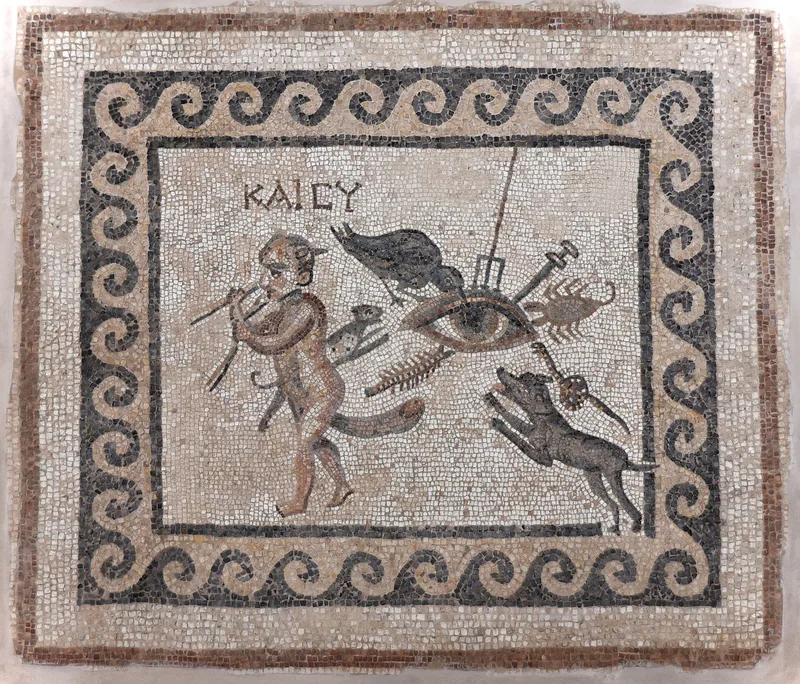
In Greek the evil eye was baskania, and the person who cast it was baskanos; Latin writers spoke of fascinatio and invidia, literally "looking against". Virgil gives the classic shepherd's complaint in his third Eclogue: nescio quis teneros oculus mihi fascinat agnos, "some eye, I know not whose, bewitches my tender lambs". Pliny the Elder's Natural History records Roman remedies, among them spitting. Plutarch devotes a chapter of his Table Talk to the question of why some people are said to bewitch with the eye,.
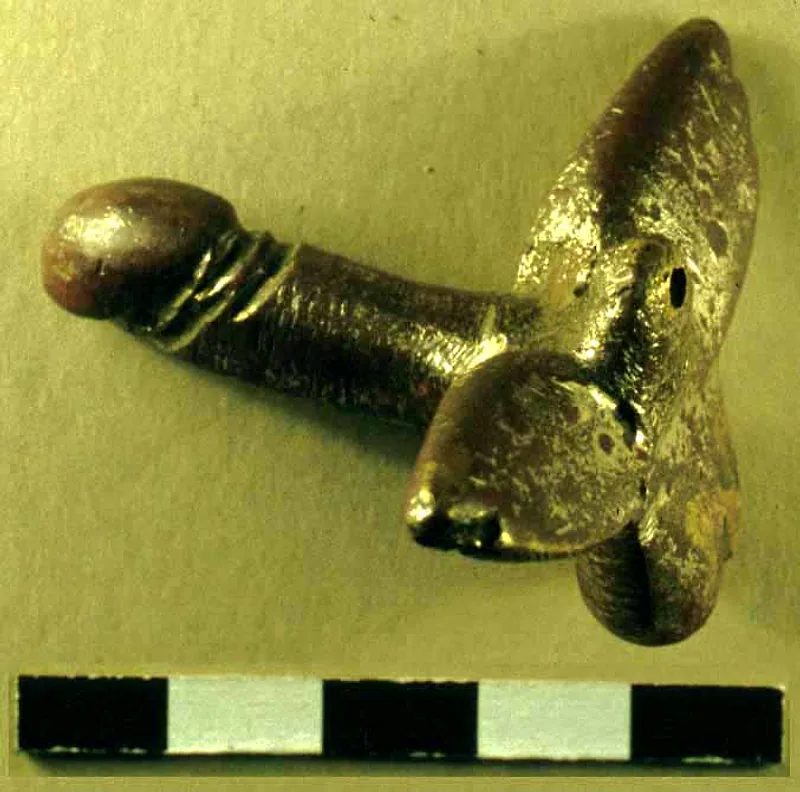
Romans hung the fascinum, a phallic amulet, on children and on chariots of triumphing generals, on the principle that an obscene or startling image draws and deflects the harmful gaze. The best-known threshold mosaic, from the so-called House of the Evil Eye at Antioch (second century CE), shows an eye pierced by a trident and a sword and assailed by a raven, a dog, a snake, a scorpion and other creatures, with the Greek words kai sy, "and you too", returning the curse to the envious. See also Greco-Roman Magic.
Jewish, Christian and Islamic Teaching on the Evil Eye§
In the Hebrew Bible the "evil eye" usually means a mean or grudging disposition rather than a magical force; Proverbs 23:6 warns, in the King James wording, "Eat thou not the bread of him that hath an evil eye". Rabbinic literature, however, treats ayin hara as a real danger. A well-known passage in the Babylonian Talmud (Bava Metzia 107b) attributes to the sage Rav the opinion that the great majority of deaths are caused by the evil eye, and the Mishnah's tractate Avot lists the evil eye among the things that drive a person out of the world. Jewish folk practice developed formulas, amulets and red threads against it; see Jewish Magic and Folklore.
The New Testament uses the phrase in the moral sense: in Mark 7:22 an "evil eye" is among the things that come from within and defile, and in the parable of the labourers the master asks, "Is thine eye evil, because I am good?" (Matthew 20:15). Christian folk practice nonetheless absorbed the older belief, and in Greece the healing prayer called xematiasma is still recited by laypeople, as described in our spellbook entry on Greek mati.
In Islam the belief rests on scripture and hadith. A tradition recorded in the collections of al-Bukhari and Muslim states that "the eye is real" (al-'ayn haqq). The last two chapters of the Qur'an, recited for protection, seek refuge "from the evil of the envier when he envies" (113:5), and commentators have read 68:51 as a reference to the eye. Recitation of these verses and other forms of ruqya are the approved remedies. The relationship between the eye, envy and the jinn is discussed in Jinn and the Unseen in Islam.
Protective Charms: Blue Eyes, Hands, Horns and Red Thread§
The most recognisable modern charm is the blue-and-white glass eye, the Turkish nazar boncuğu and the Greek mati. It is hung in houses, cars and shops, pinned to babies' clothes and set into jewellery. Its blue colour has been explained by ancient glazes, by the rarity of blue eyes in the region and by protective turquoise; none of these explanations is securely documented.
The open hand, called khamsa or hamsa ("five") in Arabic and Hebrew, and popularly the Hand of Fatima or the Hand of Miriam, is used across North Africa, the Middle East and Jewish communities, often with an eye in the palm. Its history and use are traced in the spellbook entries on the Hand of Fatima and the hamsa home amulet. In southern Italy the cornicello, a twisted horn of red coral or gold, and the mano cornuta and mano fico hand gestures continue the Roman logic of deflection; red coral and black jet, the Spanish azabache, were both prized against the eye.
Other common protections include red thread tied round the wrist or a cradle; garlic, rue and alum; South Asian nazar charms such as the black kajal dot on a baby's face and the lemon and chillies over a shop door; and spitting or knocking wood. The wider family of such objects is treated in Amulets and Talismans.
Theories of the Gaze: From Plutarch to Anthropology§
Ancient writers did not regard the evil eye as irrational. Many Greek theories of vision held that the eye sent out rays or effluences that touched what it saw. Plutarch's speakers argue that emotions such as envy alter the body and charge these emanations with harm, just as the eyes of the sick were thought to pass on disease. This model survived into the Renaissance, when Marsilio Ficino discussed how spirits from the eyes could infect a beholder, and Francis Bacon's essay "Of Envy" (1625) notes that envy and love alone among the affections seem to "fascinate".
Modern scholarship looks instead at function and meaning. Frederick Thomas Elworthy's The Evil Eye (1895) gathered vast folklore material as survivals of primitive belief. Later anthropologists, in the essays collected by Maloney and in Alan Dundes's The Evil Eye: A Casebook (1981), treated the belief as a way of managing envy and inequality, of explaining sudden illness, especially in infants, and of regulating display in close-knit communities. The classicist John H. Elliott's multi-volume Beware the Evil Eye (2015–2017) reconstructs the belief across the ancient Mediterranean and in the Bible.
Diagnosis and Cure: Oil, Water, Eggs and Prayer§
Cures focus on detecting and lifting the eye rather than punishing the caster. In Italy, Greece and Malta a common diagnostic is to drop olive oil into a bowl of water while reciting a prayer: if the drops spread or form an eye, the eye is present, and the prayer is repeated until they hold together. In the Hispanic world and parts of the Mediterranean a healer passes an egg over the patient and breaks it into water to read the result. Turkish and Persian practice includes the burning of rue (üzerlik, esfand) and the pouring of molten lead into water over the sufferer's head, a ritual cousin of the New Year divinations described in New Year Superstitions.
Throughout, the evil eye has sat alongside medicine rather than replacing it. Religious authorities in Islam and Judaism have tried to channel the belief into prayer while discouraging reliance on amulets. Today the belief is often held lightly, as cultural habit as much as conviction; the psychology of such half-beliefs is explored in The Psychology of Superstition.
Frequently asked questions§
What does the evil eye mean?§
It means harm caused by a look, usually an envious or admiring one, that brings illness or misfortune to the person or thing looked at. The word also names the blue-eye charm that is worn to ward it off.
Is the evil eye in the Bible?§
Yes, but mostly in a moral sense. Verses such as Proverbs 23:6, Mark 7:22 and Matthew 20:15 use "evil eye" to mean stinginess, envy or ill will, while later Jewish and Christian folk practice treated it as a harmful force.
Why are evil eye charms blue?§
No single origin is documented. Explanations include the blue glazes of ancient Mediterranean bead-makers, the association of turquoise with protection in Persia and Turkey, and the idea that the uncommon blue eye was the most dangerous and so the best mirror to deflect it.
Is the hamsa an evil eye charm?§
The hamsa, or khamsa, is a protective hand used in Muslim, Jewish and wider Middle Eastern and North African culture. It is very often combined with an eye and is widely used against the evil eye, though it also carries broader meanings of blessing and protection.
Sources and further reading§
- The Evil Eye — Frederick Thomas Elworthy, 1895
- The Evil Eye — Clarence Maloney (ed.), 1976
- The Evil Eye: A Casebook — Alan Dundes (ed.), 1981
- Beware the Evil Eye: The Evil Eye in the Bible and the Ancient World — John H. Elliott, 2015
- Magic and Magicians in the Greco-Roman World — Matthew W. Dickie, 2001
- Natural History — Pliny the Elder, 77
- The Essayes or Counsels, Civill and Morall — Francis Bacon, 1625