Birth lore · Your birthday
Coral (Precious Coral)
Precious red coral, the skeleton of a slow-growing marine animal, is the Navaratna gem of Mars and a protective amulet for children in Mediterranean tradition; it is soft, organic and today subject to conservation concerns.
History and lore
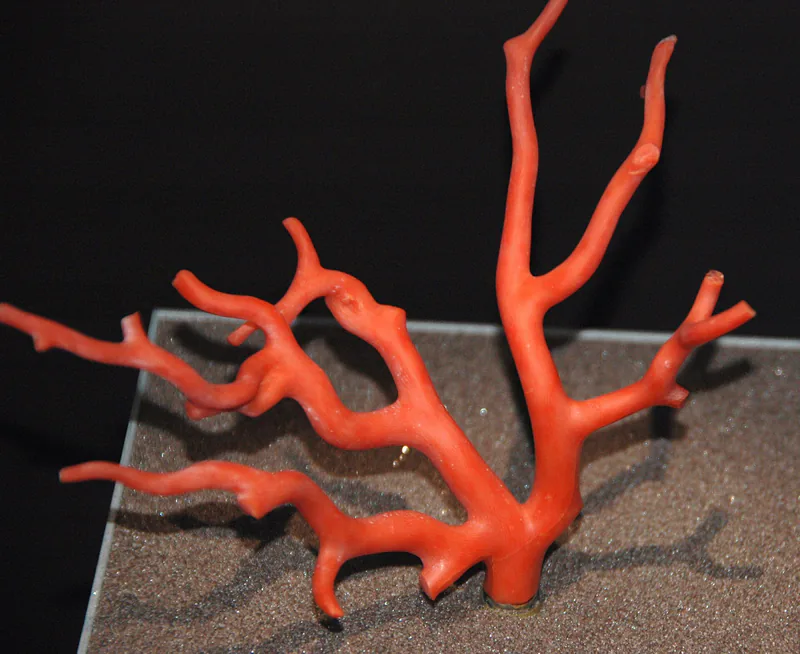
Red coral from the Mediterranean, the skeleton of the colonial animal Corallium rubrum, has been prized since prehistory. Greek myth gave it a dramatic origin: in Ovid's Metamorphoses, when Perseus laid Medusa's severed head on a bed of seaweed, the plants hardened and turned red, and the sea nymphs, delighted, scattered them through the sea. Pliny the Elder records that the people of India valued coral as highly as Romans valued pearls, and that Gauls once decorated weapons and helmets with it; coral was a major Mediterranean export along the trade routes to India for centuries.
Southern Italy became the heart of coral working. Torre del Greco, near Naples, has carved coral since at least the eighteenth century and remains the world centre of the craft, while Trapani and Sciacca in Sicily also had celebrated workshops. Far inland, coral reached Tibet and the Himalaya, where it is set with turquoise in jewellery and headdresses, and it entered Native American jewellery of the Southwest through trade.
In the traditions
In Indian astrology coral (pravāla, Hindi moonga) is the Navaratna gem of Mars, Mangala, the red planet of energy, courage and conflict. Jyotiṣa practitioners traditionally recommend it when Mars is judged weak or troublesome in a birth chart, setting it in gold or copper and wearing it on a particular finger and weekday; these are the customs of the tradition, described here historically. With ruby, pearl and the other Navaratna stones, coral is one of the nine gems arranged together in the classic Navaratna jewel. Western tables follow the Indian attribution and link coral with Mars and his signs, Aries and Scorpio, though Agrippa lists coral among the things of Venus.
Around the Mediterranean coral has long been a guardian of children. Pliny records that coral branches were hung on infants as amulets, and Italian families still give babies coral charms and the curved cornicello against the evil eye (see curses and protective magic). Renaissance painters often showed the Christ Child wearing coral, as in Piero della Francesca's Brera altarpiece, where a coral branch hangs at his neck, a protective charm that also foreshadows the blood of the Passion. Like turquoise, coral was said to grow pale when its wearer fell ill.
Meaning and symbolism
Coral joins the sea and the blood: life, vitality, protection of the young and vulnerable, and, through its Martial association, courage and drive. Traditional systems also prescribed coral, sometimes powdered, as medicine; these are historical practices, and coral is not a substitute for medical care. Scientific studies have not found that wearing a gem cures illness or alters the influence of planets.
The mineral
Precious coral is not a mineral but a biogenic material. Colonies of tiny polyps, octocorals unrelated to the reef-building stony corals, secrete a hard branching axis of calcium carbonate with a little organic matter; carotenoid pigments give the red, orange and pink. Growth is very slow, often a fraction of a millimetre in thickness each year. Besides Mediterranean coral, the trade uses deep-water species from the western Pacific around Japan and Taiwan, which supply deep "oxblood" reds and pale pink "angel skin". Black and golden "corals" are different animals with protein skeletons.
Overharvesting and destructive dredging have depleted many coral beds; fishing is regulated in the Mediterranean, black corals are listed under CITES, and buyers are well advised to ask about origin. Imitations include dyed bamboo coral, dyed bone, glass, plastic and reconstituted coral; genuine coral shows fine, wavy parallel growth lines along its length. At a hardness of about 3–4, coral is soft and easily harmed by acids, perfume, cosmetics and heat. Wipe it with a soft damp cloth after wearing and store it apart from harder gems.
Sources and further reading
- Metamorphoses, Book IV — Ovid, c. 8 CE
- Natural History, Books 32 and 37 — Pliny the Elder, c. 77 CE
- Bṛhat Saṃhitā — Varāhamihira, c. 550 CE
- Three Books of Occult Philosophy — Heinrich Cornelius Agrippa, 1533
- The Curious Lore of Precious Stones — George Frederick Kunz, 1913
- Gems: Their Sources, Descriptions and Identification (6th ed.) — Michael O'Donoghue (ed.), 2006