Liber XXVIII · Superstitions · Chapter V: European Superstitions
European Superstitions: Folk Beliefs from Ireland to Russia
European superstitions by region: Irish fairy forts, German lucky pigs, Italian cornicello, Greek mati, Spanish New Year grapes and Russian travel customs.
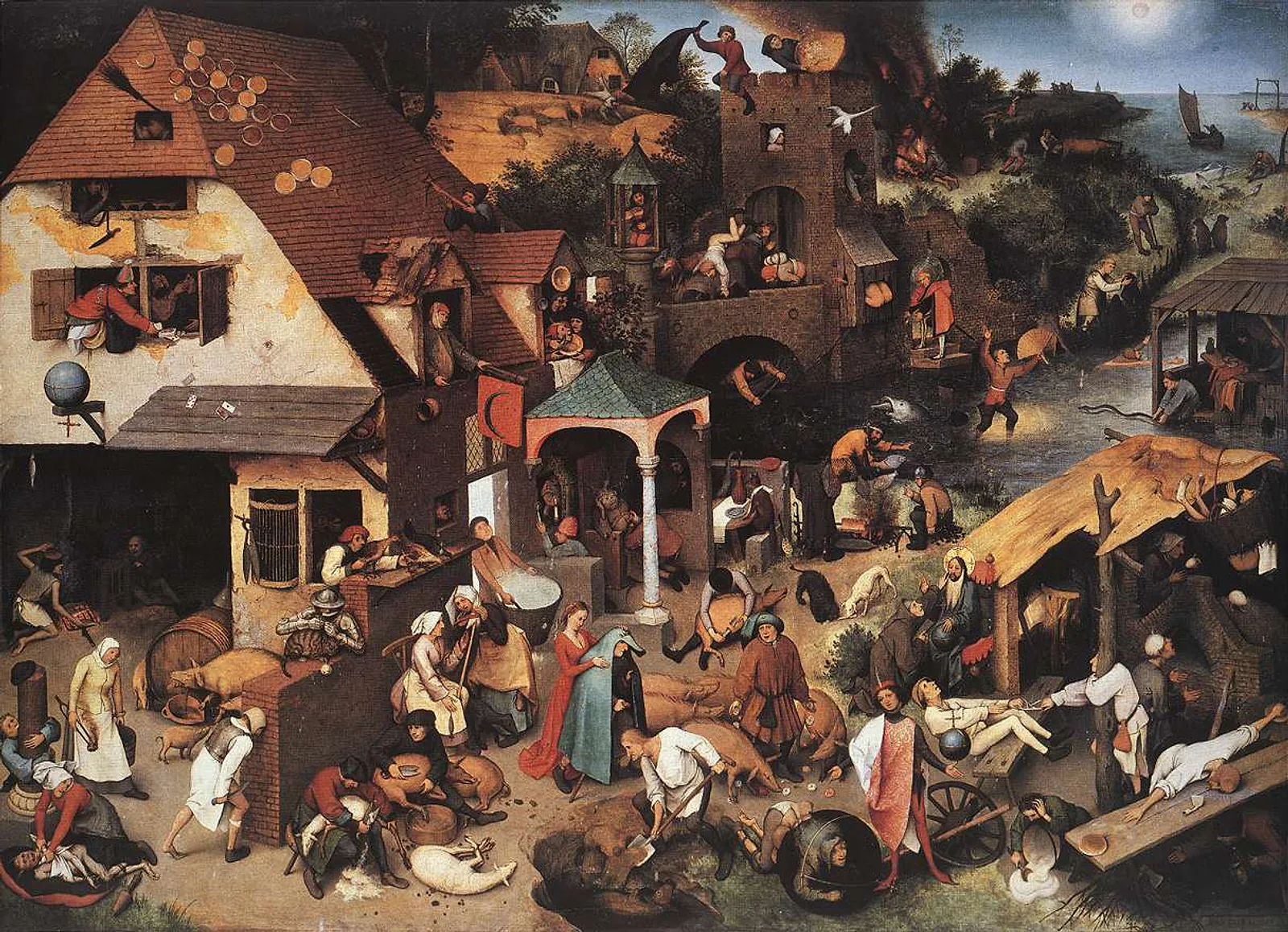
European superstitions are the everyday rules of luck and danger kept by ordinary people across the continent, from saluting magpies in England and avoiding Irish fairy forts to eating twelve grapes at a Spanish New Year or sitting down in silence before a journey in Russia. Most grew up inside a Christian culture that blended saints' days, blessed objects and older seasonal customs, and many are younger than they look: some date only from the nineteenth or twentieth century.
How Europe Came to Speak of "Superstition"§
The Latin superstitio meant excessive or improper religious fear, and medieval theologians used it for any practice that sought a result through means God had not ordained. The history of the word is traced in What Is Superstition?. The Reformation sharpened the charge: Protestant writers attacked holy water, saints' relics and blessed candles as Catholic superstition, while Catholic reformers after the Council of Trent tried to purge popular devotion of what they saw as magic. The historian Euan Cameron has shown that these campaigns did not abolish folk belief so much as reclassify it.
From the early nineteenth century the Romantic movement turned superstitions into precious survivals of national tradition. Jacob Grimm's Deutsche Mythologie (1835) mined them for traces of pre-Christian religion, and later collectors throughout Europe followed his lead, culminating in the ten-volume Handwörterbuch des deutschen Aberglaubens (1927–1942). In Britain the work of Iona Opie and Moira Tatem and of Steve Roud has since put the subject on a firm documentary footing, often showing that a supposedly ancient belief is first recorded quite late.
Saints, Seasons and Sacramentals: The Christian Framework§
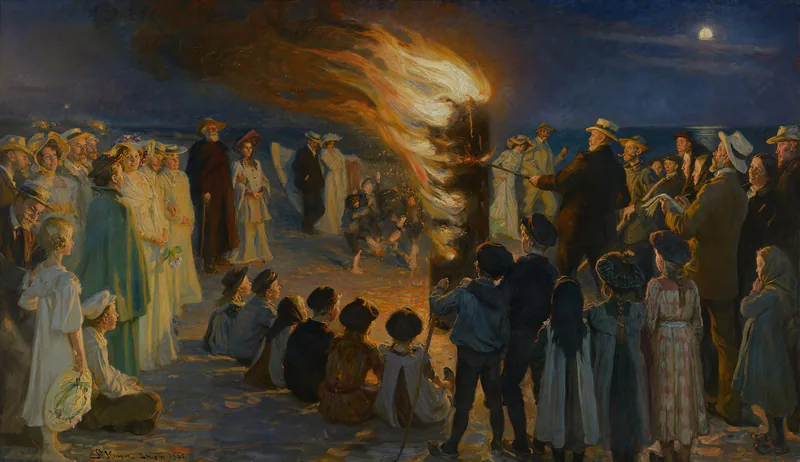
Before modern secularisation, most European superstition lived inside the Church year rather than against it. The eves of saints' days, when the boundary between worlds was believed to be thin, were favoured for love divination: on St Agnes' Eve (20–21 January), immortalised in John Keats's poem of 1820, young women hoped to dream of a future husband; similar customs attached to St Andrew's Eve in Poland and Central Europe, where melted wax was poured into water and its shapes interpreted. Midsummer, St John's Eve, brought bonfires, herb gathering and, in Sweden, the custom of picking seven kinds of flowers to sleep on in order to dream of one's beloved.
Objects blessed by the Church acquired protective uses beyond their liturgical role. Candles blessed at Candlemas were lit in thunderstorms; palms from Palm Sunday were tucked behind pictures or in barns; holy water was sprinkled on fields and cattle. The Twelve Days between Christmas and Epiphany, the German Rauhnächte, were surrounded with prohibitions, for instance against hanging out washing, and with omens for the coming year. These overlaps between faith and folk practice are discussed in Folk Christianity and Folk Magic.
The British Isles and Ireland§
British and Irish superstition is unusually well recorded. Among the commonest beliefs are touching or knocking on wood after speaking of good fortune, crossing fingers, avoiding new shoes on the table and greeting a solitary magpie. Roud's research shows that several of these are first recorded only in the nineteenth or early twentieth century; touching wood, for instance, is not reliably attested before the 1800s, despite popular claims linking it to tree spirits or the wood of the Cross.
Ireland adds a distinctive layer of fairy belief. Ringforts, the earthwork enclosures of early medieval farmsteads, were widely known as fairy forts, and lone hawthorn bushes as fairy trees; damaging them was believed to bring illness or misfortune. The belief remains culturally significant: in 1999 a road scheme near Latoon in County Clare was reportedly modified after the storyteller Eddie Lenihan publicly warned that a fairy bush stood in its path. Scotland, meanwhile, keeps the custom of first-footing at Hogmanay, when the first visitor across the threshold after midnight, ideally a dark-haired man bearing coal, salt or whisky, sets the household's luck for the year.
The background to these beliefs in older religion is explored in Celtic Religion, although historians caution that a direct line from pagan cult to modern custom is rarely demonstrable.
German-Speaking Lands, Scandinavia and Iceland§
German New Year customs are rich in luck symbols. Marzipan pigs, four-leaf clovers, horseshoes, ladybirds and chimney sweeps appear on cards and sweets; the phrase Schwein gehabt, "to have had pig", means to have been lucky. Meeting or touching a chimney sweep is thought to bring luck, a belief often explained by the sweep's role in keeping houses safe from fire. Bleigießen, melting small pieces of lead on New Year's Eve and reading the shapes they form in cold water, was a household favourite until European rules restricting lead in consumer products led sellers to switch to wax and tin around 2018. Actors and others wish one another luck with toi, toi, toi, imitating spitting three times.

In Scandinavia trolls and the hidden folk survive mainly as folklore and tourism, but in Iceland belief in the huldufólk, the hidden people, has a living public dimension. Surveys suggest that a substantial share of Icelanders are unwilling to rule out their existence, and road projects have occasionally been contested on the grounds that they disturb elf rocks, as in the protests at Gálgahraun in 2013, which also had strong environmental motives. Wider background can be found in Norse and Germanic Religion.
The Mediterranean: Italy, Greece, Spain and Portugal§
Around the Mediterranean the dominant theme is the evil eye, the harm caused by an envious or admiring glance. In southern Italy the malocchio is diagnosed by dropping oil into water and watching how it spreads, and is warded off by the cornicello, a small red or gold horn, or by the hand gesture of the horns. In Greece the mati is countered by blue eye beads and by mock spitting, ftou ftou, after praising a child. These protective objects are discussed in Amulets and Talismans and Protective Magic.
Calendar fears differ by country. In Italy the number seventeen has traditionally been feared, an aversion commonly explained by the Roman numeral XVII rearranging into VIXI, "I have lived", that is, I am dead; the explanation is learned and probably later than the belief. In Greece and the Spanish-speaking world it is Tuesday the thirteenth rather than Friday that is unlucky, a choice Greeks sometimes connect with the fall of Constantinople on a Tuesday in 1453. Spain's twelve grapes, one swallowed at each stroke of midnight on New Year's Eve, are often said to have been invented in 1909 to sell a grape surplus, but newspaper evidence shows the custom among Madrid's middle classes already in the 1880s.
Slavic and Eastern Europe§
Russian and other Slavic folk customs are particularly concerned with thresholds and journeys. Before a long trip, travellers and their families traditionally sit down together in silence for a moment, prisest' na dorozhku. Shaking hands or passing objects across a threshold is avoided, since the threshold was once associated with the household's dead and its guardian spirit, the domovoi. Returning home for something forgotten is considered unlucky, unless one looks in a mirror before setting out again.
Several Slavic rules concern counting and celebration. Flowers given to the living are bunched in odd numbers, since even numbers are reserved for funerals; birthdays should not be celebrated in advance; whistling indoors is said to whistle away the household's money. W. F. Ryan's history of magic in Russia shows how such beliefs coexisted for centuries with Orthodox Christianity and with clerical efforts to suppress them. Further south, Romanian and Balkan traditions preserved rich beliefs about the restless dead, such as the strigoi, which later fed the literary vampire.
Across the continent, many of these customs are kept with a smile rather than with conviction, yet they remain remarkably persistent. Comparable occupational beliefs are discussed in Superstitions of Sailors, Actors and Gamblers, and the reasons people keep them in The Psychology of Superstition.
Frequently asked questions§
Why is Tuesday the 13th unlucky in Greece and Spain?§
In Greek and Spanish tradition Tuesday has long been considered an inauspicious day, and combining it with thirteen produces the equivalent of the English-speaking Friday the 13th. Greeks often link Tuesday to the fall of Constantinople in 1453, while in Spanish the day is associated with Mars, god of war, through its name martes. These explanations are traditional rather than proven origins.
Is knocking on wood an ancient pagan custom?§
Probably not in any demonstrable way. The custom is widely explained as appeasing tree spirits or invoking the wood of the Cross, but in Britain it is not reliably recorded before the nineteenth century. Its true origin is unknown.
What is the Italian horn charm?§
The cornicello is a small twisted horn, usually red, gold or coral, worn or hung to ward off the malocchio, the evil eye. It is especially associated with Naples and southern Italy and belongs to a long Mediterranean tradition of horn and phallic amulets reaching back to antiquity.
Are Irish fairy forts protected?§
Ringforts are archaeological monuments and many are protected under Irish heritage law. Folk belief has added a second layer of protection, since many farmers have traditionally refused to disturb them, which helped thousands survive into modern times.
Sources and further reading§
- The Penguin Guide to the Superstitions of Britain and Ireland — Steve Roud, 2003
- A Dictionary of Superstitions — Iona Opie and Moira Tatem, 1989
- Enchanted Europe: Superstition, Reason, and Religion, 1250–1750 — Euan Cameron, 2010
- Religion and the Decline of Magic — Keith Thomas, 1971
- Teutonic Mythology — Jacob Grimm, 1835
- The Bathhouse at Midnight: An Historical Survey of Magic and Divination in Russia — W. F. Ryan, 1999
- Russian Folk Belief — Linda J. Ivanits, 1989
- The Evil Eye: A Casebook — Alan Dundes (ed.), 1981