Liber XXVIII · Superstitions · Chapter I: African & Caribbean Beliefs
African and Caribbean Folk Beliefs: Omens, Spirits and Charms
African and Caribbean folk beliefs: Akan day names, Yoruba twins and abiku, the tokoloshe, the khamsa hand, Jamaican duppies and Trinidad's soucouyant.
African and Caribbean folk beliefs are the everyday ideas about luck, danger and the unseen held across a continent of more than fifty countries and a sea of islands shaped by the African diaspora: the protective hand of North Africa, Akan day names and Yoruba twin traditions in the west, the tokoloshe of southern Africa, and the duppies, jumbies and soucouyants of the Caribbean. Many of these beliefs belong to living religions and moral systems, and the word "superstition" was long used by colonial governments and missionaries to dismiss and criminalise them.
Belief, Religion and the Colonial Word "Superstition"§
Any account of African and Caribbean folk belief must begin with how the category was imposed. In Jamaica obeah, a term for spiritual power and healing practices of African origin, was first made a crime in 1760, after the uprising known as Tacky's Revolt, in which obeah practitioners were believed to have played a role. Similar laws spread across the British Caribbean, and the historian Diana Paton has shown how they were used to police healing, divination and gatherings well into the twentieth century; some remain on the statute books. In Africa, colonial witchcraft ordinances, such as Kenya's of 1925 and South Africa's Witchcraft Suppression Act of 1957, punished both accusations of witchcraft and the practices of diviners, lumping healer and alleged witch together.
For this reason scholars generally prefer neutral terms such as folk belief, popular religion or indigenous knowledge. The religious systems behind many of the beliefs below are treated in their own right in African Traditional Religions, African Diasporic Religions, West African Vodun and Haitian Vodou. For the general concept see What Is Superstition?.
Misfortune and Its Causes: Witchcraft, Ancestors and Moral Order§
E. E. Evans-Pritchard's classic study of the Azande of central Africa, published in 1937, explained a principle found in many African societies. When an old granary collapsed and injured the people sheltering beneath it, the Azande knew perfectly well that termites had eaten the supports. What witchcraft explained was why it fell at that moment on those particular people. Misfortune was read as having a personal cause, whether an envious neighbour, an offended ancestor or a broken taboo, and the remedy was to identify and address it through divination, sacrifice or reconciliation.
Such ideas give meaning to suffering and enforce social norms such as generosity and respect for elders. They also have a darker side when accusations fall on the vulnerable. Researchers including Adam Ashforth in South Africa and Peter Geschiere in Cameroon have shown that fears of witchcraft did not fade with modernisation but often intensified with urbanisation, inequality and new forms of wealth. Human rights organisations have documented accusations against children in parts of Central and West Africa, and attacks on people with albinism in East Africa, driven by the false belief that their bodies bring wealth. Governments, churches and associations of traditional healers in the affected countries have condemned these crimes, and they should never be confused with the ordinary practice of African religions. The European parallel is discussed in Maleficium, Curses and Protective Magic.
Twins, Names and the Days of the Week§
Akan day names§
Among the Akan peoples of Ghana and Côte d'Ivoire, every person receives a day name according to the weekday of birth: a boy born on Friday is Kofi, a girl Afua; Saturday's children are Kwame and Ama; and so on through the week. The day of birth is linked to the kra or okra, the soul, and is believed to say something about character. The names are a matter of identity and pride rather than superstition, but they show how closely time and personhood are bound together.
Twins and spirit children§
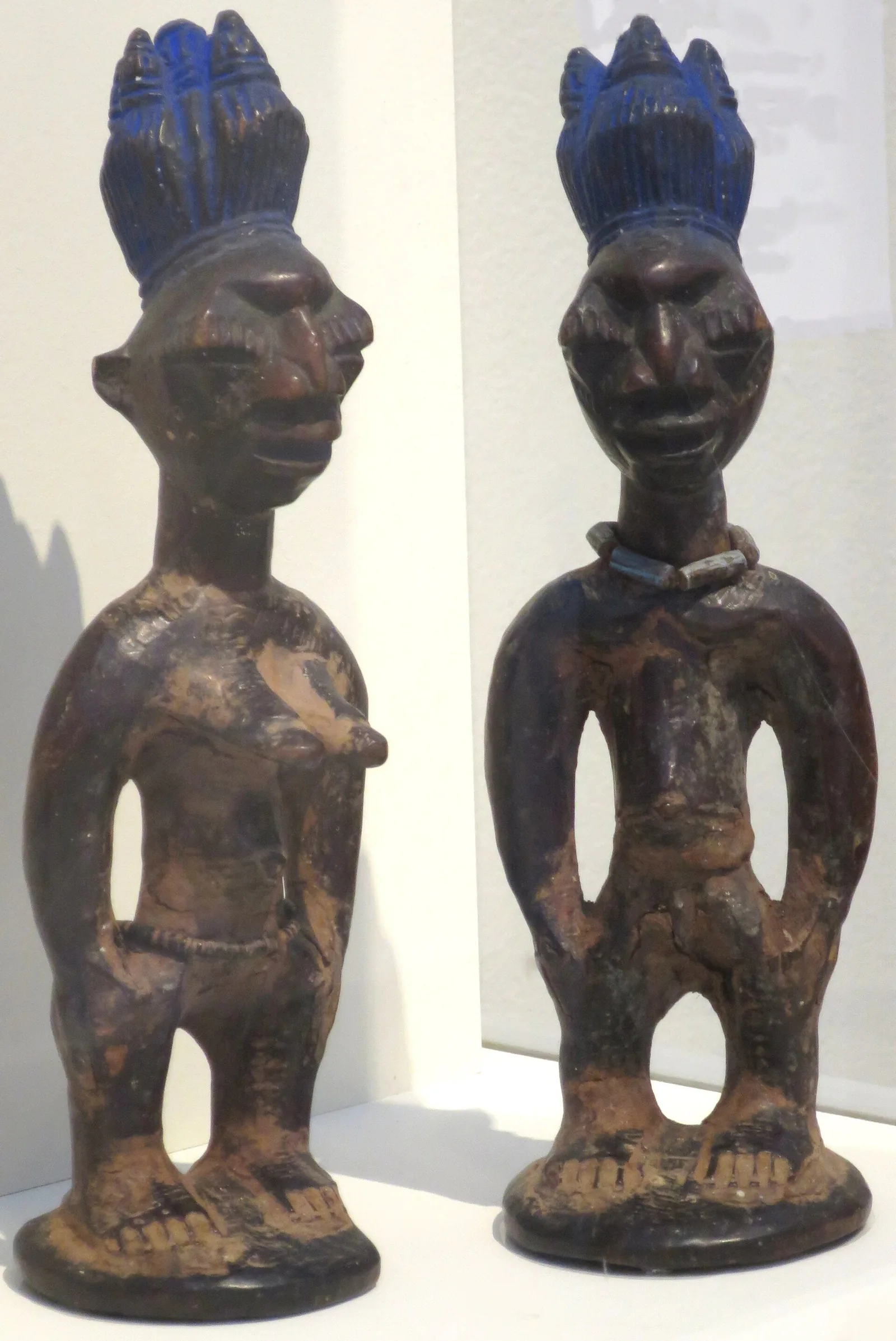
The Yoruba of south-western Nigeria have one of the highest natural twinning rates in the world, and twins, ibeji, are honoured as special beings. When a twin died, parents traditionally commissioned a small carved figure that was fed, washed and clothed in place of the child, and many such figures now sit in museums. Attitudes elsewhere were not always so positive: in parts of the Niger Delta and the Cross River region twins were once regarded as unnatural, a belief the Scottish missionary Mary Slessor campaigned against in Calabar in the late nineteenth century.
The Yoruba concept of abiku and the Igbo ogbanje describe spirit children who are born only to die and return, again and again. Parents who had lost several infants might give a new child a name meant to persuade it to stay, such as Kokumo, "this one will not die", or Durojaiye, "stay and enjoy the world", and might mark or adorn it to break the cycle. The novelist Chinua Achebe and the poet Wole Soyinka both drew on these beliefs, which reflected the harsh realities of infant mortality.
Southern and Eastern Africa: Tokoloshe, Lightning and Protection§
In Zulu and Xhosa folklore the tokoloshe is a small, mischievous and sometimes dangerous being, often said to be sent by a witch to trouble sleepers. A widely reported household custom is to raise beds on bricks so that the creature cannot reach the sleeper; the tokoloshe also features in popular newspapers, jokes and court cases, a sign of how folk belief coexists with urban life. Lightning, a deadly hazard on the highveld, was associated with the impundulu or lightning bird, and specialists known as "heaven-herds" were called on to protect homesteads from strikes.
Protective medicine, muthi in southern Africa, may be worn, buried at the boundaries of a property or applied to the body by a diviner-healer such as a sangoma or an inyanga. These healers work within a framework that honours the ancestors and diagnoses the causes of illness, and they are now formally recognised in South African health law. In Ethiopia a belief in buda, a harmful eye power, was historically attributed to marginalised artisan groups such as smiths and potters, showing how evil-eye beliefs can reflect social boundaries.
North Africa: The Hand, the Eye and the Jinn§
In Morocco, Algeria, Tunisia, Libya and Egypt the evil eye, al-ʿayn, is a common concern, shared with the Mediterranean and the Middle East. The protective hand known as the khamsa ("five"), sometimes called the hand of Fatima, is hung in homes and cars and worn as jewellery; the phrase khamsa fi ʿaynek, "five in your eye", deflects an envious look, and in Tunisia fish motifs serve the same purpose. Jewish communities of North Africa used the same hand symbol, an example of shared regional culture discussed in Jewish Magic and Folklore.
Beliefs about the jinn, beings mentioned in the Qur'an, also shape daily caution: some avoid pouring hot water down drains without saying the name of God, or whistling at night. Islamic scholars have long debated such customs, generally approving recitation of the Qur'an for protection while disapproving of amulets thought to compromise trust in God. The religious background is explained in Jinn and the Unseen in Islam, and the wider history of eye charms in Amulets and Talismans.
The Caribbean: Duppies, Jumbies and Maljo§
The folklore of the Caribbean reflects the meeting of West and Central African, European, Indigenous and Asian peoples under slavery and indenture. In Jamaica the restless dead are duppies, a word of probably African origin; among the most feared is the rolling calf, a fiery-eyed spectral beast trailing a chain. The Jamaican wake known as nine-night, held over the nights after a death, helps ensure that the spirit departs peacefully. Martha Warren Beckwith recorded many of these beliefs in the 1920s, and Zora Neale Hurston wrote about Jamaica and Haiti in the 1930s.
In Trinidad, Tobago, Guyana and the eastern Caribbean, spirits are jumbies. The soucouyant is an old woman who sheds her skin at night and travels as a ball of fire to drink blood; folklore says she can be delayed by a heap of rice left at the door, which she is compelled to count grain by grain. Maljo, from the French for evil eye, is warded off from babies with black-and-red seed bracelets known as jumbie beads, while in Puerto Rico, the Dominican Republic and Cuba infants wear an azabache, a jet charm often shaped as a small fist, a custom brought from Spain.
Haiti's figure of the zonbi, a person believed to have been deprived of will and put to work by a sorcerer, received international attention in the 1980s through the case of Clairvius Narcisse and the ethnobotanist Wade Davis's hypothesis that a poison was involved. That hypothesis remains contested. The folklore of the zombie should be kept distinct from the religion of Haitian Vodou and from Afro-Caribbean traditions such as Santería, which practitioners understand as ways of serving God and the spirits rather than as superstition.
Frequently asked questions§
What is a duppy?§
In Jamaican folklore a duppy is the spirit or ghost of a dead person, which may linger and cause harm if not properly settled. The rolling calf is a particularly feared form. Funeral customs such as the nine-night are partly intended to send the spirit peacefully on its way.
Why are some Caribbean babies given jet or bead bracelets?§
They are protective charms against maljo or mal de ojo, the evil eye, which is believed to make infants ill through envious or admiring looks. The azabache jet charm comes from Spanish tradition, while jumbie bead bracelets use red and black seeds.
Is obeah still illegal?§
It depends on the country. Obeah was criminalised across much of the British Caribbean from the eighteenth century onward. Several states have repealed their laws, while others retain them, though prosecutions are now rare.
What does the tokoloshe have to do with beds on bricks?§
In southern African folklore the tokoloshe is a small malicious being that attacks sleepers. Raising a bed on bricks is a widely reported precaution intended to keep the sleeper out of its reach.
Sources and further reading§
- Witchcraft, Oracles and Magic Among the Azande — E. E. Evans-Pritchard, 1937
- African Religions and Philosophy — John S. Mbiti, 1969
- The Modernity of Witchcraft: Politics and the Occult in Postcolonial Africa — Peter Geschiere, 1997
- Witchcraft, Violence, and Democracy in South Africa — Adam Ashforth, 2005
- Twins in African and Diaspora Cultures: Double Trouble, Twice Blessed — Philip M. Peek (ed.), 2011
- The Cultural Politics of Obeah: Religion, Colonialism and Modernity in the Caribbean World — Diana Paton, 2015
- Black Roadways: A Study of Jamaican Folk Life — Martha Warren Beckwith, 1929
- Tell My Horse: Voodoo and Life in Haiti and Jamaica — Zora Neale Hurston, 1938