Liber XVII · Islam · Chapter V: Jinn & the Unseen
Jinn and the Unseen in Islam: Angels, Iblis and Spirits
Jinn and the unseen in Islam: al-ghayb, angels, jinn of smokeless fire, Iblis and Satan, possession, the evil eye, protective recitation and genie lore.

In Islam the "unseen" (al-ghayb) is the whole realm of reality hidden from the senses: God Himself, the angels, the jinn, the soul's life after death, paradise and hell. The jinn are intelligent beings that the Qur'an says God created "of smokeless fire", invisible to humans but, like them, endowed with free will and accountable to God. Belief in angels is one of the articles of Islamic faith, and belief in the jinn rests on many Qur'anic verses, so both have shaped Muslim theology, healing practices and folklore from the beginning.
Al-Ghayb: The Unseen in Islamic Belief§
The opening of sura al-Baqara describes the God-fearing as those who "believe in the unseen" and establish prayer. In Islamic theology al-ghayb includes everything not accessible to ordinary perception or reason: the divine attributes, the angels and jinn, the decree, the questioning in the grave, the resurrection and the hereafter. The Qur'an states that God alone knows the unseen fully, revealing parts of it only to messengers whom He chooses (al-Jinn 72:26–27). For this reason fortune-telling and claims to know the future were condemned by most Muslim scholars, although, as Islamic Occult Sciences shows, astrology and other arts of prognostication were nonetheless widely practised and debated.
After death, according to Islamic teaching, the soul enters the barzakh, an intermediate state between this world and the resurrection, during which two angels, Munkar and Nakir, question the dead in the grave about their Lord, their religion and their prophet. The descriptions of the Day of Judgement, the bridge over hell and the gardens of paradise belong to the same unseen realm.
Angels in the Qur'an and Hadith§
Angels (malāʾika, singular malak) are, according to a hadith in the collection of Muslim, created from light. They have no free will to disobey, do not eat or marry, and are neither male nor female. Among those named in the Qur'an and hadith are Jibril (Gabriel), who brought revelation to the prophets; Mika'il (Michael), associated with providence and rain; Israfil, who will blow the trumpet at the end of time; and the Angel of Death (malak al-mawt), popularly called 'Izra'il. Two "noble scribes" record each person's deeds, Malik guards hell and Ridwan paradise.
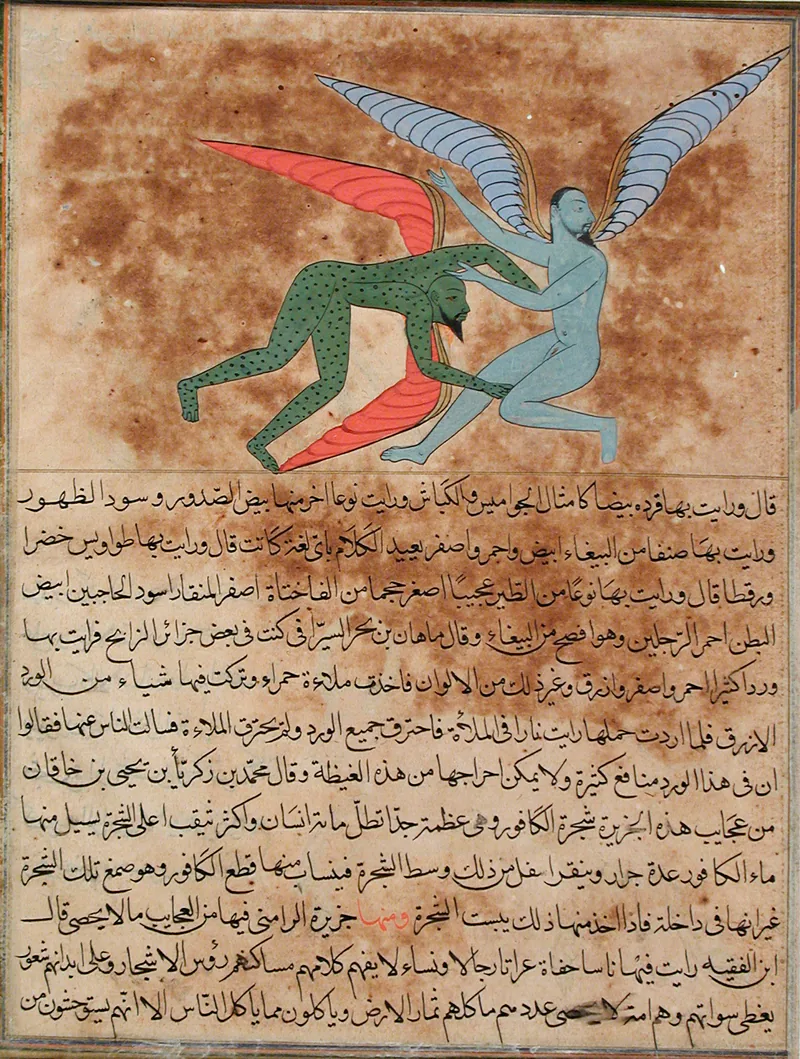
The Qur'an also tells of two angels in Babylon, Harut and Marut, who taught people a form of magic while warning that they were only a trial (al-Baqara 2:102). The same verse defends Solomon against the charge of sorcery, saying that it was the devils who taught magic. Commentators elaborated a story of the two angels' fall, which, like Jewish legends of the Watchers, became a source for later lore about forbidden knowledge. The wider history of angels in religion and magic is surveyed in Angels and Spirits.
The Jinn: Beings of Smokeless Fire§
Belief in jinn was widespread in pre-Islamic Arabia, where they were thought to haunt deserts, ruins and wells and to inspire poets and soothsayers (kāhin); a madman was majnūn, "possessed by a jinn". The Qur'an rejects the accusation that Muhammad was a poet, soothsayer or majnūn, but it affirms the existence of the jinn and integrates them into its monotheism. Humans were made from clay and the jinn "of smokeless fire" (ar-Rahman 55:14–15); both were created only to worship God (adh-Dhariyat 51:56).
An entire sura, al-Jinn, relates how a company of jinn heard the Qur'an recited and believed. It describes jinn who once listened at the gates of heaven but are now driven off by flaming missiles, which commentators connected with shooting stars. The Qur'an thus presents jinn as a parallel community: some are Muslims, some unbelievers, and all will be judged. Theologians and jurists went on to discuss whether jinn can marry humans, whether they pray behind a human imam and whether they will enter paradise. Their subjection to Solomon, who in the Qur'an commands jinn to build for him, is told in Sulayman in Islamic Tradition.
Later literature named many kinds of jinn: the powerful ʿifrīt (a word the Qur'an uses of the jinn who offers to bring the Queen of Sheba's throne to Solomon), the rebellious mārid, the shape-shifting ghūl of the desert, and others. Folk belief held that jinn could take the form of snakes, dogs or cats, frequented thresholds, latrines and dark places, and could be offended by people who unknowingly harmed them. A well-known compendium on the jinn by the fourteenth-century scholar Badr al-Din al-Shibli of Damascus, Ākām al-marjān, gathered hadith and stories on all these questions.
Iblis, Satan and the Whisperer§
The Qur'an tells several times how God commanded the angels to bow to Adam and all did so except Iblis, who argued that he, made of fire, was better than a being made of clay. Cast out, he asked for respite until the Day of Judgement in order to lead humans astray. One verse states that Iblis "was of the jinn" (al-Kahf 18:50), and most theologians therefore regard him as a jinn who had risen among the angels, though some held that he was a fallen angel. He is also called al-shayṭān, Satan, and the word shayāṭīn, devils, is used of rebellious jinn and of evil humans alike.
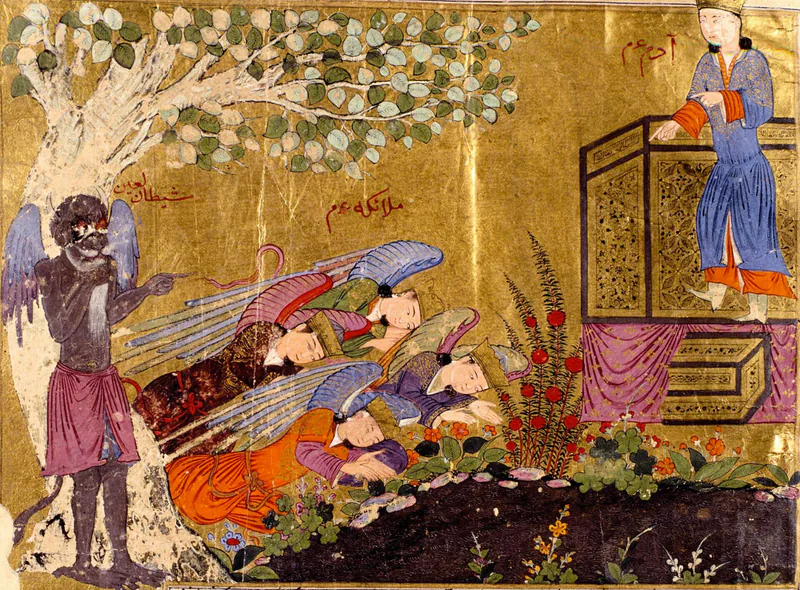
Satan's main power in the Qur'an is to whisper (waswasa) temptation and doubt; he has no authority over sincere servants of God. The last sura, an-Nas, asks refuge from "the evil of the sneaking whisperer… of the jinn and of mankind". Some Sufis, notably al-Hallaj and Ahmad Ghazali (d. 1126), gave Iblis a paradoxical role as a lover of God who refused to bow to anyone but Him, an interpretation most theologians rejected. The comparative history of Satan is traced in The History of Satan and the Devil.
Possession, the Evil Eye and Protective Recitation§
Whether jinn can enter and possess a human body was debated. Many scholars, including Ahmad ibn Hanbal and Ibn Taymiyya, affirmed it, while some Mu'tazili theologians denied it. Islamic tradition also affirms the reality of the evil eye (ʿayn), the harm caused by an envious or admiring glance, on the basis of hadith.
The approved remedy in mainstream Sunni teaching is ruqya, healing by recitation: the Fatiha, the Throne Verse (al-Baqara 2:255) and the last two suras, al-Falaq and an-Nas, known together as al-muʿawwidhatān, "the two seeking refuge", are recited over the sufferer or into water. Jurists distinguished such recitation from forbidden sorcery, permitting it if it used God's words and names in an understandable form. Popular practice went further, with written amulets, folk healers and protective images such as the hand-shaped khamsa; these blend into the talismanic arts described in Islamic Occult Sciences and the wider history of protective magic. Spirit-possession cults such as the zār of Egypt, Sudan and Ethiopia and the Gnawa ceremonies of Morocco, studied by anthropologists, combine Islamic and African elements and have often been criticised by religious scholars. Modern Muslim healers and psychiatrists in many countries debate how to distinguish possession from mental illness, and medical care is generally recommended alongside prayer.
Jinn in Folklore and the Arabian Nights§
Jinn are central to the storytelling of the Islamic world. In the Thousand and One Nights a fisherman releases a vengeful jinni from a sealed brass bottle, the seal being that of Solomon, and jinn carry lovers across the world or build palaces overnight. The best-known Western image, the genie of Aladdin's lamp, entered the Nights through Antoine Galland's French translation in the early eighteenth century, from a story told to him by the Syrian Hanna Diyab; no older Arabic manuscript of it is known. The English "genie" comes from the French génie, chosen for its similarity in sound to jinnī. Nineteenth-century observers such as Edward William Lane recorded jinn beliefs in daily Egyptian life, and they remain a living part of religion and folklore today.
Frequently asked questions§
Are jinn mentioned in the Qur'an?§
Yes, many times. The Qur'an describes their creation from smokeless fire, their duty to worship God, their division into believers and unbelievers, their service to Solomon and their listening to the Qur'an; sura 72 is named after them.
Is Iblis an angel or a jinn?§
The Qur'an says that Iblis "was of the jinn", and most Sunni scholars hold that he was a jinn who had been among the angels when the command to bow to Adam was given. A minority view regarded him as a fallen angel. Since angels in Islamic belief cannot disobey, the jinn interpretation became dominant.
What is ruqya?§
Ruqya is the recitation of Qur'anic verses and prayers for healing or protection from harm, including the evil eye and the influence of jinn. Mainstream scholars permit it when it uses God's words and names and does not involve sorcery.
Sources and further reading§
- The Meaning of the Glorious Koran — Marmaduke Pickthall, 1930
- Islam, Arabs, and the Intelligent World of the Jinn — Amira El-Zein, 2009
- Legends of the Fire Spirits: Jinn and Genies from Arabia to Zanzibar — Robert Lebling, 2010
- An Account of the Manners and Customs of the Modern Egyptians — Edward William Lane, 1836
- Wombs and Alien Spirits: Women, Men, and the Zar Cult in Northern Sudan — Janice Boddy, 1989
- Magic and Divination in Early Islam — Emilie Savage-Smith (ed.), 2004