Liber XXVIII · Solomonic Magic · Chapter V: Legends of Solomon
Sulayman in Islam: Solomon, the Jinn and the Queen of Sheba
Sulayman (Solomon) in the Qur'an and Islamic lore: command of jinn and wind, bird and ant speech, Bilqis the Queen of Sheba, his ring and sealed jinn.

In Islam, Solomon is Sulayman ibn Dawud, a prophet and king to whom God granted a kingdom unlike any other: command over the wind, authority over the jinn, and understanding of the speech of birds and ants. The Qur'an tells of his encounter with the Queen of Sheba, later named Bilqis, and post-Qur'anic tradition adds a magic ring, sealed bottles of jinn and a rich store of legend that later flowed into the Thousand and One Nights.
Sulayman as Prophet and King in the Qur'an§
The Qur'an presents Sulayman as the son and heir of David (Dawud), endowed with wisdom and judgment. Unlike the biblical account in 1 Kings, which ends with Solomon's apostasy, the Qur'an treats him as a righteous prophet throughout, one who repeatedly turns to God in gratitude for gifts he recognizes as tests. His story is not narrated in a single continuous chapter; it appears in episodes scattered across several suras, each emphasizing a lesson about divine favor, humility and true sovereignty.
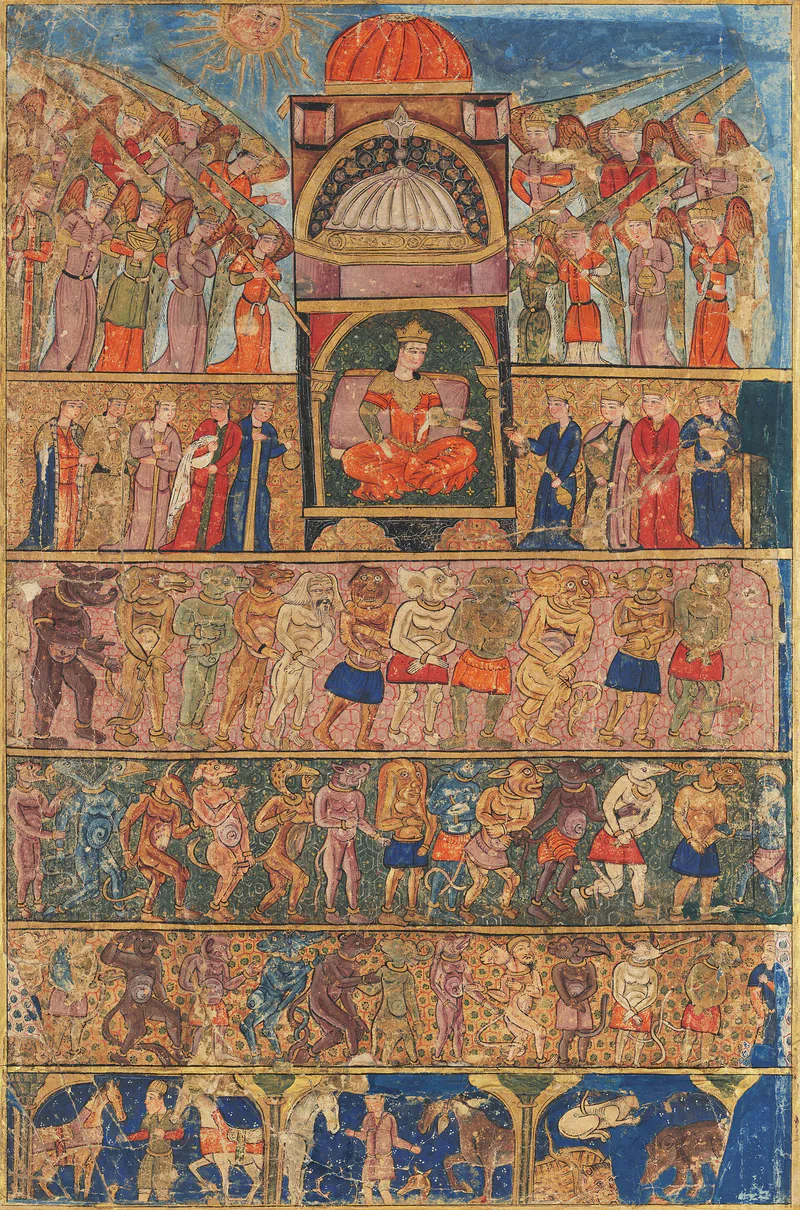
Sura 38 records Sulayman's prayer for a kingdom "such as shall not belong to anyone after me" (38:35), which God grants by subjecting to him the wind, which blew gently at his command, and the devils (shayatin), every builder and diver, along with others bound in fetters. Sura 34 adds that the jinn made for him whatever he wished: sanctuaries, statues, basins like reservoirs and fixed cauldrons, and that God caused a spring of molten copper to flow for him.
The Death of Sulayman§
One of the most memorable Qur'anic episodes concerns his death (34:14). Sulayman died while standing, leaning on his staff, and the jinn continued their toil because they did not realize he was dead. Only when a creature of the earth, understood as a woodworm or termite, gnawed through the staff and his body fell did the jinn understand. The verse comments that had they known the unseen, they would not have remained in humiliating labor. The story makes a theological point: the jinn, often credited in popular belief with secret knowledge, do not know the unseen.
Command of the Wind and the Jinn§
Sulayman's authority over the jinn is the most influential part of his image in later Islamic culture. In Islamic cosmology the jinn are beings created from smokeless fire, possessing free will, capable of belief or unbelief, and normally invisible to humans. Sulayman's ability to command them, discipline them and set them to work was understood as a unique prophetic gift, not as a skill that others could learn.
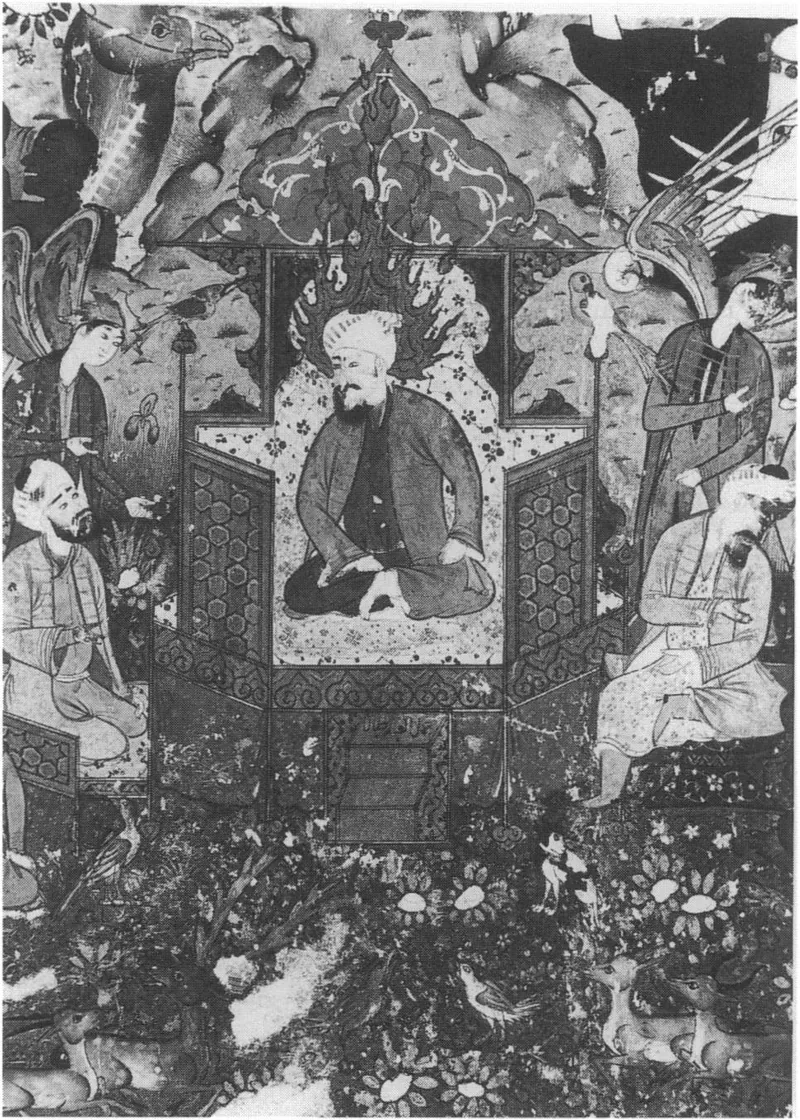
Commentators elaborated on the wind that carried Sulayman's court. A common image describes a vast carpet or platform on which the king, his army and his throne travelled, covering a month's journey in a morning and another in an evening, an interpretation of Qur'an 34:12. These motifs became central to Persian and Ottoman art, where Sulayman is often depicted enthroned amid jinn, animals and birds.
The Speech of Birds and the Valley of the Ants§
Sura 27, named "The Ants" (al-Naml), is the richest source for Sulayman's story. It opens with his declaration that he and his father were taught the language of birds. As his army of men, jinn and birds marches, they reach a valley where an ant warns her fellows to enter their dwellings lest Sulayman and his hosts crush them unknowingly. Sulayman smiles, laughs at her words, and prays to be grateful for God's favor. The episode is often cited as a lesson in mercy toward all creatures and in the humility of a king who listens to the smallest voice.
Sulayman and the Queen of Sheba (Bilqis)§
The same sura narrates the meeting with the Queen of Sheba. Sulayman notices the hoopoe (hudhud) is missing from his review of the birds. The bird returns with news of a kingdom in Saba ruled by a woman with a magnificent throne, whose people worship the sun. Sulayman sends a letter, delivered by the hoopoe, beginning "In the name of God, the Merciful, the Compassionate" and calling her to submit.
The queen consults her counsellors and sends a gift, which Sulayman refuses as worthless compared with what God has given him. He then asks who among his court can bring her throne before she arrives. An ifrit, a powerful jinni, offers to do so before the king rises from his seat; but one "who had knowledge of the Book" brings it in the blink of an eye. Commentators often identified this figure as Asaf ibn Barkhiya, Sulayman's vizier, and later esoteric writers associated his feat with knowledge of the greatest name of God.
When the queen arrives she is tested with her disguised throne and then invited into a palace whose floor is made of glass over water. Thinking it a pool, she lifts her skirts, is told it is smooth glass, and declares that she has wronged herself and submits, with Sulayman, to God (27:44). The Qur'an does not name her; the name Bilqis comes from later tradition. In Ethiopian tradition, by contrast, the queen is Makeda, and the Kebra Nagast makes her the mother of Menelik, founder of the Solomonic dynasty.
The Ring of Sulayman and the Usurping Jinni§
The Qur'an says that God "tried Sulayman and placed upon his throne a body; then he turned back" (38:34). Commentators sought to explain this obscure verse, and one widely circulated interpretation drew on a legend closely related to the Talmudic story of Solomon and Asmodeus. Sulayman's authority, it said, resided in a ring (khatam) engraved with the greatest name of God. A rebellious jinni, often called Sakhr, obtained the ring and sat on the throne in Sulayman's likeness for forty days, while the true king wandered unrecognized. The jinni eventually threw the ring into the sea; a fish swallowed it; and Sulayman, working for fishermen, found it in a fish's belly and regained his kingdom.
Many classical exegetes, including major commentators such as al-Tabari, recorded versions of this story, while others, including later scholars like Ibn Kathir, criticized such narratives as Isra'iliyyat, material borrowed from Jewish and Christian lore of doubtful reliability, and preferred other interpretations of the verse. This debate is itself an important part of the history: it shows Muslim scholars weighing popular legend against standards of transmission. The ring became known as khatam Sulayman, and the term was applied to the hexagram and pentagram in Islamic art, as described in our article on the Seal of Solomon.
Sulayman and Magic: Qur'an 2:102§
Because Sulayman commanded jinn, he was sometimes credited with sorcery. The Qur'an rejects this directly. Sura 2:102 states that the devils recited falsehoods about the kingdom of Sulayman, that Sulayman did not disbelieve, but the devils disbelieved, teaching people magic. The verse then mentions the two angels Harut and Marut in Babylon, who taught magic only after warning that they were a trial. Exegetes explained that devils had buried books of magic under Sulayman's throne and, after his death, claimed that his power came from them.
This verse frames a tension that runs through Islamic attitudes. On one side, orthodox scholarship insists that Sulayman's power was a prophetic gift and that sorcery is forbidden. On the other, a body of practical talismanic literature, known as 'ilm al-huruf (the science of letters) and associated texts, invoked Sulayman's name and seal for protection and for binding jinn. Grimoire-like works on jinn and talismans circulated widely, and amulets bearing the Solomonic star remain common across the Muslim world. Mystical writers within Sufism generally read Sulayman's kingdom allegorically, as dominion over the lower self.
Sealed Jinn in the Thousand and One Nights§
The motif of jinn imprisoned by Sulayman became a staple of storytelling. In "The Fisherman and the Jinni," from the Thousand and One Nights, a poor fisherman nets a brass bottle stoppered with lead and stamped with the seal of Sulayman. When he opens it, a gigantic ifrit emerges, explains that he rebelled against Sulayman and was imprisoned and cast into the sea, and threatens to kill his liberator. The fisherman tricks him back into the bottle by doubting that so great a being could have fit inside.
The "City of Brass," another tale in the collection, describes an expedition sent by the Umayyad caliph Abd al-Malik ibn Marwan to recover brass vessels in which Sulayman had imprisoned jinn. The expedition passes through deserted cities that teach the vanity of worldly power, making the tale both an adventure and a meditation on mortality. Both stories reflect the same image found in the Goetia, where Solomon shuts spirits in a brass vessel, and in the late antique Testament of Solomon; see also our overview of the Ars Goetia's 72 spirits.
Frequently asked questions§
Is Sulayman the same person as King Solomon?§
Yes. Sulayman is the Arabic form of Solomon, son of David. Islam regards him as a prophet and a righteous king, and the Qur'an recounts episodes of his life that partly overlap with and partly differ from the Bible.
Did Sulayman control the jinn in the Qur'an?§
Yes. The Qur'an states that God subjected the jinn and devils to Sulayman, who used them to build and to dive, and that some were held in fetters. This is presented as a unique divine gift, not a learned magical technique.
What is the name of the Queen of Sheba in Islam?§
The Qur'an does not name her. Later Islamic tradition calls her Bilqis. In Ethiopian tradition she is known as Makeda.
Does the Qur'an say Sulayman practised magic?§
No. Qur'an 2:102 explicitly states that Sulayman did not disbelieve and that it was the devils who taught people magic, falsely attributing it to his kingdom.
Sources and further reading§
- The Qur'an, suras 2:102, 21:78–82, 27:15–44, 34:12–14, 38:30–40
- Jami' al-Bayan (Tafsir) — Muhammad ibn Jarir al-Tabari, early 10th century
- Tales of the Prophets (Qisas al-Anbiya) — al-Kisa'i, trans. W. M. Thackston, 1978
- The Arabian Nights — trans. Husain Haddawy, 1990
- The Kebra Nagast — trans. E. A. Wallis Budge, 1922
- The Figure of Solomon in Jewish, Christian and Islamic Tradition — ed. Joseph Verheyden, 2013
- Demonizing the Queen of Sheba: Boundaries of Gender and Culture in Postbiblical Judaism and Medieval Islam — Jacob Lassner, 1993
- Solomon and Sheba — ed. James B. Pritchard, 1974