Liber XXIII · Rastafari · Chapter I: Beliefs: Jah, Babylon & Zion
The Kebra Nagast in Rastafari: Solomon, Sheba and the Ark
The Kebra Nagast explained: the Ethiopian epic of Solomon, the Queen of Sheba, Menelik and the Ark, its medieval origins, and its meaning in Rastafari belief.

The Kebra Nagast ("Glory of the Kings") is an Ethiopian work in the classical Ge'ez language, usually dated to the early fourteenth century, which tells how the Queen of Sheba visited King Solomon, bore him a son, Menelik, and how the Ark of the Covenant came to Ethiopia. It was the charter of Ethiopia's Solomonic dynasty, and for Rastafari it is a key text: it presents Haile Selassie I as an heir of David and Solomon and Ethiopia as the true Zion.
It is one of several sources, alongside the Bible and the speeches of Haile Selassie, discussed in Rastafari beliefs.
What the Kebra Nagast Is§
The Kebra Nagast is a long prose compilation of 117 chapters. It is not a single narrative but a learned anthology: it gathers biblical stories, apocryphal legends, prophecies and interpretation around one argument, that the kings of Ethiopia are the legitimate heirs of the kings of Israel and that God's covenant presence now rests in Ethiopia.
The work is framed as a debate among the bishops at a church council, where one speaker declares that he has found in a church in Constantinople a book proving that the sovereignty of the whole world belongs to the emperor of Rome and the king of Ethiopia. The story of Solomon and Sheba follows as the substance of that proof. A colophon names the scholars responsible and claims that the Ge'ez text was translated from Arabic, which had in turn come from a Coptic original. Whether such earlier versions existed is uncertain; scholars agree that the work as we have it draws on many older traditions, Jewish, Christian, Islamic and Ethiopian.
Although it is revered, the Kebra Nagast is not part of the biblical canon of the Ethiopian Orthodox Church, which already has one of the largest canons in Christianity, including 1 Enoch and Jubilees (see the Book of Enoch and the Christian Bible and its canon). It belongs instead to the literature of royal history and national identity.
The Story of Makeda, Solomon and Menelik§
The Bible says only a little. In 1 Kings 10 and 2 Chronicles 9 the queen of Sheba hears of Solomon's wisdom, comes to Jerusalem with spices, gold and precious stones, tests him with hard questions and returns to her land. Jesus refers to her in Matthew 12:42 as "the queen of the south". Arabic and Islamic tradition knows her as Bilqis, as described in Sulayman in Islamic tradition.
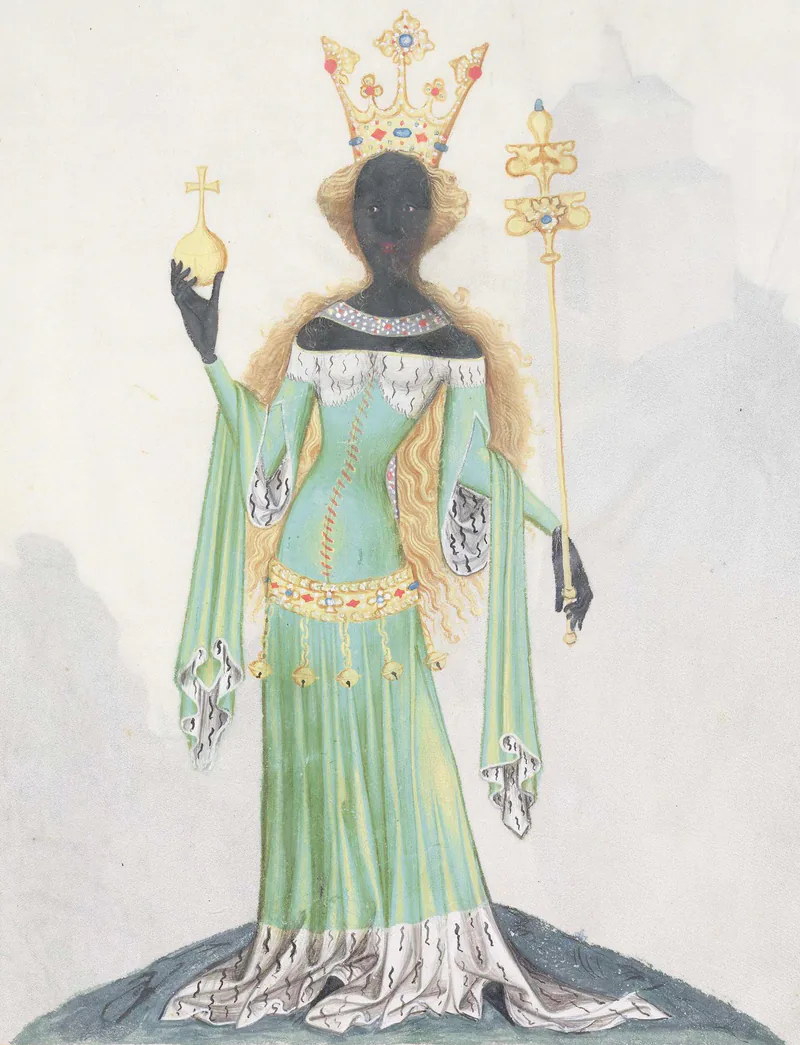
The Kebra Nagast gives her a name, Makeda, and a kingdom in Ethiopia. Told by the merchant Tamrin of Solomon's wisdom, she travels to Jerusalem, learns from the king and turns from the worship of the sun to the God of Israel. Before she leaves, Solomon contrives to share her bed, and she returns home bearing his child, with a ring as his token. Her son, called Bayna-Lehkem ("son of the wise man") and later Menelik, grows up in Ethiopia and, as a young man, travels to Jerusalem to meet his father. Solomon recognises him, wishes him to stay as heir, and when he will not, anoints him king of Ethiopia and sends with him the firstborn sons of Israel's leading families.
The Ark of the Covenant and Ethiopia as the New Zion§
The climax of the story is the removal of the Ark. Azariah, son of the high priest Zadok, unwilling to be parted from the Ark, which the text calls Zion, takes it secretly from the Temple with the help of an angel and leaves a replica in its place. The party travels south in a miraculous journey, their wagons lifted above the ground. When Solomon discovers the loss and pursues them, it is too late; he mourns, and is comforted by the understanding that God has willed the Ark to go to his firstborn son's kingdom.
From this story flows the Kebra Nagast's theology. Israel has lost the Ark and with it the covenant presence; Ethiopia, which received it, is now the chosen nation and Zion. Ethiopian Christians hold that the Ark remains at the Church of St Mary of Zion in Aksum, guarded by a single monk who alone may see it, and every Ethiopian Orthodox church contains a tabot, a consecrated tablet representing the Ark, which is carried in procession on feast days such as Timkat. The relationship between this tradition and the Rastafari is explored in Rastafari and the Ethiopian Orthodox Church.
Dating, Authorship and Purpose§
Most historians date the Kebra Nagast in its present form to the early fourteenth century, roughly 1314–1322, in the reign of Emperor Amda Seyon. Its colophon names a scholar called Yeshaq among those who prepared it. Behind this date stands a political event: in 1270 Yekuno Amlak overthrew the Zagwe dynasty, which had ruled for more than a century, and founded a new line claiming descent from Solomon and Menelik. The Kebra Nagast gave that claim its fullest literary form, and it helped bind together crown and church for centuries.
The book's claims became law in modern times. Ethiopia's constitution of 1931, issued by Haile Selassie, declared that the imperial line descended without interruption from Menelik I, son of King Solomon and the Queen of Sheba, and the revised constitution of 1955 repeated it. Modern scholars, among them Edward Ullendorff and Stuart Munro-Hay, treat the Ark narrative as legend rather than history, while recognising its enormous importance for Ethiopian culture. Ethiopian Christians, for their part, regard the presence of the Ark at Aksum as a matter of faith.
How the Kebra Nagast Reached Jamaica§
European knowledge of the Kebra Nagast began with the Scottish traveller James Bruce, who summarised it in his Travels to Discover the Source of the Nile (1790). A critical edition of the Ge'ez text with a German translation was published by Carl Bezold in 1905. The decisive version for the English-speaking world was E. A. Wallis Budge's translation, The Queen of Sheba and Her Only Son Menyelek, published in London in 1922.
Budge's translation appeared just as Ethiopianism and the Garvey movement were at their height, and copies circulated among Black readers in the Caribbean and the United States. When Ras Tafari was crowned in November 1930 with the titles "King of Kings" and "Elect of God", the Solomonic lineage described in the Kebra Nagast offered Jamaican preachers such as Leonard Howell a scriptural frame for what they had seen in the newspapers; the background is told in the origins of Rastafari.
The Kebra Nagast in Rastafari Belief and Reasoning§
For Rastafari the Kebra Nagast does three things. First, it establishes the emperor's descent: Haile Selassie is the heir of David and Solomon, often described in Rastafari tradition as the 225th ruler in that line, and so the Lion of the Tribe of Judah of Revelation 5:5, a title discussed in Haile Selassie I in Rastafari. Second, it confirms that Black Africans are heirs of Israel: if the Ark went to Ethiopia, then the covenant passed to Africa, and Rastafari can speak of themselves as the true children of Israel. Third, it makes Ethiopia Zion, the holy land to which the scattered children of Africa will return.
A belief widespread among Rastafari holds that the Kebra Nagast was deliberately kept from Black people, sometimes linked with the claim that King James's translators removed books from the Bible. Historians note that the work was never part of any biblical canon, Ethiopian or European, and that the King James Version of 1611 made no decisions about Ethiopian literature. The belief nonetheless expresses a real experience: that colonial education gave Jamaicans little knowledge of African history or of Africa's ancient Christian civilisation.
Popular editions aimed at Rastafari readers, such as those of Miguel F. Brooks (1995) and Gerald Hausman (1997), have kept the book in circulation, and passages from it are read and debated in reasoning sessions alongside the Psalms and the Prophets. For many Rastafari the Kebra Nagast is not an infallible scripture but a witness, one strand in a web of texts by which they understand Haile Selassie, Empress Menen (see Empress Menen Asfaw) and their own history.
Frequently asked questions§
What is the Kebra Nagast?§
It is a fourteenth-century Ethiopian work in Ge'ez whose title means "Glory of the Kings". It tells the story of the Queen of Sheba, King Solomon and their son Menelik I, and of how the Ark of the Covenant came to Ethiopia, and it served as the founding legend of Ethiopia's Solomonic dynasty.
Is the Kebra Nagast part of the Bible?§
No. It is not in the biblical canon of any church, including the Ethiopian Orthodox Church, though it is highly revered in Ethiopia. Rastafari read it alongside the Bible as a witness to Ethiopia's sacred history.
Why is the Kebra Nagast important to Rastafari?§
It traces Haile Selassie's lineage back to Solomon and David and places the Ark of the Covenant in Ethiopia. For Rastafari this confirms that the emperor is the Lion of Judah, that Black Africans are heirs of Israel and that Ethiopia is Zion.
Is the Ark of the Covenant really in Ethiopia?§
The Ethiopian Orthodox Church teaches that the Ark is kept at the Church of St Mary of Zion in Aksum, where no outsider may see it. Historians cannot verify the claim and generally regard the Kebra Nagast's account as a medieval legend.
Sources and further reading§
- The Kebra Nagast (The Queen of Sheba and Her Only Son Menyelek) — E. A. Wallis Budge, 1922
- Kebra Nagast (The Glory of Kings) — Miguel F. Brooks, 1995
- The Kebra Nagast: The Lost Bible of Rastafarian Wisdom and Faith from Ethiopia and Jamaica — Gerald Hausman, 1997
- Ethiopia and the Bible — Edward Ullendorff, 1968
- The Quest for the Ark of the Covenant: The True History of the Tablets of Moses — Stuart Munro-Hay, 2005
- Travels to Discover the Source of the Nile — James Bruce, 1790
- Rastafari: Roots and Ideology — Barry Chevannes, 1994
- From Garvey to Marley: Rastafari Theology — Noel Leo Erskine, 2005