Liber XXIII · Rastafari · Chapter IV: The Mansions of Rastafari
Rastafari and the Ethiopian Orthodox Church: Faith and Tension
How Rastafari met the Ethiopian Orthodox Tewahedo Church: Haile Selassie's faith, Abuna Yesehaq in Jamaica from 1970, baptism, Bob Marley and Orthodox Rastas.

The Ethiopian Orthodox Tewahedo Church, the ancient national church of Ethiopia, established itself in Jamaica in 1970 at the request of Haile Selassie I, and it drew many Rastafari into its congregations. The relationship has been close but uneasy: Rastafari revere the church of the emperor and its African Christianity, while the church teaches that Haile Selassie was a devout Christian king, not God. Out of this meeting came a distinct current, the Orthodox Rastafari, now one of the recognised houses of the movement.
The other houses of the movement, from the Nyabinghi to the Twelve Tribes of Israel, are described in the mansions of Rastafari.
The Ethiopian Orthodox Tewahedo Church in Brief§
Christianity became the religion of the Aksumite kingdom in the fourth century, when King Ezana adopted it under the influence of Frumentius, a Syrian Christian who was consecrated bishop by Athanasius of Alexandria and is remembered in Ethiopia as Abba Selama. For more than sixteen centuries the Ethiopian church depended on the Coptic patriarchate of Alexandria for its bishops; it received its own patriarch only in 1959, under Haile Selassie.
The church belongs to the Oriental Orthodox communion, with the Coptic, Armenian, Syriac and Eritrean churches. These churches did not accept the definition of Christ's two natures adopted at the Council of Chalcedon in 451, as explained in Christian creeds and ecumenical councils; tewahedo, the church's own name for its doctrine, means "made one" and stresses the perfect union of divinity and humanity in Christ. It is distinct from, though in many ways close to, the Greek and Russian Eastern Orthodox churches.
Ethiopian Christianity has features that Rastafari found deeply familiar. It keeps a large biblical canon that includes 1 Enoch and Jubilees; it honours both Saturday and Sunday as holy; it forbids pork and observes long fasts, many of them without any animal products; and every church holds a tabot, a consecrated tablet representing the Ark of the Covenant, whose story is told in the Kebra Nagast in Rastafari.
Haile Selassie's Faith and the 1966 Visit§
Haile Selassie was a practising Orthodox Christian throughout his life. He attended the liturgy, built churches, sponsored a new Amharic translation of the Bible and presented himself as the defender of the faith. In public statements he described himself as a man and a servant of God. When he visited Jamaica in April 1966, crowds of Rastafari greeted him as divine, and the meeting raised a question for both sides: what should the emperor's church say to people who worshipped its emperor?
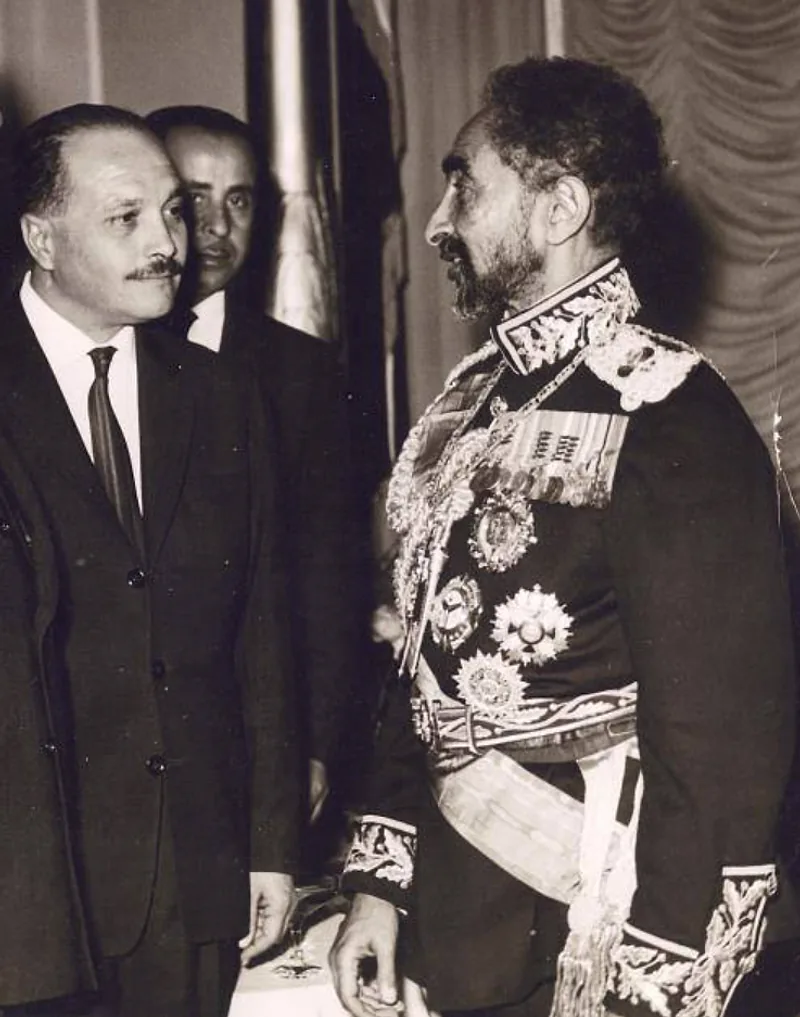
Accounts of the emperor's conversations with Rastafari elders during and after the visit vary, and some of the sayings attributed to him are oral tradition. It is clear, however, that a number of Rastafari, and some Jamaican sympathisers, asked for the Ethiopian church to be established on the island, and that the emperor agreed to send a priest.
Abuna Yesehaq and the Church in Jamaica, 1970§
The priest chosen was Laike Mandefro, an Ethiopian archimandrite, a senior monastic priest. He arrived in Kingston in 1970 and founded the Ethiopian Orthodox Church in Jamaica, with services in Ge'ez, Amharic and English. Large numbers of Rastafari came to its services, and many were baptised, by some accounts thousands in the early years. Mandefro was later raised to the rank of archbishop with the name Abuna Yesehaq and led the church in the Western Hemisphere until his death in 2005. His book The Ethiopian Tewahedo Church: An Integrally African Church (1989) presented Ethiopian Christianity as the authentic African faith to readers in the diaspora.
For Rastafari who joined, the church offered things the movement lacked: an ancient liturgy, a priesthood, sacraments, a calendar of feasts and fasts, and a living link to Ethiopia. Its icons showed Black saints and a Black Madonna; its language was the language of the Kebra Nagast. Ethiopian feasts such as Genna (Christmas, on 7 January) and Timkat (Epiphany, on 19 January) entered the Rastafari year.
Baptism, Belief and the Question of Divinity§
The difficulty lay in doctrine. Baptism in the Ethiopian church is in the name of the Father, the Son and the Holy Spirit, and the church teaches that Jesus Christ alone is God incarnate. Haile Selassie, in Orthodox teaching, was an anointed Christian monarch, the heir of Solomon perhaps, but not Christ returned. Abuna Yesehaq was respectful toward Rastafari and spoke of them as people seeking their African roots, but he did not accept their central claim.
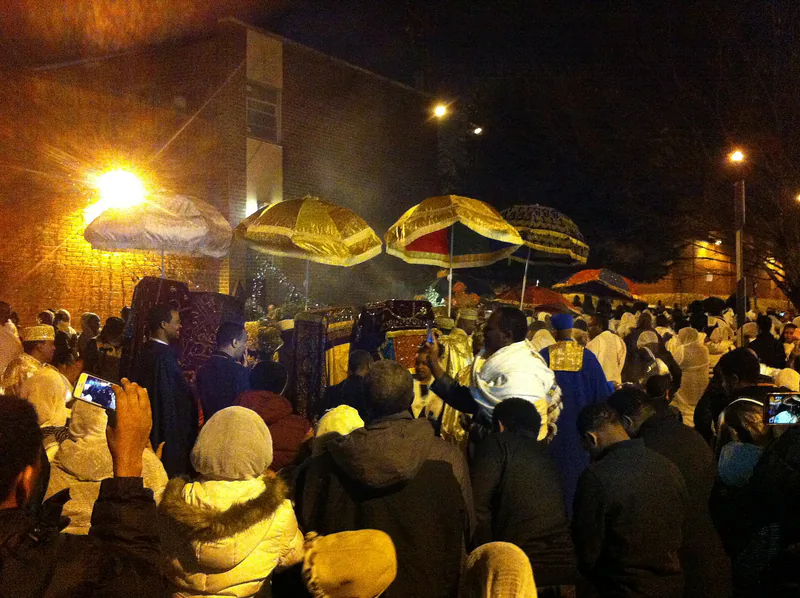
Rastafari responded in different ways. Some joined the church fully and came to understand Haile Selassie as a holy king rather than God. Others accepted baptism while keeping their belief in the emperor's divinity, sometimes privately. Many refused baptism altogether, unwilling to set aside the faith that had made them Rastafari. The Twelve Tribes of Israel, which taught that its members should read the Bible and accept Christ while honouring the emperor, found the church especially congenial, and several of its members, including musicians, were baptised. The broader range of Rastafari teaching about God in human form is set out in Rastafari beliefs.
Bob Marley's Baptism and Funeral§
The best-known Rastafari to be baptised into the Ethiopian church was Bob Marley. A member of the Twelve Tribes of Israel, he was baptised by Abuna Yesehaq in November 1980, by then gravely ill with cancer, and given the baptismal name Berhane Selassie, usually translated "Light of the Trinity". Marley died in Miami on 11 May 1981. His state funeral in Kingston on 21 May combined the rites of the Ethiopian Orthodox Church, led by the archbishop, with the presence of the Twelve Tribes and a national ceremony attended by the prime minister and the leader of the opposition. He was buried in a mausoleum at Nine Mile, his birthplace in the parish of St Ann.
Marley's baptism has been read in opposite ways. For Orthodox Rastafari it shows that the movement's most famous voice came home to the emperor's church; for others it was a personal step that did not change the faith he sang. His music and its role in spreading Rastafari are discussed in reggae and Rastafari culture.
Orthodox Rastafari Today§
Today the Ethiopian Orthodox Church has parishes in Jamaica, Trinidad, other Caribbean islands, North America and Britain, with congregations that mix Ethiopian immigrants, Caribbean Christians and Rastafari. Orthodox Rastafari keep dreadlocks and the ital diet, study Amharic and Ge'ez, and follow the church's fasts and feasts. Some independent congregations have gone further and adapted Ethiopian liturgy to worship addressed to Haile Selassie himself, a practice the church does not recognise.
In Ethiopia, Rastafari settlers at Shashamane and elsewhere have had a mixed relationship with the national church, whose clergy and laity often find the deification of the late emperor puzzling or offensive, especially since his overthrow in 1974 and death in 1975. When the emperor's remains were reburied in Holy Trinity Cathedral in Addis Ababa in November 2000, Rastafari from many countries attended an Orthodox ceremony that honoured him as a Christian king. The encounter between the movement and the church remains one of the most important conversations within Rastafari, touching on the question, discussed in Rastafari today, of how the faith understands Haile Selassie a half-century after his death.
Frequently asked questions§
Are Rastafari members of the Ethiopian Orthodox Church?§
Some are. Since 1970 many Rastafari in Jamaica and elsewhere have been baptised into the church, forming what is often called the Orthodox Rastafari house. Many others belong to other mansions or to no organisation and do not accept the church's teaching about Haile Selassie.
Did Haile Selassie belong to the Ethiopian Orthodox Church?§
Yes. He was a devout Orthodox Christian, the church's protector as emperor, and the ruler under whom it received its first Ethiopian patriarch in 1959. He did not claim to be divine.
Who was Abuna Yesehaq?§
Abuna Yesehaq, born Laike Mandefro, was the Ethiopian priest sent to Jamaica in 1970 to establish the Ethiopian Orthodox Church there. He baptised many Rastafari, including Bob Marley, and later served as archbishop for the church in the Western Hemisphere until his death in 2005.
Was Bob Marley baptised?§
Yes. In November 1980, months before his death, Marley was baptised into the Ethiopian Orthodox Church with the name Berhane Selassie. His funeral in Kingston in May 1981 was conducted by Ethiopian Orthodox clergy.
Sources and further reading§
- The Ethiopian Tewahedo Church: An Integrally African Church — Abuna Yesehaq, 1989
- Ethiopian Christianity: History, Theology, Practice — Philip F. Esler, 2019
- Ethiopia and the Bible — Edward Ullendorff, 1968
- Rastafari: From Outcasts to Culture Bearers — Ennis Barrington Edmonds, 2003
- From Garvey to Marley: Rastafari Theology — Noel Leo Erskine, 2005
- Exodus! Heirs and Pioneers, Rastafari Return to Ethiopia — Giulia Bonacci, 2015
- Catch a Fire: The Life of Bob Marley — Timothy White, 1983
- Rastafari: Roots and Ideology — Barry Chevannes, 1994