Liber XXIII · Rastafari · Chapter II: Haile Selassie I
Haile Selassie I: The Emperor of Ethiopia in Rastafari Belief
Haile Selassie I, emperor of Ethiopia (1930–1974): his life, coronation, exile, 1966 Jamaica visit and death, and why Rastafari honour him as Jah.

Haile Selassie I (1892–1975), born Tafari Makonnen, ruled Ethiopia as regent from 1916 and as emperor from 1930 until his overthrow in 1974. For most Rastafari he is far more than a historical monarch: the returned Messiah, the living manifestation of God, or Jah's chosen king, whose titles and Solomonic lineage they read as the fulfilment of biblical prophecy. His own faith, however, was that of the Ethiopian Orthodox Church, and he never claimed to be divine.
From Tafari Makonnen to Regent of Ethiopia§
Tafari Makonnen was born on 23 July 1892 at Ejersa Goro, near Harar in eastern Ethiopia. His father, Ras Makonnen, was a cousin and leading general of Emperor Menelik II and a commander at the victory over Italy at Adwa in 1896. Tafari was educated at home and by French Catholic missionaries in Harar, and while still in his teens held provincial governorships, including Harar itself from 1910.
When Menelik died in 1913, his grandson Lij Iyasu succeeded him but was never crowned; suspected of favouring Islam and alienating the nobility and the church, he was deposed in 1916. Menelik's daughter Zewditu became empress, and Tafari, now with the title ras ("head", roughly duke), became regent and heir. As regent he pursued cautious modernisation: Ethiopia joined the League of Nations in 1923, he issued decrees against the slave trade, and in 1924 he toured Europe, the first Ethiopian ruler to do so. In 1928 he was crowned negus (king). His marriage in 1911 to Menen Asfaw, later Empress Menen, lasted until her death in 1962; many Rastafari honour her alongside him.
The Coronation of 1930 and the Solomonic Line§
Empress Zewditu died on 2 April 1930, and on 2 November 1930 Tafari was crowned in St George's Cathedral, Addis Ababa, as Haile Selassie I, Negusa Nagast ("King of Kings"), Elect of God and Conquering Lion of the Tribe of Judah. Foreign delegations, including the Duke of Gloucester for the British crown, attended, and newsreels carried the ceremony worldwide.

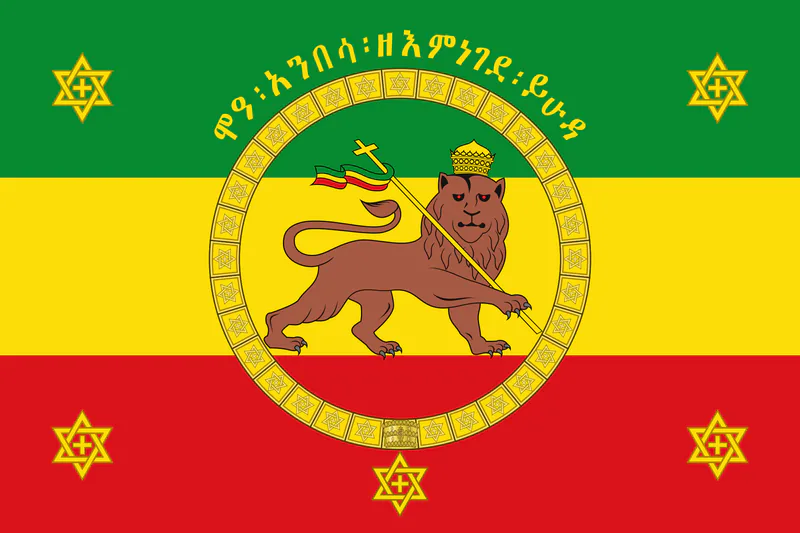
The titles had deep roots. Ethiopia's ruling house claimed descent from King Solomon and the Queen of Sheba through their son Menelik I, as told in the Kebra Nagast ("Glory of the Kings"), a Ge'ez work usually dated to the early fourteenth century. Its story of the Ark of the Covenant brought from Jerusalem to Aksum made Ethiopia, in its own eyes, the heir of Israel. The "Solomonic" dynasty had been restored in 1270, and the lion of Judah was its emblem.
In Jamaica, readers of the King James Bible recognised the language. Revelation 19:16 gives the returning Christ a name written on his vesture:
KING OF KINGS, AND LORD OF LORDS.
Revelation 5:5 speaks of the Lion of the tribe of Judah who prevails to open the sealed book. For the first Rasta preachers, whose story is told in the origins of Rastafari, a Black king crowned with these titles in the oldest Christian kingdom of Africa could only be the Messiah returned. The name of the movement, Ras Tafari, preserves his title and name before the coronation.
War, Exile and Return§
The written constitution of 1931 strengthened the crown, but on 3 October 1935 Fascist Italy invaded. Italian forces used aircraft and poison gas, and after the defeat at Maychew in March 1936 Haile Selassie left the country in May. On 30 June 1936 he addressed the League of Nations in Geneva, warning that collective security was at stake; the speech made him a symbol of resistance to Fascism, though the League did little.
He spent the next five years in exile, mostly at Fairfield House in Bath, England. For Black people around the world the invasion was an outrage, and the early Rastafari read the war as the struggle of Ethiopia against Babylon. With British and Commonwealth forces and Ethiopian patriots, the emperor re-entered Addis Ababa on 5 May 1941.
The post-war emperor§
After the war Haile Selassie centralised power, expanded education and promoted Ethiopia as a leader of independent Africa. A revised constitution followed in 1955, and in 1959 the Ethiopian Orthodox Church received its first Ethiopian patriarch, ending centuries of dependence on Egyptian bishops. In May 1963 he hosted the founding of the Organisation of African Unity in Addis Ababa, and in October 1963 he spoke to the United Nations General Assembly against racial discrimination, a speech later set to music by Bob Marley, as told in reggae and Rasta culture. He also granted land at Shashamane, south of the capital, through the Ethiopian World Federation to people of the African diaspora who wished to settle in Ethiopia; the later history of the settlement is told in Rastafari today.
The Emperor in Rastafari Theology§
Rastafari does not have a single doctrine of Haile Selassie, and believers express it in several ways:
- God incarnate. Many Rastafari, especially in the Nyabinghi tradition, regard him as Jah in human form, the "living God" in contrast to a distant God in the sky. "Haile Selassie I" is often read as "Haile Selassie the First" and also as the "I" of the divine self.
- Christ returned. Others see him as the Second Advent of Christ in his kingly character, fulfilling Revelation.
- Divine king and representative of Christ. The Twelve Tribes of Israel emphasise Jesus Christ and honour Haile Selassie as Christ's representative and a king of David's line.
- Part of a trinity. The Bobo Ashanti venerate him as king in a trinity with Marcus Garvey as prophet and their founder Prince Emmanuel as priest.
He is addressed as H.I.M. (His Imperial Majesty), Jah Rastafari, the Almighty, or Earth's Rightful Ruler, and he and Empress Menen are sometimes called King Alpha and Queen Omega. His speeches, collected in Ethiopian government editions from the 1960s, are read in some circles almost as scripture. The differences between these views are explored in the mansions of Rastafari, and their place in the wider worldview in Rastafari beliefs.
The 1966 Visit to Jamaica§
On 21 April 1966, during a Caribbean tour that also included Trinidad and Tobago and Haiti, Haile Selassie landed at Palisadoes airport in Kingston. A crowd estimated at tens of thousands, many of them Rastafari with flags, drums and chalices, filled the tarmac, and the emperor remained in the aircraft until the Rasta elder Mortimo Planno was asked to calm the crowd. Rain had fallen that morning and stopped as the plane arrived, which many took as a sign.
The visit gave Rastafari a public legitimacy it had never had: the emperor received Rastafari elders, and newspapers that had mocked the movement had to report a head of state greeted by its members. The date is now kept as Grounation Day. A widely repeated oral tradition holds that the emperor advised Jamaican Rastas to seek "liberation before repatriation", building up Jamaica before emigrating to Africa; the saying is not documented in his recorded speeches, but it shaped a turn toward life and politics in Jamaica.
After the visit the emperor's government supported the establishment of the Ethiopian Orthodox Church in Jamaica, where Archbishop Abuna Yesehaq began work in 1970. Many Rastas joined it, and Bob Marley was baptised into it in 1980, though the church itself teaches that Haile Selassie was a Christian king, not God. The church belongs to the Oriental Orthodox family described in the article on Eastern Orthodox Christianity.
Revolution, Death and the Question of Divinity§
By the 1970s the aged emperor's rule was failing. A famine in Wollo in 1972–73, concealed by the government and then exposed by the British journalist Jonathan Dimbleby, discredited the court. A committee of military officers, the Derg, deposed Haile Selassie on 12 September 1974. He died in custody on 27 August 1975; the regime announced complications after surgery, but it is widely believed that he was killed. His remains were found under a palace building in 1992 and reburied in Holy Trinity Cathedral, Addis Ababa, in November 2000.
For Rastafari the news posed a theological question. Many refused to accept the reports, which came from a hostile regime; others held that God cannot die and that "Jah lives", the title of a song Marley released within weeks. Some speak of the emperor's continuing spiritual presence, while others, especially in the Twelve Tribes, never placed their faith in his physical immortality.
Ethiopian and critical perspectives§
Many Ethiopians are puzzled or uneasy at the deification of their former ruler, whom they remember as a Christian monarch, a moderniser and also an autocrat whose government imprisoned opponents and failed in the famine. Historians such as Harold Marcus and Bahru Zewde have written critical accounts of his reign, and Ryszard Kapuściński's literary portrait The Emperor depicted the decay of his court. Rastafari writers have generally answered that the emperor's divinity is a matter of revelation, not of political record.
Frequently asked questions§
Why do Rastafari believe Haile Selassie is God?§
His coronation titles, King of Kings and Conquering Lion of the Tribe of Judah, and his claimed descent from Solomon matched biblical prophecies about the Messiah in the eyes of early Jamaican preachers. Many Rastafari regard him as God incarnate, others as Christ returned or as Christ's divine representative.
Did Haile Selassie believe he was God?§
There is no record of him claiming divinity. He was a devout member of the Ethiopian Orthodox Church, and he supported that church's mission to Jamaica, which teaches that he was a Christian king.
What happened when Haile Selassie visited Jamaica?§
He arrived in Kingston on 21 April 1966 to an enormous crowd of Rastafari and others. The visit raised the movement's status in Jamaica and is commemorated every year as Grounation Day.
How did Haile Selassie die?§
He was deposed by the military Derg in September 1974 and died in custody in August 1975. The official account blamed illness after surgery, but he is widely believed to have been killed; his remains were reburied in Addis Ababa in 2000.
Sources and further reading§
- My Life and Ethiopia's Progress, 1892–1937 — Haile Selassie I (trans. Edward Ullendorff), 1976
- Haile Sellassie I: The Formative Years, 1892–1936 — Harold G. Marcus, 1987
- A History of Modern Ethiopia, 1855–1974 — Bahru Zewde, 1991
- King of Kings: The Triumph and Tragedy of Emperor Haile Selassie I of Ethiopia — Asfa-Wossen Asserate, 2015
- The Emperor: Downfall of an Autocrat — Ryszard Kapuściński, 1978
- Selected Speeches of His Imperial Majesty Haile Selassie First, 1918 to 1967 — Haile Selassie I, 1967
- The Kebra Nagast (The Queen of Sheba and Her Only Son Menyelek) — E. A. Wallis Budge, 1922
- The Rastafarians — Leonard E. Barrett, 1977