Liber XXIII · Rastafari · Chapter VI: Origins: Garvey & Ethiopianism
Marcus Garvey and Rastafari: The Prophet of African Redemption
Marcus Garvey and Rastafari: his life, the UNIA and Black Star Line, his religious ideas, his criticism of Haile Selassie and why Rastas call him prophet.

Marcus Mosiah Garvey (1887–1940) was a Jamaican-born organiser, journalist and orator who founded the Universal Negro Improvement Association and led the largest mass movement of people of African descent in the early twentieth century. He was never a Rastafarian, and he criticised Haile Selassie in the 1930s, yet Rastafari honour him as a prophet whose teaching of African pride, redemption and return prepared the way for their faith.
Early Life in Jamaica and Travels Abroad§
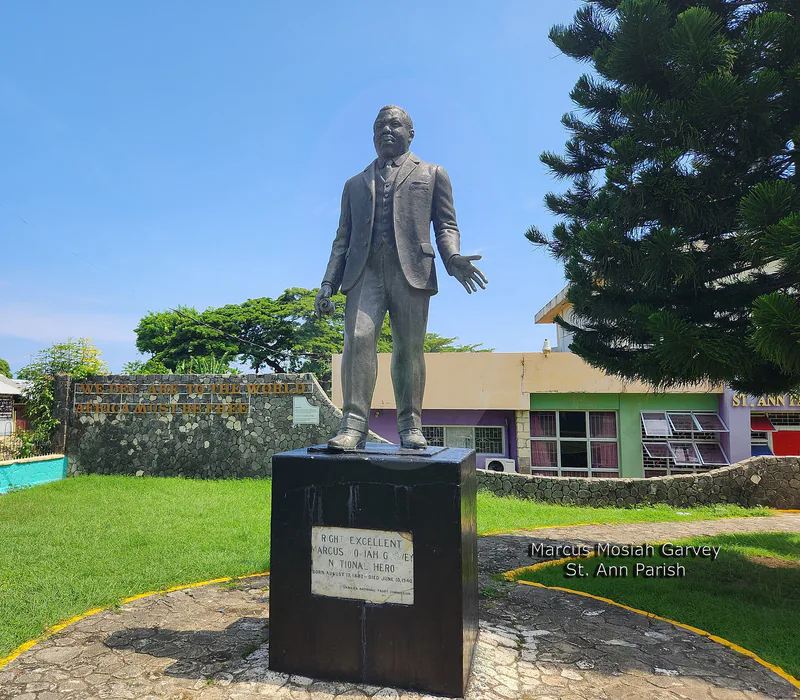
Garvey was born on 17 August 1887 at St Ann's Bay, on the north coast of Jamaica, the son of a stonemason. He left school young, trained as a printer and moved to Kingston, where he took part in a printers' strike and in early nationalist circles. Between about 1910 and 1912 he travelled in Central America, working in Costa Rica and Panama, where he saw the conditions of West Indian labourers on plantations and canal works, and he began to publish small newspapers.
From 1912 to 1914 he lived in London. There he worked for the African Times and Orient Review, edited by the Egyptian-Sudanese writer Dusé Mohamed Ali, and met African and Asian nationalists. He also read Booker T. Washington's autobiography Up from Slavery, which, he later wrote, made him ask where the Black man's government, king and nation were. These years gave him the conviction that people of African descent everywhere formed one race with one destiny.
The UNIA, the Negro World and the Black Star Line§
Back in Jamaica in July 1914, Garvey founded the Universal Negro Improvement Association and African Communities League (UNIA). Its early progress in Kingston was slow, and in 1916 he went to the United States, settling in Harlem. There the association grew with astonishing speed in the years after the First World War. Garvey's weekly Negro World, from 1918, carried his speeches across the Americas, the Caribbean and Africa, where colonial governments often banned it.
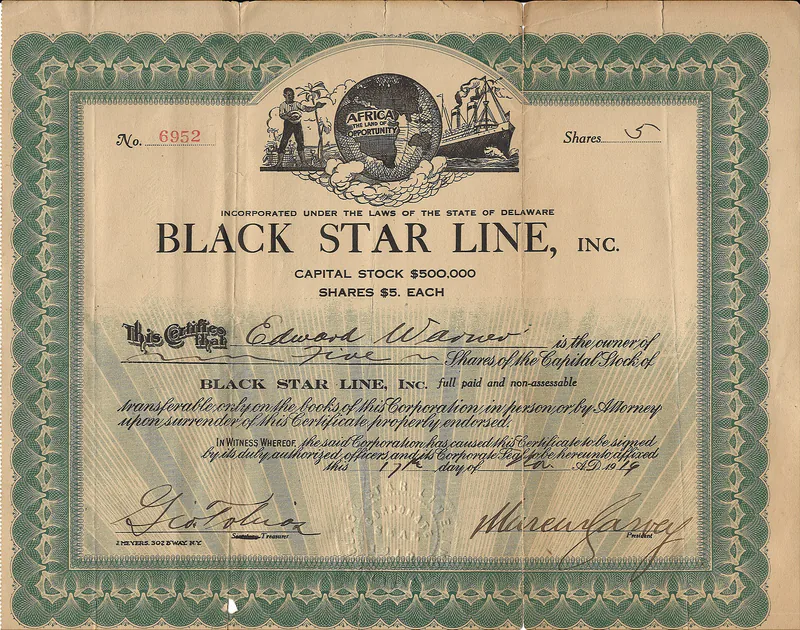
In 1919 the UNIA launched the Black Star Line, a shipping company owned by Black shareholders, meant to link the Black world in trade and to carry settlers to Africa. In August 1920 the association held its first International Convention of the Negro Peoples of the World in New York, which adopted a Declaration of Rights and a flag of red, black and green; Garvey was elected Provisional President of Africa. Plans for settlement in Liberia followed. The movement had hundreds of branches, uniformed auxiliaries and a ceremonial style of parades, titles and regalia.
The Black Star Line was badly managed and lost money. In 1923 Garvey was convicted in the United States of mail fraud in connection with its share sales, a prosecution his supporters regarded as political. He entered prison in Atlanta in 1925; his sentence was commuted in 1927 and he was deported to Jamaica. He founded the People's Political Party there in 1929, served on the Kingston and St Andrew council, and moved to London in 1935, where he died on 10 June 1940. In 1964 his remains were brought back to Jamaica and reinterred in Kingston, and he became the first of Jamaica's National Heroes.
Garvey's Religious Ideas§
Garvey was a Christian, raised a Methodist and later close to Roman Catholicism, and he never founded a religion. But his movement had a strongly religious atmosphere. UNIA meetings opened with prayers and hymns, and a chaplain-general, George Alexander McGuire, founded the African Orthodox Church in 1921 as a church for Garveyites. Garvey taught that people should see God through their own eyes: if white people pictured God as white, Africans should picture him as Black, and Christ and the Virgin should be painted as Black. He drew constantly on Psalm 68:31, "Ethiopia shall soon stretch out her hands unto God", the watchword of the Ethiopianism described in the origins of Rastafari.
His speeches spoke of the redemption of Africa as a divine plan, of a coming day of reckoning for oppressors and of the "Universal Ethiopian Anthem", the UNIA's hymn, which hailed Ethiopia as the land of the fathers. Such language, joined to his call to "look to Africa", gave his followers a religious framework that the first Rastafari would fill with a new content.
The "Look to Africa" Prophecy§
Rastafari tradition holds that Garvey once told his audiences to look to Africa, where a Black king would be crowned, for the day of deliverance would be near. When Ras Tafari was crowned emperor in 1930, Garveyites in Jamaica who remembered such words saw the prophecy fulfilled. The saying is repeated in Rastafari teaching, in reggae songs and in popular histories.
Historians, among them Robert A. Hill, the editor of Garvey's collected papers, have not found this exact statement in Garvey's speeches or writings. Hill and others suggest that it may compress several themes of Garveyite preaching, or that it may come from other preachers in his circle, and that its attribution grew in memory after 1930. The absence of a document does not make the tradition meaningless: it records how Rastafari understood the continuity between Garvey's movement and their own. Several of the earliest Rastafari preachers, including Leonard Howell, had been in contact with Garveyism.
Garvey's Criticism of Haile Selassie§
Garvey initially welcomed the coronation of 1930 and supported Ethiopia when Italy invaded it in 1935. But after the emperor left his country in 1936 and went into exile in England, Garvey criticised him sharply in his London magazine The Black Man. He accused Haile Selassie of failing to prepare Ethiopia for war, of relying on white advisers and of fleeing rather than staying with his people, and he described the emperor's government as feudal. The emperor did not receive him.
Rastafari have handled this criticism in different ways. Some regard it as a human error by a prophet who saw the larger truth; others say Garvey was deceived by reports from Babylon's press; others simply set it aside. The episode is one of the reasons historians emphasise that Garvey was a forerunner of Rastafari, not its founder.
Garvey's Place in Rastafari Faith§
In Rastafari belief Garvey's role is that of the forerunner, often compared to John the Baptist preparing the way for Christ. His portrait hangs beside Haile Selassie's in many homes and tabernacles, his birthday, 17 August, is a holy day in the Rastafari calendar, and his sayings are quoted in reasoning. The Bobo Ashanti go furthest, honouring a trinity in which Garvey is the prophet, Prince Emmanuel Charles Edwards the priest and Haile Selassie the king, as explained in Bobo Ashanti.
Reggae spread this devotion. Burning Spear's album Marcus Garvey (1975) and many other songs presented him as a prophet whose words had come true. His red, black and green also passed into the movement's colours, as described in Rastafari symbols. For the wider Rastafari story, see Rastafari: History, Beliefs and Practice.
Frequently asked questions§
Was Marcus Garvey a Rastafarian?§
No. Garvey was a Christian who never accepted Haile Selassie as divine and criticised him after 1936. Rastafari nevertheless regard him as a prophet whose teachings prepared the way for their faith.
Did Marcus Garvey say "Look to Africa for the crowning of a Black king"?§
The saying is central to Rastafari tradition, but historians have not found it in Garvey's recorded speeches or writings. It may summarise themes of his preaching or come from others in his movement.
Why is Garvey important to Rastafari?§
He taught African pride, the redemption of Africa and the return of its scattered people, and he encouraged believers to see God in their own image. These ideas, together with his symbols and organisation, formed the soil from which Rastafari grew.
When is Marcus Garvey's birthday celebrated?§
His birthday, 17 August, is observed by many Rastafari as a holy day, often with a Nyabinghi gathering. In Jamaica it is also marked publicly in honour of the National Hero.
Sources and further reading§
- Philosophy and Opinions of Marcus Garvey — Amy Jacques Garvey (ed.), 1923
- The Marcus Garvey and Universal Negro Improvement Association Papers — Robert A. Hill (ed.), 1983
- Black Moses: The Story of Marcus Garvey and the Universal Negro Improvement Association — E. David Cronon, 1955
- Race First: The Ideological and Organizational Struggles of Marcus Garvey and the Universal Negro Improvement Association — Tony Martin, 1976
- Marcus Garvey: Anti-Colonial Champion — Rupert Lewis, 1987
- Negro with a Hat: The Rise and Fall of Marcus Garvey — Colin Grant, 2008
- The World of Marcus Garvey: Race and Class in Modern Society — Judith Stein, 1986