Rastafari Symbols: Lion of Judah, Red, Gold and Green Explained
Rastafari symbols explained: the Lion of Judah, red, gold and green, the emperor's image, the Star of David, dreadlocks, the drum and the chalice.

The best-known Rastafari symbols are the Conquering Lion of the Tribe of Judah, the colours red, gold and green taken from the flag of imperial Ethiopia, and the image of Haile Selassie I himself. Around them stand a wider set of signs, among them the Star of David, the Ethiopian cross, dreadlocks, the knitted crown or tam, the Nyabinghi drum and the chalice, each of which links the believer to Ethiopia, to the Bible and to the struggle against "Babylon".
Rastafari has no official catalogue of symbols and no central authority to define them, so meanings vary between houses and individuals. What follows describes the symbols as Rastafari commonly explain them, together with their historical sources. For the movement as a whole, see the overview Rastafari: History, Beliefs and Practice; for symbols across world religions, see religious symbols.
The Conquering Lion of the Tribe of Judah§
The lion is the central emblem of Rastafari. Its source is double. In the Bible, the dying Jacob blesses his son Judah as "a lion's whelp" from whom the sceptre will not depart (Genesis 49:9–10), and the book of Revelation names "the Lion of the tribe of Juda" as the one worthy to open the sealed book (Revelation 5:5). In Ethiopia, the emperors of the Solomonic dynasty, who claimed descent from King Solomon and the Queen of Sheba as told in the Kebra Nagast, bore the title "Conquering Lion of the Tribe of Judah". The crowned lion carrying a staff topped by a cross appeared on imperial seals, coins, stamps and on the flag.
When Ras Tafari Makonnen was crowned Haile Selassie I in November 1930 with this title, the first Rastafari preachers read it as a direct fulfilment of Revelation. For them the lion is therefore the emperor himself, the returned Messiah or living God, as explained in Haile Selassie I in Rastafari belief.
The lion carries other meanings as well. It stands for strength, royalty and courage, qualities that colonial culture denied to Africans. Many Rastafari compare their uncut locks to the lion's mane, and the roar of the lion is linked with the righteous voice that "chants down" Babylon. Some Rastafari keep the imperial form of the lion, holding the cross-staff and wearing a crown; others use a simple lion's head. Since the revolution of 1974 removed the lion from Ethiopia's flag, the lion flag has become for Rastafari a sign of loyalty to the emperor and his dynasty rather than to the modern Ethiopian state.
Red, Gold and Green: The Rastafari Colours§
The colours most closely associated with Rastafari are red, gold (or yellow) and green, the three bands of the Ethiopian flag. Ethiopia used these colours in pennants and banners from the reign of Menelik II in the late nineteenth century, and the tricolour, usually with green at the top, became the national flag in the early twentieth century; under the empire the Lion of Judah stood at its centre. Because Ethiopia was the one African state to defeat a European army, at Adwa in 1896, and to remain independent through the colonial scramble, its colours came to stand for Africa itself. Ghana adopted red, gold and green with a black star at independence in 1957, and many other African states followed.
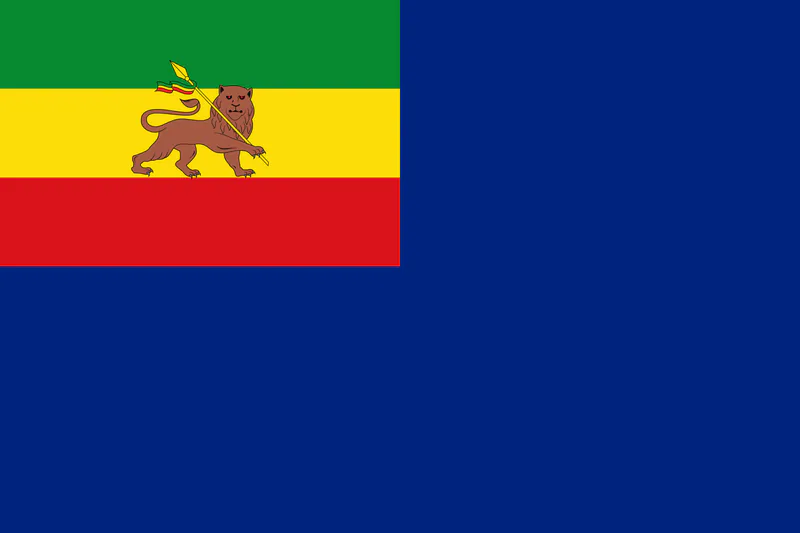
Rastafari explanations of the colours are fairly consistent, though not fixed:
- Red for the blood of the martyrs and of all who died in slavery and in the struggle for freedom.
- Gold for the wealth of Africa, for the sun, or for the faith and royalty of the emperor.
- Green for the land, vegetation and fertility of Africa, and for hope.
Many Rastafari also use black, for the African people, which comes from the red, black and green flag adopted by Marcus Garvey's Universal Negro Improvement Association in 1920. The two schemes are often combined, so that a Rasta tam or banner may carry red, gold, green and black together, joining Garvey's pan-Africanism with Ethiopia. The movement's debt to Garvey is described in the origins of Rastafari.
The Image of Haile Selassie and the Imperial Crown§
Rastafari treat the portrait of Haile Selassie as more than a picture of a ruler. Photographs of the emperor in uniform or coronation robes, often beside Empress Menen, hang in homes, tabernacles and shops, and are carried on banners at Nyabinghi gatherings. For believers they are images of the living God or of his chosen king, and they are handled with respect. The joint image of emperor and empress expresses the Rastafari ideal of King Alpha and Queen Omega, the divine male and female; the empress is discussed in Empress Menen Asfaw.
The imperial crown belongs to the same family of symbols. Rastafari speak of "crowning" and of the faithful as royal; the knitted tam is often called a crown, and the title "King of Kings and Lord of Lords" (Revelation 19:16) is applied to the emperor. Coins, medals and stamps of the imperial period are collected as relics of the Solomonic monarchy.
The Star of David, the Ark and the Ethiopian Cross§
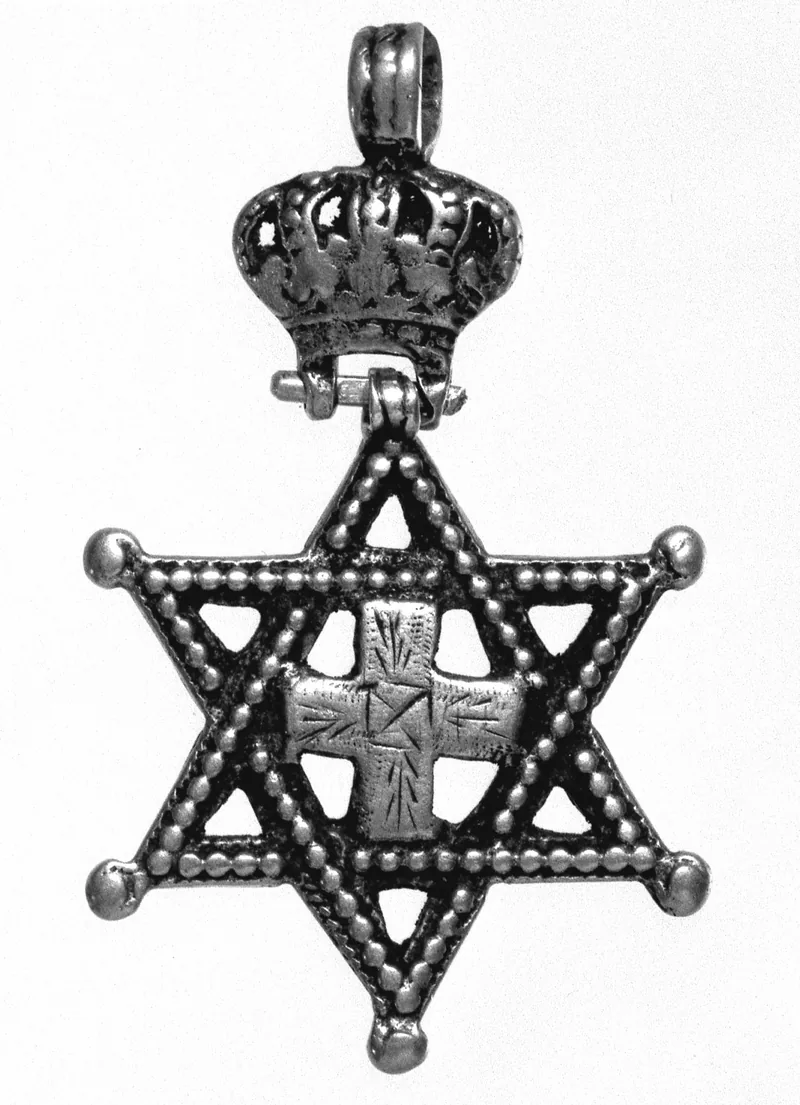
Rastafari understand themselves as the true Israel, the descendants of Africans whom the Bible calls the chosen people, a theme covered in Rastafari beliefs. The six-pointed star, which Rastafari call the Star of David or Seal of Solomon, expresses this identity and the Solomonic descent of the emperors. It appears in Rasta art, on flags and on jewellery, sometimes enclosing the lion. Its older history as a magical seal is told in Solomon's ring and the Seal of Solomon.
The Ark of the Covenant, which Ethiopian tradition holds was brought to Aksum by Menelik, the son of Solomon and Sheba, is a related emblem. Every Ethiopian Orthodox church keeps a tabot, a consecrated tablet representing the Ark, and Rastafari who have joined that church, or who admire it, value the Ark as a sign that God's covenant passed to Ethiopia.
The Ethiopian cross, with its elaborate pierced and looped designs in metal or wood, is used above all by Rastafari close to the Ethiopian Orthodox Church and by the Twelve Tribes of Israel, who give a large place to Christ. Others avoid the cross, associating the Latin cross with the colonial churches. The relationship between the two faiths is described in Rastafari and the Ethiopian Orthodox Church.
Dreadlocks, the Tam and the Body as Symbol§
For many Rastafari the most important symbol is the body itself. Dreadlocks, grown in keeping with the Nazirite vow of Numbers 6:5, declare a covenant with Jah, a likeness to the lion and a refusal of Babylon's standards of grooming. Not all Rastafari wear them, and some say that the true locks are within, but the dreadlocked head became the movement's public sign from the 1950s onwards, as explained in Rastafari livity.
The knitted tam, often in red, gold, green and black, covers and gathers the locks. The Bobo Ashanti wrap their locks in tall turbans and wear long robes, while women of most houses cover their heads in public worship. Clothing in the Rastafari colours, walking sticks or rods carved with lions, and Ethiopian-style robes worn at gatherings all turn the body into a visible statement of faith.
The Drum, the Chalice and Sacred Sound§
Some objects are symbols because of their role in ritual. The three Nyabinghi drums, the bass, funde and repeater, are said to carry the heartbeat of Africa and to strike down Babylon; their place in worship is described in Nyabinghi and reasoning. The chalice, the communal pipe used in reasoning, is treated as a vessel of the sacrament and of shared meditation; the religious and legal history of the herb is told in Ganja in Rastafari.
Speech too has symbolic force. The pronoun "I-and-I" and the habit of replacing syllables with "I", explained in Iyaric, make language itself a sign of the unity of the believer with Jah. The idea that words carry divine power is explored in Word, Sound and Power.
How Rastafari Symbols Spread and Were Commercialised§
From the 1970s reggae carried Rastafari symbols around the world. Album covers, stage banners and posters placed the lion, the tricolour and the emperor's portrait before audiences who knew little of their meaning, as discussed in Reggae and Rastafari. Tourist markets in Jamaica, fashion brands and cannabis advertising adopted the colours and the dreadlocked figure, often detached from any religious sense.
Many Rastafari object to this. They point out that the colours belong to Ethiopia and to the memory of the martyrs, and that the emperor's image is sacred to them; using it to sell products, or linking it only with cannabis, strikes them as disrespect. Scholars of the movement, such as Ennis Edmonds, have described how Rastafari moved from the margins of Jamaican society to become "culture bearers", a success that also exposed its symbols to commercial use. Within the movement the symbols keep their older meaning as signs of faith, identity and resistance.
Frequently asked questions§
What does the lion mean in Rastafari?§
The lion represents Haile Selassie I, who bore the title Conquering Lion of the Tribe of Judah, and the biblical Lion of Judah of Genesis and Revelation. It also stands for strength, royalty and African dignity, and many Rastafari link it with their dreadlocks.
What do red, gold and green mean in Rastafari?§
They are the colours of the Ethiopian flag. Rastafari commonly say that red stands for the blood of martyrs, gold for the wealth of Africa and green for its land and vegetation; black, from Marcus Garvey's flag, is often added for the African people.
Why do Rastafari use the Star of David?§
Rastafari regard themselves as the true Israel and the Ethiopian emperors as descendants of King Solomon. The six-pointed star expresses that biblical and Solomonic identity and often appears together with the Lion of Judah.
Are Rasta colours the same as pan-African colours?§
They overlap. Red, gold and green come from Ethiopia and were adopted by many African states, while red, black and green are the pan-African colours of Garvey's movement; Rastafari often combine all four.
Sources and further reading§
- The Rastafarians — Leonard E. Barrett, 1977
- Rastafari: Roots and Ideology — Barry Chevannes, 1994
- Rastafari: From Outcasts to Culture Bearers — Ennis Barrington Edmonds, 2003
- Rastafari and the Arts: An Introduction — Darren J. N. Middleton, 2015
- Ethiopia and the Bible — Edward Ullendorff, 1968
- The Ethiopians: A History — Richard Pankhurst, 1998