Liber XXVII · Solomonic Magic · Chapter VIII: The Ring & Seal
Seal of Solomon: The Ring, Its Legends and Its Symbol
The Seal of Solomon explained: the magic ring in Jewish, Christian and Islamic legend, the hexagram and pentagram as seal, amulets and later grimoire use.
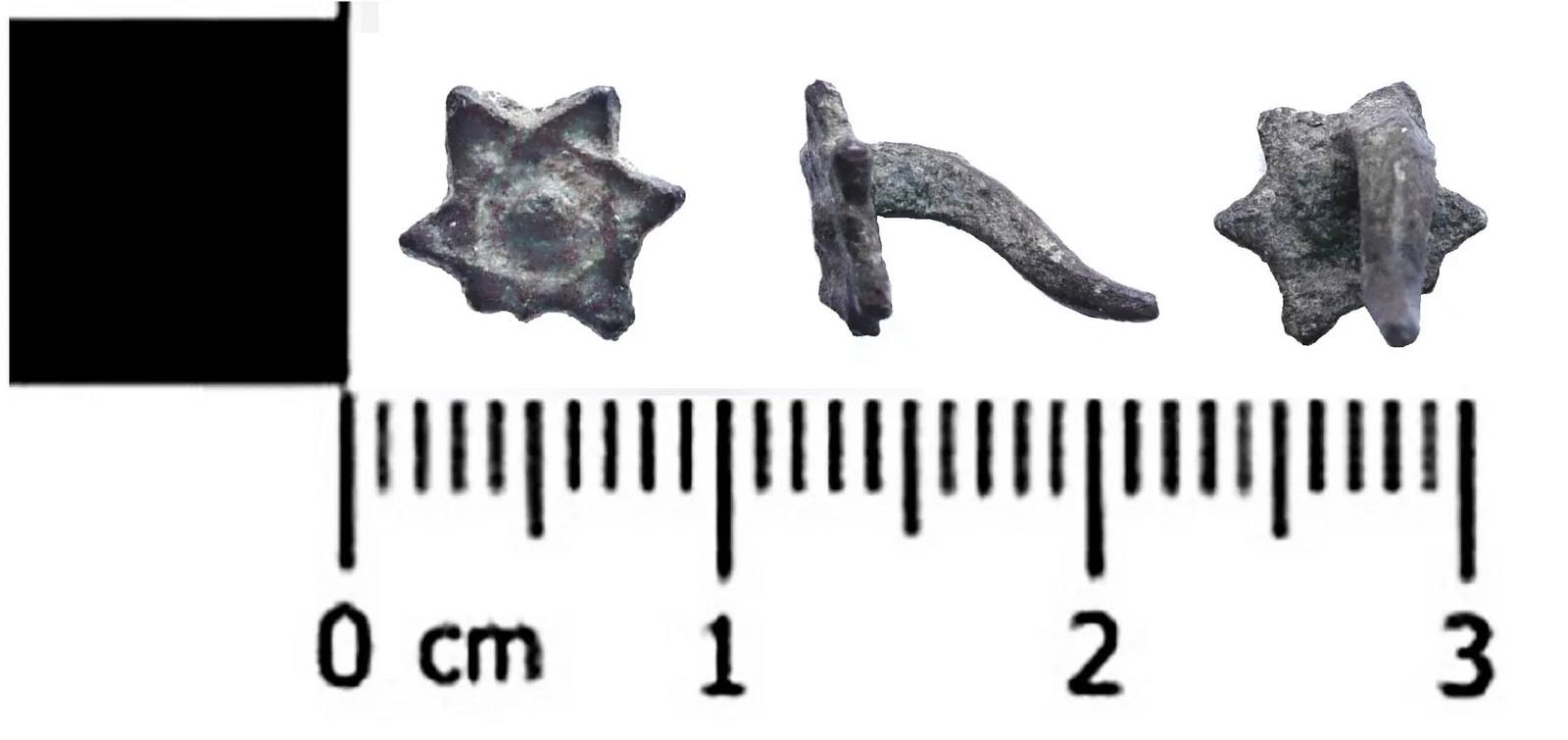
The Seal of Solomon is the legendary signet ring of King Solomon, said in Jewish, Christian and Islamic tradition to bear a divine name or sign that gave him command over demons, jinn and the natural world. Over the centuries the phrase also came to name a geometric figure engraved on that seal, usually a six-pointed star (hexagram) and sometimes a five-pointed star (pentagram), which appears on amulets, coins, architecture and the pages of Renaissance grimoires.
Solomon as Magician: How the Legend Began§
The biblical Solomon of 1 Kings and 2 Chronicles is a wise ruler, a builder and a poet, but not a sorcerer. The famous description of his wisdom in 1 Kings 4 credits him with proverbs and songs and with knowledge of trees, beasts, birds, creeping things and fish. It was this encyclopedic knowledge of nature that later readers expanded into mastery of hidden forces.
By the late Second Temple period the expansion was well underway. The Wisdom of Solomon (7:17–21) has the king claim knowledge of the powers of spirits and the virtues of roots, and the Jewish historian Josephus, writing in the late first century CE, reports in his Jewish Antiquities (8.2.5) that God granted Solomon skill against demons and that he composed incantations and forms of exorcism still in use. Josephus then describes a certain Eleazar who, in the presence of the future emperor Vespasian, drew a demon out of a possessed man through the nostrils using a ring that held a root prescribed by Solomon. This is the earliest clear literary link between Solomon, a ring and the expulsion of spirits.
The ring itself becomes central in the Greek pseudepigraphon known as the Testament of Solomon, probably composed somewhere between the first and fifth centuries CE. There the archangel Michael brings Solomon a small ring bearing an engraved seal, and with it the king summons, interrogates and enslaves a long procession of demons to build the Temple in Jerusalem.
The Ring in Jewish Tradition: Gittin 68 and Ashmedai§
The most influential Jewish version of the legend appears in the Babylonian Talmud, tractate Gittin 68a–b, a passage that weaves together exegesis of the Temple's construction with folklore about the king of demons, Ashmedai (Asmodeus). Because Scripture states that no iron tool was heard in the Temple while it was being built, the rabbis imagined that Solomon needed the shamir, a creature or substance able to cut stone. Only Ashmedai knew where it was kept.
To capture him, Solomon's general Benaiah son of Jehoiada was equipped with a chain and a ring, each engraved with the divine name. The bound demon eventually led them to the shamir. The story then takes a darker turn: once the Temple was complete, Solomon asked Ashmedai what made demons greater than men, and the demon demanded the ring as the price of the answer. Freed from the name that held him, Ashmedai flung the king far away and took his place on the throne, while Solomon wandered as a beggar until the sages recognized the impostor and restored the ring. The full narrative is treated in our article on Solomon and Asmodeus.
Two features of the Talmudic account are worth noting. First, the power of the ring lies not in the metal or the craftsmanship but in the engraved name of God; the ring is a carrier for divine authority. Second, the story is morally ambivalent. The ring grants Solomon dominion, but his curiosity and pride cost him his kingdom, a theme that later commentators linked to his eventual turn toward foreign gods in 1 Kings 11.
Later Jewish Elaborations§
Medieval Jewish writers and collectors of legends added to the material. Some describe the seal as bearing the Tetragrammaton, others the names of the four rivers of Eden or a combination of letters. Louis Ginzberg's Legends of the Jews gathers many of these variants and shows how freely they circulated between Jewish, Christian and Muslim storytellers in the Mediterranean and Near East.
The Ring of Sulayman in Islamic Tradition§
In Islam, Solomon is Sulayman, a prophet and king to whom God subjected the wind, the jinn and the birds. The Qur'an does not describe a ring, but the commentators and the "stories of the prophets" literature (qisas al-anbiya) supply one. In a widely repeated account explaining Qur'an 38:34, where God says He "tried Solomon and placed a body upon his throne", a rebellious jinni, often named Sakhr, steals or tricks his way into possession of the ring and rules in Sulayman's likeness for forty days. The ring is eventually thrown into the sea, swallowed by a fish, and recovered when Sulayman, working as a fisherman's helper, cuts the fish open.
The parallels with Gittin 68 are obvious, and scholars generally regard the Islamic and Jewish forms as branches of a shared Near Eastern legend rather than one copying the other directly. The theme also passed into popular literature. In the Thousand and One Nights, jinn imprisoned in brass vessels stoppered with Solomon's seal recur, most famously in "The Fisherman and the Jinni." For more on these traditions see Sulayman in Islamic tradition.
Hexagram or Pentagram? The Shape of the Seal§
Neither the Talmud nor the Qur'an specifies what the seal looked like, and for much of its history the "Seal of Solomon" was not tied to a single figure. In the Testament of Solomon some manuscripts describe the seal as a pentalpha, a five-pointed star formed of interlaced alphas, and the pentagram was widely called Solomon's seal in late antique and medieval Christian contexts.
In the Islamic world the term khatam Sulayman was applied to both the hexagram and the pentagram. Six-pointed stars appear in mosque decoration, metalwork, manuscript illumination, talismanic scrolls and coinage from North Africa to Central Asia. When Morocco adopted a new national flag in 1915, the green interlaced pentagram on a red field was described as the seal of Sulayman.
The Hexagram and the Star of David§
The six-pointed star's association with Jewish identity is relatively late. Gershom Scholem, in his essay on the "curious history" of the six-pointed star, argued that for most of the medieval period the hexagram was a general magical and decorative sign used by Jews, Christians and Muslims alike, often under the name "Seal of Solomon." Its use as a communal emblem is documented in Prague from the fourteenth century, and it spread gradually until the Zionist movement adopted it in the late nineteenth century. The names "Shield of David" (Magen David) and "Seal of Solomon" overlapped for centuries, sometimes on the same object, and Kabbalistic amulet makers freely used both.
Amulets, Talismans and the Protective Seal§
Long before printed grimoires, Solomon's seal functioned in material culture as protection. Late antique and Byzantine amulets frequently show a rider on horseback spearing a prostrate female demon, accompanied by inscriptions invoking the "seal of Solomon" or the "seal of the living God." Gemstones, bronze pendants and clay tokens with this "holy rider" imagery have been found across the eastern Mediterranean, and archaeologists generally associate them with protection against illness, the evil eye and threats to childbirth.
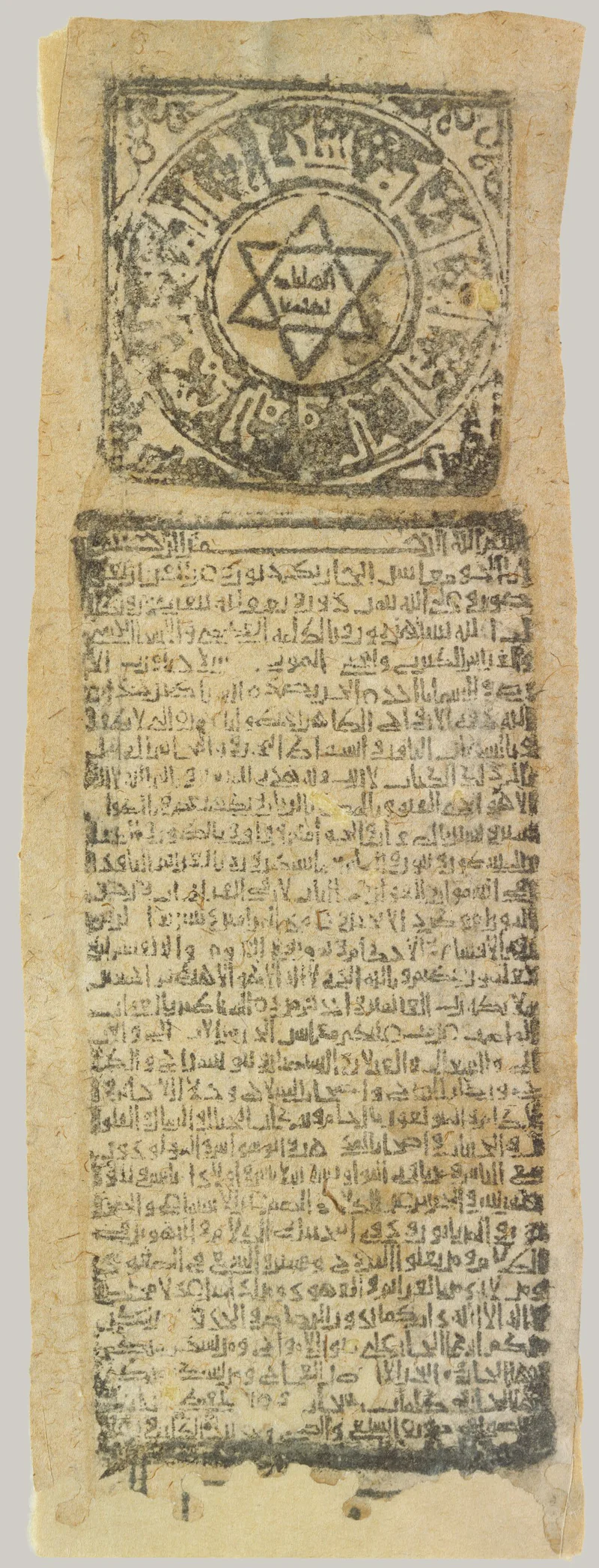
In Jewish amulet traditions the hexagram, often filled with divine names or letters, appears on protective texts for mothers and infants. In the Islamic world, talismanic shirts, bowls and scrolls combine Qur'anic verses with Solomonic stars and magic squares. Across all three traditions the logic is similar to the Talmudic story: the seal works because it bears, or stands for, the name and authority of God, which demons are compelled to obey.
The Seal of Solomon in the Grimoires§
When the Renaissance grimoires attributed to Solomon took shape, they drew on this inheritance. The Key of Solomon contains dozens of "pentacles" (here meaning protective and operative talismans, not only five-pointed stars), each inscribed with Hebrew letters, divine names and biblical verses and attributed to one of the seven planets. The magician carries or displays them for protection and to command spirits, a direct echo of Solomon's ring.
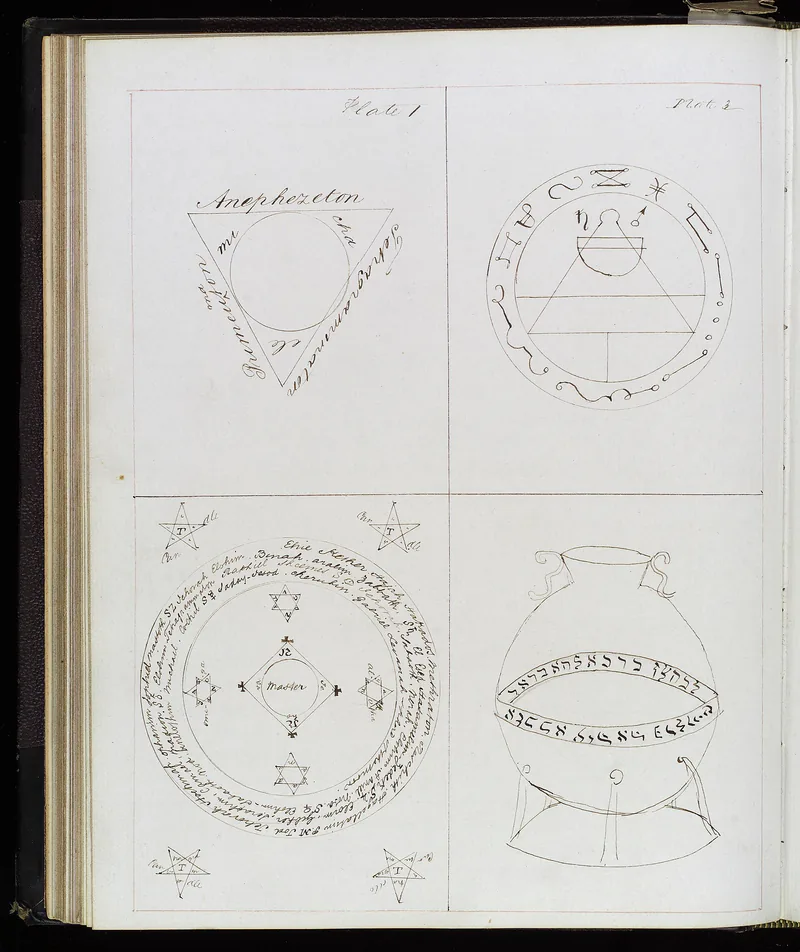
The seventeenth-century Lesser Key of Solomon, particularly its first book, the Goetia, includes a figure called the Hexagram of Solomon, to be displayed on the magician's robe, and a Pentagram of Solomon worn as a lamen, alongside a "Secret Seal of Solomon" by which the king is said to have shut the spirits in a brass vessel. These figures are presented as reconstructions of the very seal that bound the demons in legend. Our overview of the Ars Goetia and its 72 spirits describes how these diagrams fit into the wider system.
Nineteenth- and twentieth-century occultists, notably the Hermetic Order of the Golden Dawn, reinterpreted the hexagram and pentagram as cosmological diagrams: the pentagram associated with the four elements crowned by spirit, the hexagram with the planets and the union of opposites. In this modern esoteric language, the "Seal of Solomon" became shorthand for the harmony of above and below, a reading with roots in Hermetic philosophy rather than in the ancient legend.
Interpreting the Legend§
Historians of religion read the Seal of Solomon as a case study in how a biblical figure became a patron of magic. Several factors converged: Solomon's reputation for universal knowledge, the prestige of the Temple, Near Eastern traditions of royal seals as instruments of binding authority, and a widespread belief that divine names carried real power. A seal in the ancient world was a legal instrument; to set one's seal on something was to claim and control it. The legend transfers this administrative idea to the spirit world.
The story also carried a warning. In both the Talmudic and Islamic versions Solomon loses the ring and suffers humiliation, reminding the reader that the power belongs to God and not to the king. That ambivalence remained part of the Solomonic tradition even as the grimoires turned his name into a guarantee of efficacy.
Frequently asked questions§
What is the Seal of Solomon?§
It is the legendary signet ring of King Solomon, said to bear a divine name or sign giving him power over demons and jinn. The phrase also refers to a geometric figure, usually a hexagram and sometimes a pentagram, associated with that ring in amulets and later magical books.
Is the Seal of Solomon the same as the Star of David?§
They overlap historically. For centuries the hexagram was called both the Seal of Solomon and the Shield of David and was used by Jews, Christians and Muslims as a decorative and protective sign. Its role as a specifically Jewish emblem developed gradually from the late Middle Ages and was cemented in the modern period.
Where does the story of Solomon's ring come from?§
The Bible does not mention a magic ring. The idea develops in Josephus, the Greek Testament of Solomon, the Babylonian Talmud (Gittin 68) and Islamic commentary and prophet stories, which share many motifs.
Is the Seal of Solomon a pentagram or a hexagram?§
Both figures have carried the name. The Testament of Solomon tradition favored the five-pointed pentalpha, while Islamic and later Jewish usage often applied the name to the six-pointed star. Renaissance grimoires include both a "Pentagram of Solomon" and a "Hexagram of Solomon."
Sources and further reading§
- The Babylonian Talmud, tractate Gittin 68a–b (Soncino translation, ed. Isidore Epstein, 1935–1952)
- Jewish Antiquities, Book 8 — Flavius Josephus, c. 93–94 CE
- The Testament of Solomon — trans. D. C. Duling, in The Old Testament Pseudepigrapha, vol. 1, ed. James H. Charlesworth, 1983
- The Legends of the Jews — Louis Ginzberg, 1909–1938
- "The Curious History of the Six-Pointed Star" — Gershom Scholem, 1949 (reprinted in The Messianic Idea in Judaism, 1971)
- Solomon the Esoteric King: From King to Magus, Development of a Tradition — Pablo A. Torijano, 2002
- The Figure of Solomon in Jewish, Christian and Islamic Tradition — ed. Joseph Verheyden, 2013
- Grimoires: A History of Magic Books — Owen Davies, 2009