Liber XXVIII · Solomonic Magic · Chapter VI: Lemegeton
Lesser Key of Solomon (Lemegeton): Its Five Books Explained
The Lesser Key of Solomon (Lemegeton) explained: its five books, 17th-century origins, sources like Weyer's Pseudomonarchia Daemonum, and modern editions.
The Lesser Key of Solomon, also called the Lemegeton Clavicula Salomonis, is an anonymous seventeenth-century grimoire compiled in England from five older magical texts: the Goetia, the Theurgia-Goetia, the Ars Paulina, the Ars Almadel and the Ars Notoria. It is best known for the Goetia, a catalogue of seventy-two spirits attributed to King Solomon, which was published in English by S. L. MacGregor Mathers and Aleister Crowley in 1904.
What Is the Lemegeton?§
The Lemegeton presents itself as a collection of Solomon's works on spirits, both good and evil. Its title is obscure; the word "Lemegeton" has no clear meaning in Hebrew, Greek or Latin, and its origin is still debated. The compilation's English-language manuscripts present the work as a sequel or companion to the Key of Solomon, hence the familiar name "Lesser Key," though the two works have very different contents. The Key is a manual of ritual preparation and pentacles; the Lemegeton is primarily a set of spirit catalogues with their seals and conjurations.
Its compiler is unknown. The manuscripts show signs of an English hand working in the seventeenth century, drawing on printed and manuscript sources in Latin and English, and fitting them into a five-part structure attributed to Solomon. Most scholars place the compilation in the middle or later part of the century, but precision is not possible.
Manuscripts and Dating§
The principal witnesses are in the British Library: Sloane MS 2731, Sloane MS 3648, Sloane MS 3825, and Harley MS 6483, among others. Sloane 3825 is often regarded as one of the most complete and is central to modern editions. The manuscripts differ in order, completeness and spelling of names, and some include only some of the books.
Although the compilation is seventeenth-century, its components are older. The Ars Notoria goes back to the late twelfth or thirteenth century. The Ars Almadel is referenced in medieval sources. The spirit catalogue of the Goetia is closely related to lists circulating in the sixteenth century, and the Theurgia-Goetia derives from material in the Steganographia of Johannes Trithemius (written around 1500). The Lemegeton is therefore best understood as a seventeenth-century anthology of older magical traditions.
The Five Books of the Lemegeton§
1. Ars Goetia§
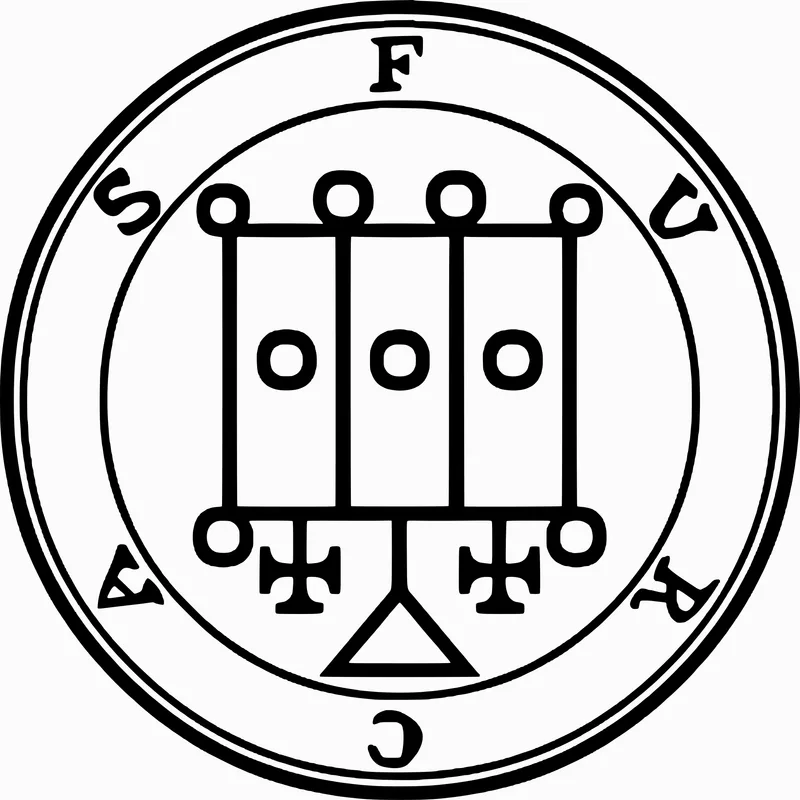
The first and most famous book lists seventy-two spirits that Solomon is said to have bound and shut in a brass vessel. Each entry gives the spirit's rank (king, duke, prince, marquis, president, earl or knight), its appearance, its powers, the number of legions it commands, and a seal or sigil. The book also describes the magic circle and triangle, the hexagram and pentagram of Solomon, the brass vessel, and a series of conjurations and constraints. The word "goetia" comes from the Greek goēteia, a term for sorcery, often with a negative connotation in antiquity. A detailed overview is in our article on the Ars Goetia and its 72 spirits.
2. Theurgia-Goetia§
The second book concerns spirits of the cardinal points and the air, described as mixed in nature, some good and some evil. It lists thirty-one chief spirits, such as the emperors of the four quarters (including Carnesiel of the east and Caspiel of the south), with dukes and servants beneath them, along with their seals. The material derives substantially from the first book of Trithemius' Steganographia, a work ostensibly about angelic communication that scholars now understand to contain cryptographic systems disguised as magical operations.
3. Ars Paulina§
The Pauline Art is attributed to the apostle Paul, drawing on the tradition that he was caught up into the third heaven (2 Corinthians 12). It has two parts: the first concerns the angels of the twenty-four hours of the day and night, with their seals and names; the second concerns the angels of the twelve signs of the zodiac and the degrees of the zodiac, linked to the individual's nativity. It combines astrological timing with angelic invocation and has a different character from the Goetia, emphasizing prayer and good spirits.
4. Ars Almadel§
The Almadel is a square wax tablet inscribed with divine names and seals, set on candlesticks, used to communicate with angels of the four "altitudes" or choras. The text describes the making of the tablet, the colors associated with each altitude, and the angels that may appear. The Almadel is mentioned in medieval sources, and versions of it survive outside the Lemegeton, indicating that it was an independent work absorbed into the compilation.
5. Ars Notoria§
The final book is the Notory Art, a medieval practice of acquiring knowledge, memory and eloquence through prayers in Latin, Greek, Hebrew and Chaldean-sounding words, accompanied by contemplation of figures called notae. It is the oldest component of the Lemegeton and was widely condemned by medieval theologians. In many manuscripts it is placed at the end and may be separate from the rest. See our full article on the Ars Notoria.
Sources: Weyer and the Pseudomonarchia Daemonum§
The direct ancestor of the Goetia's catalogue is the Pseudomonarchia Daemonum, an appendix to the physician Johann Weyer's De praestigiis daemonum (On the Tricks of Demons), published in Basel in 1577 in an expanded edition. Weyer was a critic of witch persecution who argued that many alleged witches were deluded or mentally ill rather than in league with the Devil. He printed the list of demons, which he said he had taken from a manuscript called Liber officiorum spirituum, precisely to expose what he considered the folly and impiety of such books.
The Pseudomonarchia lists sixty-nine spirits; the Goetia lists seventy-two. Most names, ranks, descriptions and powers match, with differences of order and detail. The Goetia adds several spirits not found in Weyer, among them Seere, Dantalion and Andromalius, and supplies seals that Weyer's list lacks. Reginald Scot's Discoverie of Witchcraft (1584) translated Weyer's catalogue into English, making it accessible to English readers well before the Lemegeton was compiled. Scholars generally see Weyer, Scot and related manuscripts such as the Liber officiorum spirituum and the Livre des esperitz as forming the immediate background of the Goetia.
Modern Editions: Mathers, Crowley and Peterson§
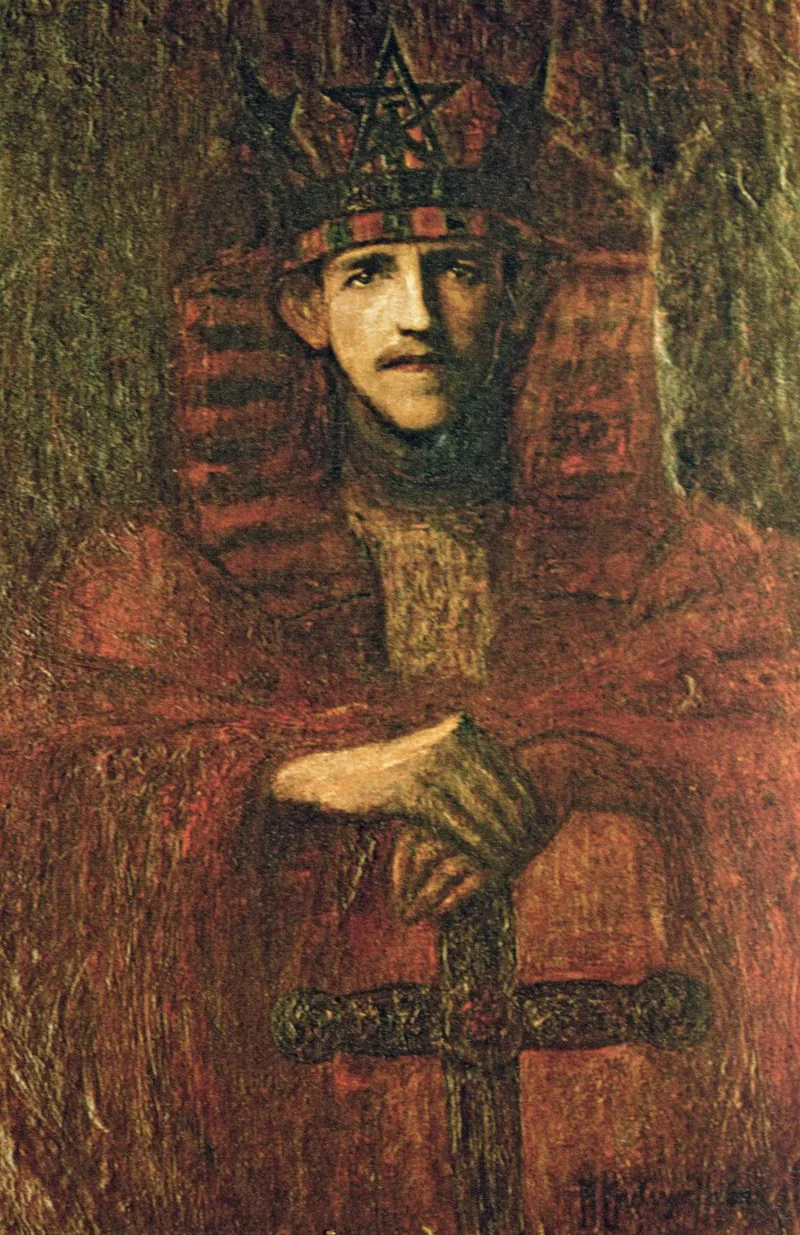
In 1904 Aleister Crowley published The Book of the Goetia of Solomon the King, a translation of the first book of the Lemegeton prepared by S. L. MacGregor Mathers from British Museum manuscripts and issued by Crowley's Society for the Propagation of Religious Truth at Boleskine. Crowley added an introduction, a "preliminary invocation" adapted from a Graeco-Egyptian magical papyrus, and notes, and the edition appeared at a time when the two men had already fallen out. Its title page famously credits the translation to "a dead hand," an allusion to Mathers. This edition defined the Goetia for twentieth-century occultism. For context see our articles on Aleister Crowley and the Hermetic Order of the Golden Dawn.
The first complete scholarly edition of all five books in English was published by Joseph H. Peterson in 2001 as The Lesser Key of Solomon: Lemegeton Clavicula Salomonis. Peterson collated the principal manuscripts, reproduced the seals, and documented variants and sources, making the Lemegeton available as a historical text rather than only through the filter of early twentieth-century occultism. Other editions and studies, including Stephen Skinner and David Rankine's 2007 The Goetia of Dr Rudd, present related manuscript material.
Reception and Significance§
The Lemegeton's reputation rests almost entirely on the Goetia, which became one of the most discussed texts in modern occultism. Its seals appear in art, fiction, music and games, and its spirit names have entered popular culture. Practitioners in contemporary ceremonial magic, chaos magick and some left-hand-path movements engage with the Goetia in widely varying ways, some treating the spirits as external beings and others, following Crowley's introduction, as aspects of the human mind.
For historians, the Lemegeton is significant as a record of how medieval and Renaissance magical materials were gathered, translated and reorganized in early modern England. It demonstrates the continuity of Solomonic attribution, the survival of the medieval notory art, the borrowing from Trithemius' cryptographic work, and the paradox that a catalogue printed by Weyer to discredit demonic magic became a foundation for its later practice.
Frequently asked questions§
What are the five books of the Lemegeton?§
They are the Ars Goetia, the Theurgia-Goetia, the Ars Paulina, the Ars Almadel and the Ars Notoria. The first concerns seventy-two spirits, the second aerial spirits of the compass, the third angels of hours and zodiac, the fourth a wax tablet for angelic contact, and the fifth prayers for knowledge.
When was the Lesser Key of Solomon written?§
It was compiled in the seventeenth century, probably in England, from older sources. Some of its components, especially the Ars Notoria, date back to the Middle Ages.
Did Aleister Crowley write the Goetia?§
No. The 1904 edition he published was translated by S. L. MacGregor Mathers from British Museum manuscripts. Crowley edited and published it, adding an introduction and other material.
Is the Lesser Key related to the Key of Solomon?§
Only loosely. Both are attributed to Solomon and share some ritual ideas, but the Key of Solomon is a separate Renaissance manual of tools, timing and pentacles, while the Lemegeton is a compilation of five distinct texts.
Sources and further reading§
- The Lesser Key of Solomon: Lemegeton Clavicula Salomonis — ed. Joseph H. Peterson, 2001
- The Book of the Goetia of Solomon the King — trans. S. L. MacGregor Mathers, ed. Aleister Crowley, 1904
- De praestigiis daemonum (with Pseudomonarchia Daemonum) — Johann Weyer, 1577
- The Discoverie of Witchcraft — Reginald Scot, 1584
- The Goetia of Dr Rudd — Stephen Skinner and David Rankine, 2007
- Grimoires: A History of Magic Books — Owen Davies, 2009
- Invoking Angels: Theurgic Ideas and Practices, Thirteenth to Sixteenth Centuries — ed. Claire Fanger, 2012